Create your own doorway

Had a great Zoom chat the other day with a newer writer. They’d found me on social media and liked what I’ve had to say about screenwriting and working on establishing a career at it. Would I be open to imparting some of what I’ve learned and any other advice I might have that could potentially help point them in the right direction?

Even though I admitted to still being one of those trying to “break in”, so my two cents of guidance was probably worth about that much anyway, how could I say no?

We talked about wide variety of topics, mostly involving screenwriting, including our respective backgrounds, experience, short- and long-term goals. They also asked for potential suggestions as to how they could go about achieving those goals.

I told them what I’ve said to many writers before, and it still rings true.

Everybody’s path to success (however you gauge it) is going to be unique to them and them alone. What works for me will probably be totally different than what works for you. If you know what your goals are, then it’s up to you to figure out what it will take for you to get there.

You need to create your own doorway, because nobody’s going to do it for you.

Use everything at your disposal. You might think you don’t have anything to work with at first, but you’d be surprised how effective even the littlest thing can be. It’s all about perspective and determination.

For example, the writer had worked on some short films in various capacities. They could use those to showcase their skills, as well as adding the other filmmakers and crew into their network. You never know who knows of another gig or has heard of a project that needs someone who can do the things you do.

If that’s what it takes for you to find that way in, that’s what you do.

The writer said nobody had put it that way before, which really helped them as they start to figure out their approach and possible strategies. They appreciated the advice, and the honesty.

This sort of stuff might seem pretty basic to those of us who’ve been at it for a long time (such as yours truly), but there will always be those just starting to dip their toes into these turbulent waters. I didn’t really have anybody like that when I was starting out, so why not offer up a helping hand in some capacity?

Now if you’ll excuse me, I’ve got a doorway to finish creating, followed by kicking it wide open.

Ask an In-the-Director’s-Chair Script Consultant!

Jeff Richards

The latest in a series of interviews with script readers and consultants who would be worth your while to work with if you want to get your script in shape. Today’s spotlight is on writer-producer-filmmaker Jeff Richards.

Jeff Richards is a story consultant, filmmaker, and writer with over twenty projects either optioned, produced, or sold. His clients range from award-winning novelists to creative writing professors to screenwriters working for major studios. His own writing includes feature films, TV series, graphic novels, and short stories, as well as writing for children’s animation and computer games. His background includes information technology, a decade as an opera singer, and he is an honorary member of the Takaya Wolf Clan of the Tsleil-Waututh First Nation.

1. What’s the last thing you read/watched that you thought was incredibly well-written?

The Karla trilogy by John Le Carré, and if you ever need a lesson that character is king, look to those. The books are often very low on action; they largely consist of dialogue (most of which is people recounting events, as you’d expect in a book about counter-intelligence) and the characters are so magnificent you don’t care that you’ve just spent hundreds of pages essentially listening to people talk. The protagonist for two of the books, Smiley, often isn’t even doing the talking; he’s merely listening. Yet it works.

As for watching, I’ve been re-watching Doctor Who, and “Blink” is possibly the best hour of television I’ve ever seen. Stunningly imaginative and original, incredibly atmospheric, and one of the very best examples of burying exposition I have ever seen in any medium. If I write something that good, I’ll die happy.

2. How’d you get your start reading scripts?

I spent several years as an independent filmmaker and although I did write most of the projects we were developing, I’d occasionally work with an outside writer and help them. That made me realize that I could apply what I’d learned as a writer to helping others with their scripts.

3. Is recognizing good writing something you think can be taught or learned?

Absolutely. The love of words is probably pretty difficult to instill in an adult, but if someone is already interested in it, then it is definitely possible to learn to recognize good writing. The secret is to read widely and actively, both good and bad material; once you’ve read and analyzed enough writing, and worked out why it works or doesn’t, you start to see the patterns very clearly, particularly in screenplays. Objectivity about our own writing? That’s trickier…

4. What are the components of a good script?

What’s most important, and what I don’t see enough of, is a unity of character, plot, and theme. People talk about “character-driven scripts” or “plot-driven scripts” when, in reality, they should driven by the same engine.

As for the rest, it’s about what you’d expect; an active protagonist, strong pacing, dialogue with subtext, an original concept, rising stakes, good conflict, a surprising but inevitable ending… all that sort of thing. However, the only absolute must-have is that it is interesting. For every other must-have you’ll see on a checklist, you can usually think of a great script that didn’t have it. Passive protagonists are death… unless you are talking about The Graduate. Or Being There. But these are scripts by master writers; you need to be very sure why you are going against the grain, and how it makes your story better. (And, as you can tell by the age of the examples, rule breaking isn’t that popular anymore in Hollywood.)

5. What are some of the most common mistakes you see?

Going back to the previous point, a disconnect between character, plot, and theme is common. This usually causes protagonists with unclear goals and flat second acts. However, the most common thing I see is on-the-nose dialogue. Characters who say exactly what they feel and think, or who sum up the central conflict in a speech. If you ever read “You know what your problem is?”, then that’s probably a bad sign.

6. What story tropes are you just tired of seeing?

I think I’m almost unique in that my answer is “none”. Every trope is ready for a great script to make it fresh. Amnesia is the most tired device in writing, yet The Bourne Identity comes along and is fantastic. There’s always room for a great script.

The thing that tires me isn’t story tropes, but clichéd dialogue. Don’t have lines from other movies in your movie. Be original.

7. What are the 3 most important rules every writer should know?

-Read widely; lessons are everywhere, and most of them are outside your genre and format. So if you’re a sci-fi feature film writer, read historical fiction. Read detective comics, manga, sitcom scripts. Expand your brain.

-Writing is rewriting; every first draft is a huge bundle of problems waiting to be solved. So solve it. And not by editing, but by rewriting. Changing words in action or dialogue is just editing. Changing characters, plot points, deleting or adding scenes, that’s rewriting. Do multiple passes, focusing on a different thing each time. One pass (or several, more often) for plot, one for each major character’s dialogue, one for action lines… if you’re building a shelf, you don’t sand and paint at the same time.

-Don’t get hung up on systems. Read how-to books, sure, but pick and choose your advice. Being a slave to a particular checklist is usually indicative of poor writing. If I can tell that you’ve read Save the Cat by reading your draft, then there’s probably too much Snyder and not enough you in your script.

8. Have you ever read a script that was an absolute, without-a-doubt “recommend”? If so, could you give the logline?

Unfortunately, I can’t share loglines due to confidentiality. But for me, “recommend” can’t focus too much on the logline. Concept is important, sure, but the writing is what matters, what makes it a “recommend”. I’ve had writers with straightforward concepts come to me and, after we hone the execution, they get jobs at major studios or get 10 on The Black List. That doesn’t come from the logline, but the execution, how they wrote (and, as per rule 2 up there, rewrote!) Chinatown’s logline doesn’t set the world afire, yet it is generally regarded as one of the great scripts. So a logline wouldn’t really illuminate why I feel a particular script is great. Loglines only show whether something is the type of script an exec should read (e.g. it’s high concept sci-fi and that’s what they’re looking for). The logline gets you the look; the writing gets you the job.

9. How do you feel about screenwriting contests? Worth it or not?

I personally don’t do them very often. I have in the past and placed well, but I never found the contest actually led to a job; what worked for me was my personal networking. However, every path is different and obviously you hear success stories. What is important is that you put in the time, both into the writing (mostly) and into building your career, whether that’s contests, pitchfests, networking… Whatever seems to be working for you, do that. If nothing’s working (and the writing is genuinely where it needs to be!), then change things up.

10. How can people get in touch with you to find out more about the services you provide?

Jeff is no longer actively seeking clients, but is still open to receiving requests via his website at strangeborders.com. He also suggests connecting with him on Twitter.

11. Readers of this blog are more than familiar with my love/appreciation of pie. What’s your favorite kind?

Pumpkin, no question. With fresh whipped cream. A great pumpkin pie will turn me into the seven-year old kid who eats so much he feels sick. It is inevitable.

I probably need help.

I can see clearly now

Ahoy! Rewrite dead ahead!

This week’s installment of The Script Adventurer! featured an interview with the multi-talented Heather Hale.  She’s worked as a writer, a director, a producer and as a consultant, so she definitely knows her stuff. (Mark your calendars – the show re-plays Sunday at 7PM on radioslot.com)

I always like to know what key piece of advice a professional or working writer would offer to the rest of us.  A thought or phrase to jot down on an index card and attach to the wallspace in front of your working area.

Heather named two.

1. Clarity is king.

You may know your story inside and out, but if the person reading it can’t follow it or is confused as to what’s going on, then you’ve got a problem.

It doesn’t matter if you’ve got the most brilliant concept ever.  The plot and story have to be clear so anybody can pick up the script and know exactly what’s going on.

It’s up to the writer to make their story as easy to follow and comprehend as possible, or else the reader/audience will get lost in the story, and not in the good way.

2. The reader is never wrong.

You think your script is perfect. The reader knows better. It’s their job to go over it with a fine-tooth comb and look for flaws.  And unless you’ve attacked that script from every conceivable angle, fixing any potential problem you can think of, they will find them.

The reader really does want to like your script, but if you give them any reason to say no, there’s no reason to be bitter about it.  They know what they’re talking about.  Look at this as an opportunity to make your script better or stronger than it was before.

-Movie of the Moment: Three over three days!  It’s been a long time since I’ve done that, and two were actually in theatres. Wow!

THE HUNGER GAMES (2012). I read the book last month, so it was pretty fresh in my mind. I liked it, although it could have been a little shorter. I can appreciate a strong female protagonist, and it’s easy to see why Katniss has caught on.  She’s tough and doesn’t give up.  Congrats to Jennifer Lawrence for doing a solid job in the lead.

I also really enjoyed Stanley Tucci as Caesar Flickerman, the blue-coiffed TV personality with perfect teeth. A great accomplishment in casting.

My only complaint – Katniss doesn’t always drive the action forward. She’s more reactive than active in some scenes.

-THE SECRET WORLD OF ARRIETY (2010). Another animated gem from Miyazaki and Studio Ghibli, based on the classic books THE BORROWERS.  A recurring theme in a lot of their films is the main character’s coming of age. And this one is no exception. If it weren’t for 3 of the characters being 3 inches tall, this could easily pass as a stage production. Good for all ages.

-RISE OF THE PLANET OF THE APES (2011). Smart and well-written. Easy to see why this was a surprise hit last summer. Especially fun if you’re familiar with the original films. K made an interesting point in that you’re rooting for the apes to win, which would mean the eventual downfall of humanity.  Count me in the camp of those who think Andy Serkis should have gotten some kind of recognition for his mocap work as Caesar.

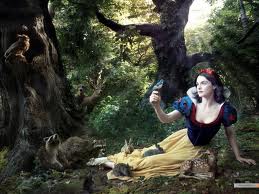
Once upon a time…

A rainy morning equals me staying later at work, which means less time to do my own stuff.

So before I sat down at the producer’s desk, I knew I wanted to finally read a script picked from several a friend had sent earlier this year.

I chose SNOW WHITE & THE HUNTSMAN by Evan Daugherty, mostly because it sounded interesting, and I knew it was in production.  What I didn’t know was that it was a spec script that sold for $1.5 million.  For that much cash, it must be an incredible piece of work.

It’s a clever take/spin on the traditional Snow White story, except here Snow is on the run from the Wicked Queen, and the dwarves are supporting characters lifted straight out of LORD OF THE RINGS who don’t come in until about halfway through.

Basically, the Queen uses alchemy and a little magic to keep herself young and beautiful, but no matter what she does, Snow will always be the fairest in the land.  Snow runs, but the Queen recruits the Huntsman to bring her back.  This goes off without a hitch, but ends with Snow and the Huntsman on the run.

They endure several sequences of adventures, getting away from comic relief in the form of bounty hunters, and each growing a little as characters, which is expected.

The whole thing ends with all the characters done wrong by the Queen attacking the castle while the subplot involving the Queen marrying the brutal king of a nearby kingdom reaches its conclusion.  I can’t remember what happens to that king, so I may go back and re-read it.

I liked the idea of the Magic Mirror having a more human appearance, but didn’t understand why it fought for the Queen during the aforementioned battle.  The concept of fairies as mercenaries was clever, but they were only in one sequence (attacking the dwarves’ den). It’s almost as if Daugherty thought of a few ideas connected to fairy tales, and tried to incorporate as many of them as he could into the story.

Overall, I enjoyed it.  It was easy to follow the story, and there’s definitely a strong sense of adventure throughout the whole thing.  Because of that, I was paying more attention to how it went from one sequence to the next, rather than
as a whole.

I wasn’t sure what to make of how Daugherty did that.  First Snow and the Huntsman are getting away from the bounty hunters at a humongous waterfall, which they go over, then all of a sudden they’re emerging onto an icy tundra-like environment.  It’s like he had each sequence planned out, then just went from one to the next.  I wonder if those transitions could have been smoother, or maybe a little more smoothed out.

The writing itself was pretty good, but not as “wow”-inducing as I was expecting.  Sometimes it almost seemed sloppy.  A scene where Snow and the Huntsman take on the Queen’s guards is over before it begins; something like “within moments, they are the only ones left standing.”  Part of the story is Snow getting the Huntsman to train her to survive in the wild, and this is the big payoff.  It should have been a little more fleshed out.

From what I could find, this is scheduled for release next year with THOR’s Chris Hemsworth as the Huntsman, TWILIGHT’s Kristen Stewart as Snow White and Charlize Theron as the Queen.  The only one I’m not sure about is Stewart.  Will she be believable as a princess turned warrior/survivalist?

I can see getting this through Netflix, but not paying to see it in the theatre.

-Movie of the Moment – SUMMER WARS, an anime from 2009.

Imagine the Internet, but on a much grander scale, with practically every aspect of life controlled on it or through it.

Now imagine an AI program made exclusively to hack programs taking control and basically screwing up the way the world runs.

In other words, Facebook has turned evil and is out to destroy the world!  I realize some people already feel this way, but this is just a bit different.  And it’s set in Japan.

Oh, and the only three people who can stop it just happen to be in the same place at the same time.

This was a fun and brilliant combination of standard Japanese animation (a family reunion of sorts for the matriarch’s 90th birthday at their country house) and eye-catching CG (almost everything set in the virtual world).

Basic set-up: girl asks two computer geek friends if one will help her with something, which turns out to be posing as her boyfriend/fiancee at her great-grandmother’s party.  The boy who goes is also a math whiz.

One of the cousins is the best gamer in this virtual world, and the black sheep uncle created the hacking program, which the US military decided to test, but soon lost control of, and now the program is running amok and has taken over almost half a billion accounts.  See? Just like Facebook.

The three must work together in order to stop the evil program from not only basically taking over the Internet, but dropping a satellite onto a nuclear power plant, resulting in the death of much of humanity.

And you thought all the Japanese ever fought were giant monsters attacking Tokyo.

While I prefer to watch foreign films in their original language, I went with the English version for this one.  No reason; just felt like it.  But it’s always weird to hear Western voices talking with a Japanese sensibility. I think it adds to the charm.

Eureka! (You don’t smell so good yourself)

Sorry.  Couldn’t resist.  Old 3 Stooges joke.

The reason behind that exclamation of wonder is because of what I was able to accomplish on yesterday’s DREAMSHIP rewrite effort.

Reading other scripts, especially those from the Black List, has really helped open my eyes in terms of how a good script looks, not only in terms of story, plot and character, but also regarding how it flows from scene to scene, and its actual appearance on the page.

As much as I’d like to name the fantastic actioner I read last week, I promised the person who sent it to me I wouldn’t, so I’m not.  But reading it made me realize I could take the same approach to my script. Great set pieces. Showing character through action. You get the idea.

Part of my problem with rewrites is that I always tend to not veer too far from the original material, so things don’t change that much. So far, that does not seem to be the case.  It’s kind of a thrill to take what I had, see if there’s a way to turn it around, or at least do something completely unexpected with it.  Even better, the new result is stronger, and also strengthens the story in ways I had never thought of or anticipated.  I like when that happens.

-Movie of the Moment: another two-fer. First, TALES FROM THE SCRIPT. A documentary consisting of interviews with screenwriters about their craft. Informative, fascinating, funny, and necessary viewing for writers trying to break in.

Second, AIKA R16: VIRGIN MISSION, anime from Japan. A prequel of sorts for a female adventurer, explaining how she got her start. Apparently this was released ten years after the original series, which I’ve yet to see. A clever concept and fun to watch, but way too many gratuitous panty shots. Just not my thing; in fact, it got a bit monotonous after a while.

Anybody got an anime series or film they’d recommend?  I lean more towards the sci-fi/comedy mix. I’ve seen just about all the Miyazaki oeuvre and most of the more well-known ones (AKIRA, STEAMBOY, COWBOY BEBOP, PROJECT A-KO), but gladly welcome something new.

*Last-minute item. This was supposed to post yesterday, but I wasn’t paying attention and inadvertently erased it.

While I was writing the above content, I got an email from my rewrite client from last week. They thanked me for my work and wanted to know what I thought about the script.

If you’ve been diligently following along, you’ll recall I did not have the highest of opinions.  Therefore, I’m working on a response I can only hope that will be politely and tactfully helpful.