You don’t know me, but can you help me?

the-stranger
Let’s not complicate things with petty details like who I am

So this email arrived yesterday.

“Hi, Paul, Do you know any past or current Executive Producers that might be eager to engage in a new multi-billion dollar franchise that could be as good as “Harry Potter” or “Star Wars”?”

Immediate smartass answer: Well, of course I do, person-I’ve-never-communicated-with-before! I like the cut of your jib, especially with that totally unsolicited request for help! I’ll pass your info along straightaway! Even though I think smoking is a totally unhealthy thing, I’m going to learn how just to be able to literally light cigars with hundred-dollar bills which I’ll be grabbing out of the huge bags o’cash which will no doubt be continuously rolling in once Hollywood gets its mitts on this!

Secondary upon-reflection answer: Do you really think this is the best approach?

Sure, we’ve been connected on a networking site for several years, but as far as I can recall, have had absolutely no interaction during that time. No emails. No comments on a post. Not even a single “Hey, how’s it going?” And then, totally out of the blue, you come to me and ask for help.

I’m more than happy to help somebody out when I can, but it has to be somebody I know, somebody I’ve communicated with, and somebody I think is worth helping. Apart from this nebulous “connection” we have, to me you’re little more than a total stranger.

And you’re not asking for just any kind of help. You have what you proclaim to be “the next big thing”. If I had a dollar for every time I’ve heard or read that about a script/story/idea, I’d be able to fund my own franchise.

It’s great that you have a high opinion of your material, as you should, but keep in mind you might be the only one who does. You can prognosticate all you want, but that’s not going to impact anything. You can’t say something’s going to be a hit because you want it to be.

I’m still a little fuzzy on the details, but I think the title “Executive Producer” depends on the extent of that person’s involvement with the project. Until then, I believe “producer” is the appropriate title. Feel free to enlighten the rest of us in the comment section.

Let’s also discuss the fact that you sent this to me. Me. Why? I’m not exactly Mr Industry Insider. In fact, I’m more likely in the same boat as you; a nobody busting his ass trying to establish a career. Did you know that? Did you do any research, or are you just sending this to as many people as possible, hoping one of them works out?

I never responded to the email in question, simply because I don’t think it’s worth it. I suspect anything short of “Here are those names you asked for” would not be welcome, let alone “This is a really unprofessional email, and here’s why”. As always, I wish them the best of luck.

I’ll admit I’ve made a lot of mistakes over the years, but each one has been a learning experience unto itself. I’ve learned how to network, how to communicate, and how to interact. I know how to seek out help and how to offer it. I’m a firm believer in researching and finding out everything I can about whatever it is I’m working on.

I always strive to be as professional as I can when it comes to this sort of thing. Everybody’s a potential future partner/connection/resource, but I don’t take it for granted.

I’ll treat you with respect provided you do the same.

Could it get made today?

psycho-house
“Another “boy and his mother” story? Pass.”

Originally, this post was going to be about the multiple changing of protagonists in PSYCHO (which is another great potential future topic), but the more I read about the film and thought about the impact it’s had since being released way back in 1960, it triggered a totally different train of thought.

Every once in a while, when a classic film is brought up in some context or another, the phrase “That could never get made today” will get thrown in. After the recent death of Gene Wilder, his talent was lauded via the mention of several of his most well-known roles. Willy Wonka. The Waco Kid. Victor Frankenstein (“That’s Fronken-steen.”). His performances were vital parts of each film, which no doubt contributed to making them “classics”.

But, as always, it starts with the script. (Incidentally, I don’t think Wilder gets enough credit for co-writing YOUNG FRANKENSTEIN.)

Examining the stories being told, each one has something truly unique about it, and then some. The writer (and subsequently the filmmaker) wasn’t afraid to take a chance and try something completely new and different. Sadly, the studios today aren’t as open to it. Better to play it safe then take too big a chance, which is why we’re seeing so many remakes and re-imaginings. Of course, that doesn’t always work out either (e.g. 2015’s PAN, the recent BEN-HUR remake).

While there are always original and innovative scripts floating around, it’s a lot of time, effort and money to make a film. The only recent original film I can think of is SWISS ARMY MAN, which I admit I haven’t seen yet.

Who hasn’t read a “truly original” script or about one getting a lot of attention, but a lot of the time the writer will go on to work on other projects while the script that started the whole thing gathers dust?

The best exception to this that I know of is Travis Beacham’s spec A KILLING ON CARNIVAL ROW, which drew a lot of heat when it sold in 2005, then continued to garner praise while it languished in development for years before ultimately becoming an upcoming series on Amazon – at last check, anyway.

Budgets are getting higher, and the gap continues to grow between microbudget features and mega-budget tentpoles. It’s getting harder for original material to get noticed, let alone something that screams out “NEW!” It also doesn’t help that the chances decrease if the script isn’t based on pre-existing material. This could be why today you’re more likely to see an original film that’s a low-budget independent, probably written by the filmmaker themselves.

Before that, your best bet of seeing something groundbreaking would have been at the hands of established filmmakers, only because they had that kind of leverage (and the budget) to get their projects made. An unknown writer doesn’t have that kind of luxury. All we can hope for is to connect with somebody who likes the script (and our writing) so much that they’re actually excited to help us take things beyond the “Sure, I’ll read it” stage.

That’s our objective as writers: to write something that’s not only compelling and involving, but so eye-openingly original that the reader is compelled to the point that they need to see this as a movie. Doable, but definitely not easy.

Homework time! Part one – find a script you really consider a game-changer for the same genre as yours and give it a read. Can you identify what made it so unique? What really stands out for you? Plot? Story? Characters? A little of everything? Another option is if that script has been produced, then watch the film and follow along with the script. Are they the same? Totally different? Do you think the changes add or take away from the script?

Part two – without blatantly copying the style of that script, work on applying a similar originality to yours. Did reading that script inspire ways for you to make yours really stand out?

Don’t be afraid to take chances. Strive to offer up something we’ve never seen before. The results might surprise you, too.

-Special offer just for you!

course-discount-maximumz

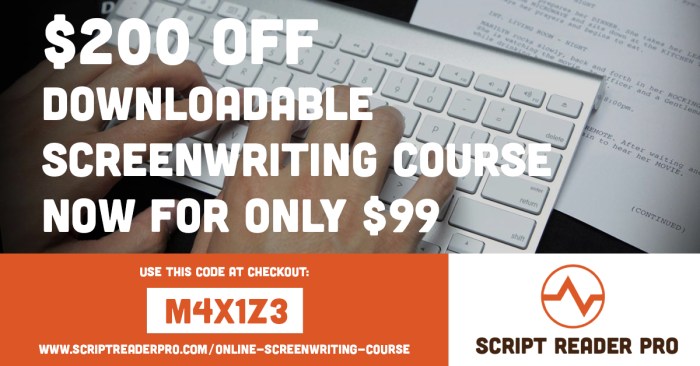
The fine folks at Script Reader Pro are running a discount for Maximum Z readers on their downloadable screenwriting course Script Hackr.

Forget all the confusing and vague “fluff” found in most screenwriting courses, coverage and books. Script Hackr will skyrocket your screenwriting skills by utilizing rarely talked about hacks and hands-on practical exercises to de-mystify theory.

The course retails at $299, but you can get it for just $99 by using the coupon code M4X1Z3 at checkout.

You can check out more details on the course here:

Quit them or queue them up?

q
As long as we’re emphasizing Qs today…(Yes, it’s a terrible joke. But that’s how we operate around here.)

Today is all about query letters.

I read about other writers who’ve gotten reads, representation, options and even production. There must have been something quite special about those letters (and scripts) to get those machines in motion.

There are also a select number of writers who’ve never had to use a query letter. Bully for them, I say. But I’ve never fallen into that category, so I’m firmly planted in the “those who send” group, which is still fine.

Taking a look at the somewhat limited results of my past efforts and reading about others’ experience makes me wonder in a “big picture” way about the nature and concept of the query letters themselves.

Are they worth the effort?

Naturally, if something happens as a result, of course they are. But even that appears to be a needle-in-a-haystack kind of scenario.

(Incidentally, any tales of query success are more than welcome in the comments section.)

There are so many factors to take into account, including but not limited to:

-who you’re sending to
-what kind of material they want
-they’re intrigued enough to want to read the script
-your script is a good match (or at least close enough) to what they want
-they think your writing’s strong enough
-they think they can make something happen with your script

Several years ago, an agent who’d struck out on their own (along with a sole assistant) told me that their office received approximately 75-100 queries a week. From around the world. Some were good, most were awful. A significant part of each morning was spent sorting through them. As you’d imagine, finding one, possibly two, that clicked seemed to be the norm.

Remember, this was a two-person operation. If they were getting that many, imagine how many the mega-agencies were getting, and still are. Possibly in the thousands.

The chances of success are minuscule, and grow smaller with each progressive step. Those not exactly in the know are more likely to think they’re the exception, but those of us who’ve been down this road before know better.

This isn’t to say that queries never work, but the odds definitely appear to be not in our favor. Luck and timing seem to also play significant parts. Maybe the person you’ve sent to just happens to be looking for a script exactly like yours. I’ve heard it does happen; just not very often.

But the dedicated, persistent and determined among us, including yours truly, will keep at it.

Even though my success rate hasn’t been the best, I’ll continue to do the research, find potential recipients, craft what I believe is a solid query, and send it out.

All that’s left is to wait, hope for the best, and keep busy working on other scripts, each of which will probably also have its own respective query letter get sent out sometime in the near future.

Disappointed, yet still driven & determined

uphill
One step at a time

The results are in for my western’s involvement with the major screenwriting contests for this year:

PAGE – nope. Didn’t get notes.

Austin – nope. Notes expected later in the year. (They got over 9100 entries for shorts and features this year. That’s A LOT.)

Nicholl – top 15%, which isn’t bad. Two sets of notes; the first reader really liked it, whereas the second’s comments make me highly suspicious about their qualifications.

On a positive note, the script placed in the top 100 of the ISA’s Emerging Screenwriters contest, which is nice. Fingers crossed it advances to the finals.

But back to the big three. It’s a little frustrating that things didn’t work out, but that doesn’t mean the script’s bad. A lot of my readers, many of whom have done well in these contests, all had very positive things to say about it and thought it was a solid and entertaining piece of work.

Two things to keep in mind about these contests:

It’s all subjective.

Sometimes you just get a shitty reader.

These also happen to be things we have no control over. Yes, it’s disappointing to get that email that includes the phrase “Unfortunately…”, but just because you didn’t do well this year doesn’t mean you won’t do better next year. This is the mantra I’m going with for now.

I’m also taking a little time off from the western to focus on the comedy and at least one or two other scripts. It helps.

Something else for you to ponder: contests aren’t the only way in. More and more I’m hearing/reading from writers who do well in contests, but nothing comes of it. They might get a read, but that’s it. You gotta keep trying from every approach you can think of.

That’s my plan.

Will I enter the contests next year? Possibly. But they’re not a priority.

Making inroads into a getting a career going is.