The good bad of your antagonist

mitchum
Few better examples than this guy

My original goal for February was to complete the second draft of the low-budget comedy. But as always, things didn’t go as planned.

I’d finished the initial edit, but then got hit with a nasty cold that put me out of commission for about a week, followed by all the activity involved with my daughter’s Bat Mitzvah (where she did a fantastic job), so writing-wise, things came to a screeching halt.

But we’re in a new month, so lots of new opportunities abound. Here’s hoping I can work this script into shape by the 31st.

I’d gotten some very helpful notes on it, the most notable of which was “Your antagonist is too nice. They need to be more at odds with the other characters.”

And they were right. Looking at it with fresh eyes, it’s easy to see how that observation rings true. During that read-through edit, I found at least three places where the character’s badness could definitely be ramped up, and expect more will be found over the course of this rewrite.

Sometimes I’ll even surprise myself by having the antagonist do something unexpected (in terms of behavior, not the story), especially if I personally find it very off-putting. But if it works within the context of the story AND further builds on the difference between them and the protagonist, all the better.

The challenge in writing a solid antagonist is really putting the emphasis on the “antagonize” part. What they want is most likely the opposite of what your protagonist wants, and they are determined to get it – possibly at all costs. To them, they’re the hero of the story, and your protagonist is what’s standing in their way.

I’ve always hated when I read a script and the antagonist is a stereotypical cookie-cutter villain who’s bad for no apparent reason, or because the story requires them to be. Why do they want what they want? I know what the hero wants, but what about them? Just because they’re the antagonist doesn’t mean there’s no story behind who they are.

So the next couple of weeks should be pretty interesting. There’s still a lot of work to do on this, but no doubt one of the high points will be the fun of coming up with ways to make my antagonist even more devious.

Because that’s the kind of character she is.

Two evils. No waiting.

choices
Either way, things aren’t looking good

Good conflict makes for good story, right?

There’s the overall conflict of the story (hero vs antagonist), but there’s also the conflict that must be present in each scene. That metaphoric moment where the two opposing forces collide on some level.

And sometimes that conflict comes from choices your hero must make.

Given the choice between an easy solution and a difficult one, the easy one is…well, easier. You’ll see this in a lot of new-writer scripts.

But easy’s dull, no fun and makes for a boring story.

Conflict is key. Showing how your hero deals with it shows what kind of person they are. Without it, how can they end up different than when they started? We want to see how they deal with all of the conflicts they encounter over the course of the story.

How about if your hero didn’t have any alternative but to make the difficult choice? They could make the easy choice, but that would take them further away from their goal, whereas making the difficult choice gets them closer to it, albeit in a now-tougher set of circumstances.

You’ve created a bigger conflict, and made things more interesting.

Now let’s take it a step further. What if both choices were difficult? A is bad, but B is worse, and the only viable option is B. Don’t just make things tough for them. Take those circumstances to the edge of impossible.

You’ve just multiplied the level of interesting, not to mention grabbed your reader/viewer’s attention, with them guessing “what happens now?”

The best conflict comes from when a character has no choice but to choose the option that makes their situation worse.

Bonus points if you can organically tie those tough options into the whole story, rather than have them seem like isolated incidents.

So this is what inner peace feels like

zen garden
Serenity, calm, and all that

Philosophy, metaphysics and existentialism aren’t really my thing, but I suppose you could say I’m feeling very “zen” these days.

Part of it is stems from completing the last-polish-before-contests of my western. It definitely reads better, and I’m extremely happy with the results.

Working on this rewrite also renewed my sense of “don’t hold back”. It was exhilarating to write material that felt so alive and vibrant. I am fully confident this will continue with each draft of each of my scripts from this point on.

For some reason, this may also tie directly into a majority of my anxiety and stress and self-imposed pressure simply disappearing, or at least being drastically reduced.  Seriously. Maybe it’s from just accepting that success will happen when it happens, and that beating myself up until it does is just counter-productive. I suspect there will be times when I’ll still get a little down, but expect it to occur on a less regular basis and definitely not as severe.

Big things of a positive nature are ahead, chums. I will do my best to maintain this blissful sensation while I keep working toward reaching that inevitable goal.

Which I do expect to happen. Preferably sooner than later, but either way I’ll get there.

**Editor’s note – this is my 700th post. While the ideal subject matter would have been “I sold a script!” or at least along those lines, I’m quite content with it covering the topic it does.

I hope you’ve enjoyed being part of this for the previous 699 posts over the past 7 years, and that you’ll keep coming back for more.

Thanks for reading!

Not perfect, but getting closer each time

reaching
Almost…

It’s that magical time of year once again: screenwriters are entering their works in some of the major contests. And I plan to be among their number. At least for a few of them.

Buoyed by some recent success (thanks, Screencraft!) and dismayed by the even more recent lack thereof (WTF, Bluecat?), I’m taking one more look at my western before sending it out. Nothing major; just seeking out any necessary last-minute fixes (of which there was at least one, which totally caught me off-guard and has since been taken care of).

I’d considered sending the end result out for some feedback, but quickly opted not to because I actually don’t need to. The script is pretty rock-solid as it is (at least in my opinion),  and is exactly what I want it to be.

How will it do in any of these contests? Beats me, but I believe it’s a quality script about unique characters in a fun, original story. I hear those are pretty popular. Is it the best you’ll ever read? Probably not, but I bet you’d still remember it long after reading it.

It’s taken me a while to trust that gut instinct about my own work. Sometimes the self-doubt and second-guessing is there, but definitely not as much as it used to be.

Ever get that feeling that truly amazing things are going to happen for you?

I do. Quite often. Especially lately.

And I intend on doing everything I can to make them happen.


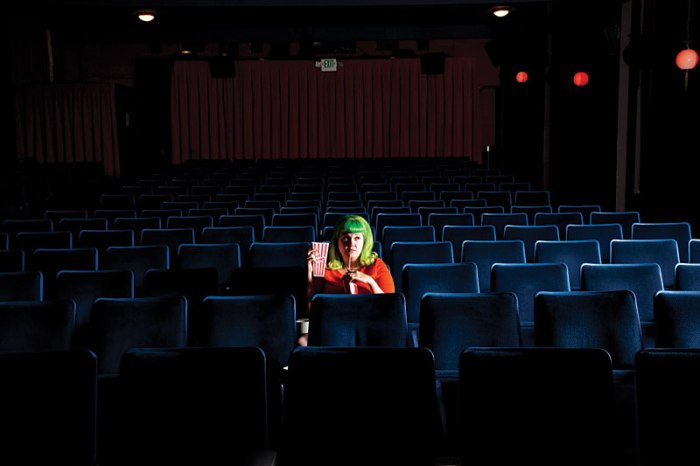
Best seat in the house

alone in theatre
The next person who comes in will sit directly in front of me. Guaranteed.

I recently had the opportunity to revisit the outline for my pulpy adventure story after having not looked at it in several months, and wanted to see what was needed in order to get me a little closer to being able to start on pages.

Time was limited, so I was only able to get through the first half. It was a pleasant surprise to discover that a lot of it still held up, plus an added bonus of some small inspirations resulting in tweaks that strengthened a few of the subplots and tied a few them together in a better way.

And of course, some of these new developments were a total change from how I’d always imagined them. This happens a lot for me.

But what was really the most positive experience out of this was how easy it was to “see” the story play out. It was as if I was in a private theatre, watching my imagination come to life on the big screen, complete with surround-sound. It definitely reinforced the kind of story I’m trying to tell.

When you’re putting your story together, or writing it, or even just reading it, how easy is it for you to visualize it? Do you “see” it as if you’re watching it in movie form? Is it a smooth transition from coming up with the idea to putting it on the page so it reads how you originally imagined it?

And therein lies part of the challenge. It’s just not an easy task, or at least isn’t for a lot of writers. It takes time to find the right words.

You might know what you want to say, but can’t find the exact way to say it, so you tinker around with it, trying and trying until something takes hold. Or maybe after writing it down, actually seeing it on the page makes you realize “this might not have been the best way to do it,” so you jump back in to come up with something new.

Sometimes I even go so far as to narrate aloud while acting out what’s happening for that particular part of the story (or as much as I can while sitting at my desk), which really helps, despite how silly it might look to somebody else.

As writers, the gears of our imaginations are always turning. Always. You could be doing something totally ordinary or mundane, and then, like a bolt from the blue, come up with a solution so perfect and now-obvious that you can’t understand why you didn’t realize it before.

So you work and work, making your writing better to the point that anybody reading your story will eventually be able to “see” it the way you want them to.