A quick refresher course

library
Researching potential connections takes just as much effort

I’ve noticed a trend recently popping up on a few online screenwriting forums.

Writers are posting their material, asking for feedback. Concepts, loglines, the first page or the first few pages of their script. Any and all of them.

On one hand, I can understand the desire to get feedback. You want to know if what you’ve got works, and if it doesn’t, how it could be improved.

On the other hand, you’re asking what is, for the most part, an assortment of total strangers with unknown levels of experience to tell you what they think. Can’t say that I’m too crazy about that.

It’s like walking into a party where you don’t know anybody, standing in the middle of the room and shouting “Hey! What do you think?”

Don’t do that.

As has been stated many times on these pages – networking is key.

Professional relationships are a vital part of this business. They take time and effort to establish and maintain, but are definitely worth it in the long run.

You need to put yourself out there and get to know other writers, preferably in person, but online/virtually works just as well. Both have benefitted me greatly, and could do the same for you.

Here are a few previous posts which might come in handy.

Getting to know you

Try the direct approach

Lattes, lunches & kindred spirits

Hey! Long time no (preferred form of communication)

Now get out there and meet people.

-Two weeks ago, I ran the SoFi Golden Gate Half-marathon with a time of 2:01:16. Not bad, especially considering the amount of uphill.

This Sunday I’ll be across the Bay and running the Berkeley Half-marathon for the first time (it’s also my 5th and final race for this year). The course is a little flatter than San Francisco, so while coming in under 1:55 would be great, I’ll also be happy with anything under 2 hours.

Once again proving that the journey to succeed really is a (half) marathon, not a sprint.

See you at the finish line.

Keep your ego out of it

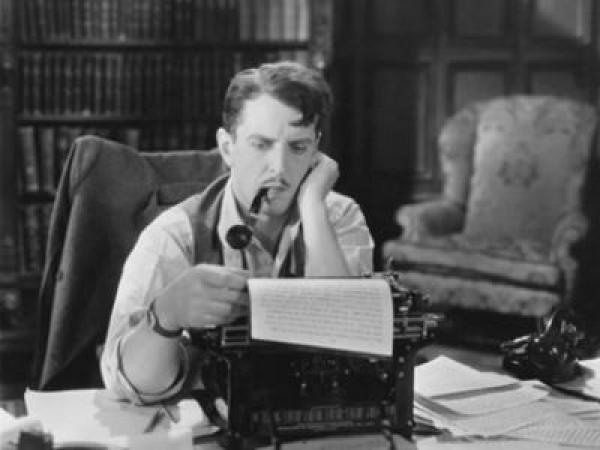
vintage lady writer
As much as she loved that scene, she eventually accepted the fact it would have to go.

I’ve received notes on three separate scripts in the past week or so, and each set is of  very high quality. Each does a very thorough and insightful job of spotlighting What Needs Work for each script.

Daunting and somewhat overwhelming at first, I’ve begun the slow and somewhat laborious process of analyzing and breaking down all the comments and suggestions. I won’t use everything, but there is definitely a lot of good material to work with.

I provided a total stranger with material, and they’re offering up their honest opinions about it. At first glance, some of the comments might be interpreted as negative, but they’re really not. This is what they saw/thought while reading my script.

No axes to grind. No vendettas. No hidden agendas. Just pure, honest opinions. I take what they said, figure out which parts I consider the most helpful, and proceed from there. Ten times out of ten, the result is a better script.

I was told once that getting critically constructive notes and being willing to accept them were signs of a quality writer. Honestly, that was a little surprising.

As much I’d like to think my stuff is great, the reality of the situation is that it’s more along the lines of “it’s okay/pretty solid, but could still use some work”, which is fine. That’s what rewrites are for. From my experience, the final draft is always different from the first. I wouldn’t have been able to produce that final draft without all those helpful notes.

Many times I’ll see a writer ask for feedback on their script, which they get, but might not be the high words of praise they were expecting. Are they ever? Then they respond with something along the lines of “You just don’t get my genius!”, and promptly reject any and all notes. The end result: a lousy script that’s not much better.

Helpful tip: don’t do that.

The whole reason you want notes is to find out how to make your script better. Hard as it is to believe, you can’t make it better if you’re not willing to accept criticism. You can be super-proud of the script you have, but don’t fool yourself into thinking it’s perfect just the way it is now.

Chances are it’s not.

What’s more important to you: having what you think is a good script, or having somebody give you tips that would actually help make it better?

Would we love to see our scripts play out onscreen, just the way we wrote them? Of course. But what you see is up there is usually a lot different from what how it originally read on the page. Happens all the time. Getting upset about it and decrying the sacrilege committed by altering even one letter or syllable from your precious text is definitely the wrong way to go.

In the next couple of days, I’ll be having separate in-depth discussions about two of my scripts with some of the people who gave me notes on them. My emotional state could probably be summed up with “excitedly nervous”. It’s a combination of looking forward to and feeling a bit anxious about hearing what they have to say.

But in the end, it’s not about the writer. It’s about the script and doing what’s necessary to make it better.

I’m here, but need to be up there

mountain climber
Onward and upward! (snappy hat optional)

I’ve been writing screenplays for quite a number of years, but only in the past, say five to six have I shown some significant improvement.

More than a few readers who’ve read my last three scripts have commented that each one displays a step up in quality a compared to its predecessor. Which is very nice to hear.

Feeling pretty confident in my skills and material, I submitted some of them to a few of the high-profile contests (or at least the ones that really matter). The results were less than encouraging. Don’t get me wrong. Top 15 percent in the Nicholl is nice, but it’s still falling short of expectations.

You can have the most incredible script you’ve ever written, enter it in a contest, and chances are it might still go nowhere. Contests are just one way in.

But I digress.

I figured there was nothing more that could be done with the scripts, so I might as well file them away and move on, using them for occasional query letters.

However.

While my scripts may not be similar to those that win contests (can you imagine me writing a coming-of-age story set in 70s Reno?), they’re still fun, entertaining reads, and my passion and enthusiasm for them continue to burn strong and bright.

Like with my writing skills, they’re good, but can still be better.

That’s why I’ve decided to do what I can to make that actually happen. I’ve already gotten several sets of notes on some of my scripts, and most mention the same issues, along with some potential fixes.

As always, I have the luxury of picking and choosing which suggestions to implement, and I sincerely hope the end result is a collection of scripts of decidedly higher quality.

It’s been quite an effort for me to get my writing to get to the level it is now, and spending a little more time on trying to make it better will be definitely worth the effort.

A population of your creation

deadpool
Part of the appeal was how blatantly non-traditional the characters were

Totally unintentionally, I’ve watched a handful of independent films lately. It’s just the way my Netflix queue was set up.

Apart from each one being a solid example of good writing and demonstrating how to craft a small and contained story with a limited number of characters, they also had the distinction of featuring well-known and established actors in a wide variety of roles.

My first thought was “How did they end up in this?”, but as the film played out and the story progressed, it became pretty apparent that the actors were attracted to the characters and that they were actually part of the story.

Ranging from those in a handful of scenes to the protagonist, each one felt fleshed out and three-dimensional. They had depth. Nobody came across as if they had no business being there to begin with.

This was also apparent in the trailers that preceded the films; many, if not all, I’d never heard of or had a very, very limited release. There must have been something to that script or the roles that would attract actors of that caliber.

As a screenwriter, you want to make sure that not only are you presenting a solid and entertaining story, but it has to be populated with original and unique characters we’re interested in, who are also developed enough that we become invested in wanting to see what happens to them.

Not as easy as you think.

How often have you seen a film or read a script where a character is simply a tired cliché? Notice how fast you lose interest?

Now if that character were something totally different than what you expected, wouldn’t you be more likely to want to go along on their journey?

Just as an example, I read a script last year with a protagonist who was introduced as a “total slacker dude, mid 20s”.

Snore.

And if that wasn’t tropey enough, he was playing a video game in his cluttered studio apartment.

Double snore. Seen it countless times before.

I’d suggested to the writer they consider really changing things up with a totally different approach. Rather than a slacker, what if the protagonist was some kind of genius? Or had been successful, but now fallen on hard times? Something, anything to not go down Cliché Avenue.

See where I’m going with this?

You’re not only telling a story, you’re providing the raw, base material for an actor to work with. They like delving into new territory just as much a reader or audience. By taking a different approach and providing the foundational details, you can create a new and original take on old and f amiliar characters.

Like with the story overall, give us somebody we’re not expecting. The more unique and interesting they are, the more likely an actor will be interested in portraying them, just as much as we’ll be interested in wanting to see what happens to them.

A few treats, but no tricks

Halloween candy
…and all the peanut butter cups you can eat

Halloween shorty today due to yet-again busy times around Maximum Z HQ.

Among the highlights:

-Finished the initial overhaul for the outline of the comedy spec. The story is still kind of/sort of the same, but still significantly different than what it was. There’s still some tweaking to be done, but I’m really liking how it turned out.

-Got some notes back on a few of my scripts. For the most part, they’re pretty positive with some good suggestions, but there were also a couple of comments that made me question if my writing abilities are where they need to be. Maybe to a certain extent, but as it was pointed out to me, those comments are from one person, and one person’s opinion is not the final say. That’s something I really need to keep in mind.

-More writers asking me to do notes or engage in a script swap. Some new, some returning for more. Guess my analysis skills are improving. Happy to help when I can, but don’t expect a fast turnaround.

-A slow but steady output of query letters continues, with a handful of “send it” responses. Not a bad percentage so far. Not relying on any of them, but always maintaining a positive & hopeful attitude. Send it, forget it, on to the next one.

Thus the journey to being a working writer continues…