
More than a few takeaways

While work continues on my actual writing projects, I’ve also been trying to reduce the number of scripts in my “Scripts to Read” folder.

It’s a decent-sized mix of recent and not-so-recent films, along with material written by professionals, colleagues, and “Hey, I saw you posting about this on social media. Sounds cool. Could I read it?”

It’s amazing how fast you can go through a script when you don’t have to give notes. Even more so when it’s exceptionally well-written, which a lot of these are.

One pair in particular, both written by the same pro.

Each script was unique unto itself, primarily in its story/concept. But you could tell that they were written by the same writer. A very distinctive style for how the stories played out, how it looked on the page, and even moreso in terms of voice.

One detail in particular that really stood out was the lightning pace in which these stories are told. Scenes are brief, to the point, and really move things forward. There’s no lingering, no unnecessary dialogue. The writer really adheres to the “get in late, get to the point, move on” method.

These were scripts that once you started, you didn’t want to stop. Honestly. The writing really was that good.

It’s also worth mentioning that these scripts don’t necessarily break any screenwriting rules, but they sure do bend them. Nothing major or drastic, but the writing is so strong that you’re willing to overlook this unusual approach.

Reading these scripts definitely makes you appreciate (and enjoy) how well-written they are, and also starts you thinking “My scripts aren’t at this level, so what can I do to get them closer to it?” Not that I’d ever try to duplicate this writer’s style – that would be futile. It’s more about letting my own voice and style really come through on all those fronts.

I’ve always been guilty of overwriting scenes, and seeing this very streamlined presentation is a good reminder that I should try for that as well.

It’s probably a good thing that I’m reading all of these scripts now because it’s still relatively early in the rewrite/overhaul phase for my scripts. I don’t think it’ll be too much of an issue to start applying what I’m picking up into them.

My scripts were good, but now it feels like there’s more potential for them to be much, much better. Here’s hoping.
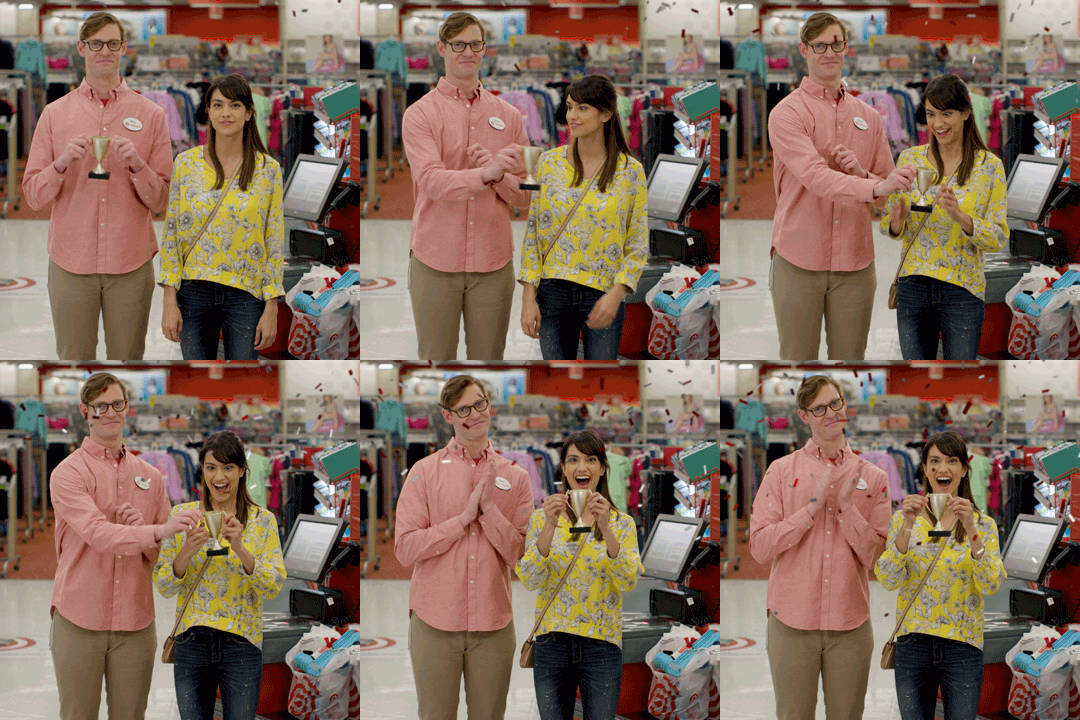
A win is a win is a win

This is a tale of two writers.

Both have recently achieved success, but of very drastic varying degrees.

The first writer has had some tremendous accomplishments over the past few weeks. Their work has placed very highly in some prestigious contests, resulting in sales, professional writing assignments, membership in the Writer’s Guild, and representation with a management company of significant importance.

The other writer had a script do well in a small contest, and had some nice things said about their writing during an online forum chat.

At first glance, the first writer definitely had the better results. Who’d complain about all of that? This is what we’re all working towards, right? That’s like a dream checklist with every box checked off. No doubt ones such as “script produced”, “film/TV show produced and released”, and “box office/ratings hit” still remain, but this is the initial phase.

Even the writer admitted they’re a bit overwhelmed by all of it.

Meanwhile, for the other writer, the contest win is nice, and while it may not be “makes the industry take notice”-level, it still fills them with a certain sense of pride. They sent their script out, hoping for something good, and that’s what happened.

Regarding the online forum chat, the moderator has raved in the past about the professional-level quality of the first writer’s material, so for the other writer to also receive similar praise was pretty uplifting and encouraging. Truth be told, it was just about the first page of a script, but why quibble?

While the first writer’s journey to success seems to be coming to fruition right before our eyes, the other writer continues to sit at their laptop, diligently plugging away and working on scripts that will hopefully garner some attention from reps and producers.

Also important – the other writer is thrilled for everything the first writer has accomplished. They’ve earned it. There might be a smidge of jealousy, but that’s expected, and the other writer can use that as motivation to do better.

The moral of the story is twofold:

First – be proud of anything you accomplish with your writing, no matter how big or small it might seem. This isn’t an easy thing we’re doing, so try to enjoy the journey and celebrate the high points whenever possible. Don’t hesitate to toot your own horn – within acceptable limits, of course.

And second – everybody’s path to success is going to be wildly different from everybody else’s. What works for one person might not work for another. It’s up to you to find your own path and keep pushing forward on it. It might take you longer than you want to reach that finish line, but it definitely feels worth it when you get there.

It is most definitely NOT a sprint

I haven’t written about it in a while, but one of my other interests is running. It’s inexpensive, good exercise, and I’m fortunate to live in a place well-suited for it.

Added bonus – plenty of time to think about whatever script I’m working on at the time.

However, the passage of time and some good old wear-and-tear are starting to take their toll. My pace is a little slower than it used to be, but I don’t mind.

I especially enjoy half-marathons. 13.1 miles is a good, solid distance. In the Before Times, I’d run about 6-8 a year.

This year, kinda-sorta. All but one of the races I’d signed up to do this year were cancelled. Race organizers, however, were undeterred. Runners were given the option of doing the races virtually, as in “you run the same distance, but on the route of your choosing, then send us your time and a map tracking your route, and we’ll send you your shirt and medal.”

With all of this going on, one of the things I’d always wanted to attempt was running a full marathon. 26.2 miles. Running a half wasn’t too hard, but taking on a full seemed much more formidable.

But the biggest challenge was I wanted to see if I could do it.

So I trained. A lot.

This is also where that part about wear-and-tear really started to make itself known – primarily in my heels and ankles.

But I kept at it, always trying to push myself a little more each time. I was confident, but still plenty nervous.

As the days wound down to Race Day, my anxiety levels were growing. The biggest question on my mind was “COULD I DO THIS?” My family were as supportive and encouraging as possible, but in the end, it was all me.

So I started out. The app in my phone announced at the onset that “tracking would continue for 26.2 miles”, which is quite intimidating during those first few steps.

“It’s the distance, not the time,” I reminded myself.

Off I went through the pre-dawn streets. Sunrise was still about 80 minutes away, and save for some hills and a bridge colored international orange, it was a pretty flat route.

The miles ticked away. I got to the halfway point, feeling pretty confident the second half might not be as challenging as expected.

Mile 19. So far, so good. At this pace, maybe an hour fifteen to go.

Mile 20. The wear-and-tear decides to kick in. For my heels and ankles. Steps got a little bit tougher to take. Then a stabbing pain at the base of my left shin. That doesn’t seem good.

I wanted to keep going, but was more concerned about inflicting further damage, so I chose the safest option: I stopped running, and walked. Not what I wanted, but at least I was still moving.

It’s the distance, not the time, remember?

I got to Mile 24 and thought “maybe I can run these last 2.2 miles” and ran for about 4 steps. Nope. The walk continued.

But I kept going, and eventually did cross the virtual finish line, with a time of 5:11:33.

Not the results I was hoping for, and despite some unexpected problems to deal with, the important thing was I DID IT.

One of the most apt metaphors about screenwriting is “It’s a marathon, not a sprint.” It takes a REALLY long time to be able to do it, especially properly, so you need to keep working at it, constantly trying to do better.

The journey to finishing a script, let alone establishing a career as a screenwriter, might not be the one you anticipated. Everybody moves at their own pace, so don’t be discouraged if it seems like everybody but you is moving forward by leaps and bounds.

The important thing is to focus on becoming a better writer and making your script better. Work on crossing the finish line that’s waiting for you, and you alone.

Giving yourself a medal, however, is totally optional.

30 days. 1 script. Go!

cruise MI
The way you actually write doesn’t have to be as challenging

Although not an officially recognized holiday, or even one the general public is aware of, January 5th is still considered National Screenwriters Day; a day to celebrate us hard-working folks who crank out the pages containing the stories of what you’re seeing and hearing in all that content on all those screens.

No doubt you’ve probably heard of NaNoWriMo, or National Novel Writing Month, aka November.

Well, since we’re just over a month away from National Screenwriters Day, why not make December be the month you write and finish a script?

For your consideration: The Thirty Day Screenplay

It’s not a class, or a competition, or even a clever scheme to part screenwriters from their hard-earned money. Instead, it’s just a writer-friendly Facebook page where people can come for inspiration, motivation, encouragement and conversation.

But mostly, they’ll come where they can proclaim to the public regarding their plans and process as part of the Thirty Day Screenplay challenge.

(Yes, we know there are 31 days in December, plus the first four days of January, but seeing as how December is more likely to be chock-full of holiday activities, you’re more likely to have some time to write during at least 30 of those days.)

This is entirely a personal choice. If you want to do it, go ahead. If not, that’s cool too. But you have to admit it would be pretty cool to start off 2019 with a brand spanking-new script.

The page is brought to you by screenwriter/crime writer consultant Scotty Cornfield and ScreenwritingU‘s Hal Croasmun.

And to help get you started, here are a few words of encouragement from Hal.

Be the word

quadruple threat
An early inspiration for my efforts (image by Hirschfeld)

Apologies for the lack of a post last week. We had to travel to a different time zone for a family function, and the jet lag really took its toll on me. It’s tough to compose something when you can barely stay awake.

But I’m back, rested, and ready to get back to work.

Among the items on the “list of stuff that needs attention”:

-continue working on the horror-comedy outline

-work with latest batch of notes on the comedy spec. Hoping to have that latest draft done sooner than expected.

-research potential representation firms to query

-look into setting up at least one networking event for SF/Bay Area writers. Previous ones were pretty successful, and are great for establishing connections.

-Among the comments that came in for the comedy spec was how it might benefit from a table read. Never did one before, so investigating setting one up. Anybody out there who’s done it?

There are a few other items going on, but those are the dominant ones for now. At first glance, it might seem like a lot, but it doesn’t feel that way to me. They’re all just parts of the machine that is me working on making a career out of this.

I think the biggest factor here is time management. I do what I can to allot a certain amount of time per task. Work on my own stuff for an hour or two. Spend some downtime at work researching reps and prodcos, then send out some queries. If an idea hits when I’m not actually writing, I jot it down immediately – mostly because I don’t trust myself to remember it a few hours later.

One caveat – If I have to do notes on a friend’s script, all attention is diverted to that. If they were reading mine, I’d want them to be just as focused on my script, so the least I can do is return the favor.

Now, I totally get that no two writers have the same schedule, so everybody will tackle things their own way and at their own pace. Maybe you can only spare an hour a day for anything writing-related, or you get up earlier than you need to because that’s your designated writing time. Any and all of it’s fine. You do what works for you.

The important thing is to be doing something. Anything that helps you along.

Also remember, and I can’t stress this enough – everybody’s path is different. What works for that other person might not work for you, and vice versa. Don’t stress out over feeling like you’re running behind. The only person you’re competing against is you.

Not sure where to start? Easy. Be a writer and write down what you’d like to accomplish. I suggest starting small – list three things you could do today to help yourself out. Write three scenes (or three pages). Send out five query emails. Contact the writer of that logline you liked in that online forum.

Get into the habit of giving yourself stuff to do, and there’s a good chance you’ll be pleasantly surprised at how much stuff is actually getting done.

By you.