Q & A with Brian Smith of Monument Scripts

Headshot_1_Brian

Brian Smith of Monument Scripts grew up on Cape Cod, long a favorite haunt of writers and artists, surrounded by and loving well-told stories. When he left the Cape, it was to study the techniques and principles of good story telling at the University of Southern California. There he earned an MFA from USC’s School of Cinematic Arts.

He began his career in the industry working for Disney, and then Universal, Sony, and DreamWorks Animation, and he has credits on 24 films and television series. Brian’s been a professional screenplay reader since 2006, and has written coverage for over 1,000 scripts and books for such companies as Walden Media and Scott Free Films.

Brian currently lives in Los Angeles, with his wife, three daughters and two dogs.

What’s the last thing you read/watched that your thought was incredibly well-written?

If we’re talking incredibly well-written, I would say the last thing was Coco. Full disclosure here, my background is in animation. I’ve worked in animation my whole career, but I’ve been kind of down on PIXAR for about the last 10 years or so. I felt like it had been at least that long since they put out a complete film. I thought Wall-E and Up were both half-great films in that the first half of each of them was great, but the other half was mediocre to just bad. Other films that they put out during that stretch, like any of the Cars movies, Finding Nemo/Dory, or even Toy Story 3, were really lacking in strong stories. They always had wonderful characters that the audience fell in love with. That allowed for hyper-emotional endings, which was ultimately why those films were so successful. I thought with Coco, they put everything together in a way that they hadn’t since The Incredibles and Ratatouille, and they finally made a complete film. The story was thematically very strong, the stakes were very high, and they gave us a twist at the end I did not see coming. I don’t cry during movies, but I had a lump the size of a golf ball in my throat at the end. The quality of the writing in the script had everything to do with that.

How’d you get your start reading scripts?

I fell into it, really. I was working on the Curious George feature years ago, and we were all about to get laid off as the show was wrapping. One of my co-workers suggested script coverage as a way to make some money while being unemployed, and he put me in contact with a creative executive he knew at Walden Media. I contacted him. He had me do a test, which they liked, and they started sending me work. I fell in love with evaluating stories and writing, and have been doing it ever since.

Is recognizing good writing something you think can be taught or learned?

Absolutely, and it can be both taught and learned. Writing is one of those unique disciplines that’s equal parts creativity and technique. You have to use your imagination in order to be a good writer, but you also have to use dramatic structure. Determining the merit or quality of a premise or an idea can be a subjective thing, but evaluating a writer’s technique and skill level is absolutely something that can be taught. What a lot of writers don’t understand is that good dramatic structure makes you a better writer. Just as anyone can be taught to implement that structure in their writing, others can be taught to evaluate how successful the writer was in implementing it and how that implementation strengthened or weakened the story.

What are the components of a good script?

A good script is a story well-told; that takes the reader on a journey to a world that the reader can envision and become a part of. In order to do that, a good script needs to have been spawned from a strong premise. A strong premise usually gives way to strong thematic elements, which are also necessary for a good script. A script is almost always better when it has something that it’s trying to say. A strong thematic component is also a way to make us care about the characters, which is probably the most important component. I need to care about the characters and what happens to them. I need to feel some emotional attachment. Without that, you’ve got nothing.

What are some of the most common mistakes you see?

Not adhering to proper story structure is a big one. The transition from Act II to Act III is one that tends to trip people up the most. Poorly written dialogue is another one. Writing good dialogue is hard, and most writers from whom I get scripts haven’t yet mastered the art of subtext, which is crucial to writing good dialogue. It also seems as though a lot of writers think that big words mean good dialogue, which isn’t necessarily the case. Finally, flat characters are a common problem in scripts I get. It’s especially problematic and common in protagonists. Many writers are reticent to give their hero a flaw or some other issue that gives him or her depth, and it’s so important to do so.

What story tropes are you just tired of seeing?

The post-apocalyptic sci-fi thing. I love science fiction and there have been some great post-apocalyptic stories. There’s a reason The Hunger Games was huge. It was a terrific story with real pathos and drama. Unfortunately, it made way for a lot of other stories that tried to do the same thing, but just didn’t do it as well. Even The Hunger Games went out on a whimper for me as the last movie wasn’t nearly as good or as compelling as the first. I had the same opinion of the books as well. But that’s a trope I kinda wish would just go away.

What are the 3 most important rules every writer should know?

Story structure, story structure, and story structure.

Have you ever read a script where you could immediately tell “This writer gets it.”? What was it about the writing that did that?

Yeah, and it was actually a bit annoying. I was reading for a contest, and got a script written by a woman who was a doctor and a lawyer, and the script was about a woman who was a doctor and a lawyer. I know this is super-petty of me, but I really wanted to hate it because it’s really annoying when someone is good and successful at everything they try. But I have to admit it was an exceptional script, with an interesting protagonist, a compelling storyline and meaningful thematic elements, all written in a cinematic style. It was easy to envision this as a courtroom drama worthy of the genre. The writer really understood what it took from a technical standpoint to write a story well, and her personal experiences allowed her to tap into material that was interesting and dramatic.

How do you feel about screenwriting contests? Worth it or not?

I believe it is worth it, especially nowadays. With studios less likely to option or buy spec scripts, doing well in a screenwriting contest might be the best way for some writers to break in to the business. And the beautiful thing is, you don’t even have to win. You could be just be a finalist, a semi-finalist, or even a quarter-finalist, and there’s a good chance someone from a studio is reading your script and could possibly be impressed with your work. Even people who aren’t winning these contests are getting meetings that could lead to work. You might not sell your script this way, but your talent could be recognized by someone who has the power to hire you to write something else, and that could break you in to the industry. I personally have a friend that experienced that. She got her script into a couple of contests. She didn’t win any of them, but her script caught the eyes of people that could do something with it, and she’s been taking meetings and getting offers for representation. So if you have a quality script you can’t get past the studios’ Threshold Guardians, enter it into a contest, and there’s a chance that the studios could be calling you.

How can people get in touch with you find out more about the services you provide?

People can check out my website: http://monumentscripts.com/ or follow me on Twitter @monumentscripts.

You can also email me directly at briansmi71@gmail.com

Readers of this blog are more than familiar with my love/appreciation of pie. What’s your favorite kind?

We must be kindred spirits, because I am definitely a pie guy. I’d rather have pie for my birthday than cake, and will never turn down a slice of pie for anything. That said, I prefer fruit pies to crème pies, and my favorite of all the fruit pies is blueberry. My favorite way to have it is warmed up with vanilla ice cream on top. That is, unless I’m eating it for breakfast. Then it’s just plain.

blueberry pie a la mode

Equal time for B, C, D, and the rest

support beams
Each one doing its job as part of something solid and sturdy

Got a key set of notes back on the dramedy spec, so from this point forward, it’s all about working with those and making the appropriate fixes. (Fortunately, not as many as I expected, but still lots of tweaking in store.) A future post will cover the gist of the advice I was given.

Up until those notes came in, I’d been dividing my time developing the stories of the two new scripts. One of them was revamping an old story, whereas the other was entirely new, so it was really building from the ground up.

Quick sidenote – I hadn’t realized how long it had been since I’d plotted out a brand spankin’ new story. Quite a while. It felt thrilling and a bit intimidating to take it on, but both sensations were heartily welcomed.

While I knew what the main storyline was, the more I worked on filling in the blanks between plot points, the more it became obvious I’d need to start developing the subplots, especially the ones among the core group of characters.

This new story is unlike anything I’d written before, so as part of putting it together, I watched a couple of films of a very similar nature to get a better idea of how things could go. I soon had a stronger sense of what worked and what didn’t from an overall perspective, but also paid close attention to each character’s story – especially the main protagonist, how it connected to the supporting roles, and how all of them factored into the main storyline.

Doing this really helped in several ways:

-the films made it easier to see how each subplot was a part of the main story, as well as being its own separate (and unique) entity.

-each subplot provided lots of opportunities to show character growth and development, again contributing to the main story, as well as emphasizing the theme as it applied to each of the characters.

-because these stories are set in a specific kind of genre, there are certain elements that are more or less required (or “expected” might be a better term). As a result, the subplots provide an almost limitless number of chances to really let the imagination run wild and go for something totally unexpected, as it applies to those elements, but still have it fall within the realm of “this is the type of thing that would happen in this type of film.”

It’s a lot to take into account, but I suspect the more I plan things out, the easier it’ll be to arrange things so all the pieces fall into their proper places.

So for now it’s all about the dramedy, but I know that when I eventually return to working on these two stories (which I definitely will), I’ll have a stronger sense of not only what should happen for the main storyline, but also all the scenes, sequences, and developments of the subplots that go along with it.

A route most circuitous

twisty road
Hang on! This’ll be a bit of a wild ride.

Most of my attention this week has been on one of my new projects. I’ll admit to originally thinking it would be a little easier to put together, which is most definitely has not.

I started out with the core concept and then proceeded to work on building the story around it. Since that initial effort, it’s probably safe to say I’ve gone through at least half a dozen variations on it. It was a constant state of flux, accompanied by me always thinking “Am I ever going to come up with something I like?”

For a few days, that was the dominant thought. But I knew the concept was solid, so it was just a matter of time and continuous trying before I found the one that worked. A new idea would spark, I’d ruminate over it a little, and if I thought it worked, would keep going. Suffice to say, there were a lot of starts and stops.

Again, I had faith in the concept. The right way to tell the story was out there, but my creativeness still hadn’t connected to it.

The story is in a specific genre, so there were several factors to keep in mind: how this world works, what’s expected, what could be twisted around and given a unique spin while still adhering to the “rules”, and most especially, any original ideas I could add in that reinforced the concept of the story.

As I racked my brain, more and more possibilities for each of those popped up. I doubted I could remember all of them, so I created a second document for the sole purpose of being an idea reference guide. That’s proven to be very helpful.

To also increase the chances this script could actually be produced, I’m putting it together with the plan of keeping things on the cheap: minimal locations, low number of characters, etc. A few of the original ideas threw some of those out the window, so they’d be cut and replaced with something a bit more on the practical side. Again, quite helpful.

As you’ve probably surmised, there was a lot going on both in my head and on the page. But as I continued push forward, with all the writing, cutting, and tweaking, it slowly started to come together.

I like how this new idea builds on that one from a few days ago, but with a great new twist, or modifying this scene in a new specific way does exactly what its previous incarnation did, but now in a more effective way. There’s been a lot of that.

It’s still a work in progress, but despite the delays, the whole thing’s slowly coming together. The plot points and the scenes between them are being filled in a way that works for me and the story.

There will definitely be a lot more work to do on it before I think it’s ready to transfer to script pages, but what was originally a big, jumbled and incoherent mess of ideas is gradually being organized into a well-structured, smartly-put-together (in theory), fun, and entertaining story.

The gears, they’re a-turnin’ again

chaplin 2
Sometimes you have to really throw yourself into your work

During a break from working on the comedy spec rewrite, I was digging through some files on some of my other scripts and found a friend’s notes on the pulp sci-fi spec.

I hadn’t read them in months, and vaguely remembered there were some quality comments, so since this is one of the scripts I’m considering working on next, I gave them a quick skimming.

(This is also a good time to remind you that unless you honestly and truly feel that a script is finished, never throw away any of the documents associated with it. You’d be surprised how invaluable those can end up being.)

Yep, definitely some good stuff in here, along with some very valid points about the story and the characters. One of the comments that really struck home for me was that while they liked the story and the ideas behind it, a lot of it still felt too familiar. There were a few moments of uniqueness, but they wanted more. Something slightly different from what they’d read.

“Familiar, but different.” I’ve heard that before.

And it really got me thinking. Even more so this time around.

As it reads now, it’s a good, fun story, but I know it can be better. And different. All while still maintaining the qualities and elements you’d expect for this kind of story, which is what made the idea of developing it so appealing to me in the first place.

Working in my favor is that this was an early draft, so some significant changes were already inevitable, and I at least have a pretty solid foundation from which to start the rebuilding process.

Another bonus is that this is the kind of story where the more new and original ideas I can come up with will only help make the end result stand out that much more.

As I mentioned, this script is a potential “next up”, but not a priority. If an idea or concept for it suddenly pops up, I can easily open up the script’s notes file and jot it down. That way I’ll have it right there and ready to go when that rewrite gets underway.

But for now, back to the comedy.

-A few items for the bulletin board:

-Filmmaker friend of the blog Hudson Phillips is running a crowdfunding project for his post-apocalyptic tale of female empowerment This World Alone. As of this writing, they’re just over 2/3 of the way there, so donate if you can!

-If you’re a screenwriter looking for something a little different in terms of a writing retreat, take a gander at what the Aegean Film Lab has to offer: an international screenwriting workshop in July on the Greek island of Patmos. It’s part of the Aegean Film Festival and a partner of the Sundance Film Festival. I won’t be able to make it, but maybe you will.

A small matter of interpretation

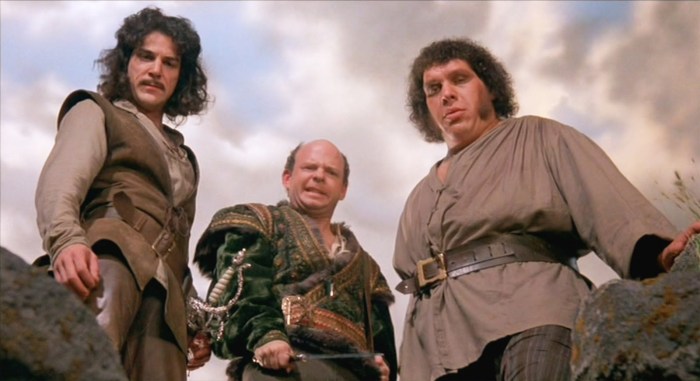
princess bride
“You keep using that word. I do not think it means what you think it means.”

Amidst all the hubbub currently surrounding my ongoing rewriting efforts, I’ve been extremely fortunate to have received some high-quality feedback on each of them.

(Incidentally, concurrently working on three scripts may be a good exercise in productivity, but it sure is an exhausting one.)

Among this trio of projects is a round of notes on the pulp sci-fi.

Some great stuff being provided by my legion of savvy readers, which includes a comment made by more than one person.

But first, a little background…

As I mentioned, I refer to this script as “pulp sci-fi”. To me, it’s reminiscent of old-timey adventure (Flash Gordon, Doc Savage, etc), which is the kind of story I enjoy reading. It’s also the filter through which I wrote it, and had a great time doing.

What’s been extremely interesting is how people interpret that phrase.

A few readers tended to share my same opinion/viewpoint, and felt the story and script reflected that. Others thought calling it a “pulp” story indicated it would be somewhat darker and grittier (which it really isn’t). And there’ve also been some who weren’t sure if what’s on the page was supposed to be taken at face value or if I was intentionally satirizing the genre.

Quite a wide variety of opinions and reactions, all of which are perfectly valid. But the responsibility falls squarely on my shoulders to provide the story with the tone I find the most applicable.

Don’t underestimate the importance of tone. This may not be the best explanation, but I see it as the story’s attitude; how it presents itself. The writing should reflect not only the components of the genre, but also the emotions the story seeks/needs to invoke in the reader.

So while I offered up what I considered to be a fun romp of a tale through the fantastic, maybe with tongue slightly pressed against cheek, that’s not what how others saw it.

Admittedly, I probably could have cleared up a lot of the confusion at the outset by adding something like “It’s pulpy sci-fi in the vein of MEN IN BLACK, HELLBOY, and THE ADVENTURES OF BUCKAROO BANZAI,” as opposed to leaving it open to interpretation. For all I know, someone saw “pulp sci-fi” and thought, “Oh, like BLADE RUNNER.” Which it most definitely is not.

Laying down that kind of foundation lets the reader know what to expect before they start, but then it’s up to the writer to consistently maintain that tone for the entirety of the script.