Hey! Long time no (preferred form of communication)

operator
A hard-at-work pre-Internet server keeping things up and running

There’ve been several previous posts here regarding the benefits and necessity of networking. It can’t be stressed enough how incredibly helpful and effective it can be, especially if you’re not in Los Angeles or somewhere you don’t have a lot of in-person access to other writers.

But it’s not enough to just make a connection. An effort needs to be made by at least one of you (most likely you) to maintain that connection and keep it healthy. And it’s not as hard as you might think.

While it can be extremely easy and tempting to get sucked into the never-ending rabbit hole of the internet, designate a portion of your non-writing time to be just as productive and try to get some networking stuff done.

Are you connected to another writer in your area, but you’ve never actually met in person? Ask them if they’re up for a get-to-know-you coffee or lunch chat.

If you’re limited to online communication, send them an email or tweet asking how they’re doing, and how their latest projects are coming along. Be helpful, or at least offer to help. They might just take you up on it.

*Important – if it’s been a while since you’ve been in touch, don’t start things off by straight-out asking for something. Would you want someone to do that to you? Didn’t think so.

If something good (career or otherwise) has happened for them, send a note of congratulations. Likewise, if something not-so-good has happened, express your sympathies accordingly.

Cliched as it may sound, keeping the lines of communication open really can help you out. I’ve been extremely fortunate to have established strong relationships with several local writers and filmmakers, and exchanged notes with writers scattered across the globe.

I reconnected with a consultant I hadn’t been in touch with for several months, and that conversation led to them offering up coverage (which I still paid for) that proved to be quite helpful.

A writer I know who works in TV and film emailed me, wanting to discuss her latest concept because she thought I was a good match for it.

None of these would have happened if I hadn’t taken the time to keep each relationship going. Rather than taking a “how can you help me?” approach, I go in with the mindset of “maybe I can help you?”

One of the things you hear so often when it comes to establishing a screenwriting career is “It’s not what you know, it’s who you know”. I’ve found both parts to be true. You definitely have to know what you’re doing in terms of craft and writing ability, but it’s equally important to establish and maintain solid, professional relationships with as many people as you can.

Because you never know who’s going to suddenly be a person of influence willing to help you out because you did the same for them.

So here’s your voluntary assignment:

1. Contact five of your connections.
2. Ask them how things are going.
3. Take it from there.

Good luck!
Rather apropos for today

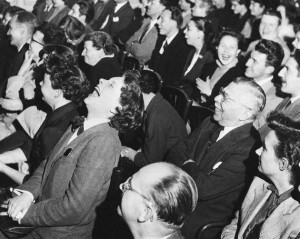
laughing crowd
Go ahead. Make me laugh.

Feedback is starting to trickle in for the latest draft of the comedy spec. So far, reviews are favorable. It’s still very rough around the edges, but confidence is running high heading into the next rewrite.

It’s very encouraging to have more than one person tell you “I actually laughed out loud. More than once!” That counts as a win in my book.

So in keeping with the comedy theme, here’s a question for you:

Someone asks for your recommendation for an underrated comedy. Preferably one they’ve never heard of.

I’d go with GOON. Quite a nice surprise. Bonus points if you know anything about or have an appreciation of hockey.

What’s your pick?

It was good enough for Spielberg…

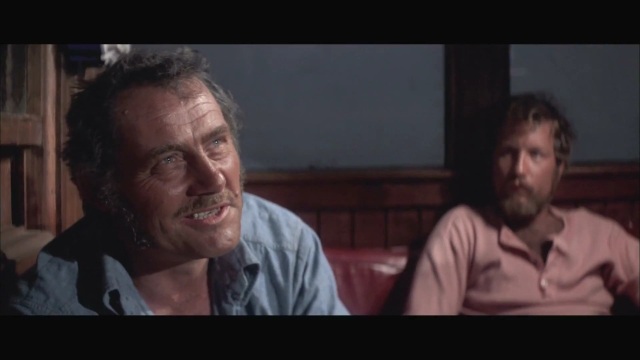
quint
“Eleven hundred men went in the water. Three hundred and sixteen men come out. The sharks took the rest.”

There’s a pivotal scene in my western where my main character reveals why she does what she does and what made her the person she is. Nothing too complicated. Just a couple of lines of dialogue.

It took a few passes to whittle it down so it got to the point fast and in as few words as possible. I think it works quite nicely.

It’s been suggested how this was a great opportunity to apply the “show, don’t tell” rule and make it a flashback. The logic being that since it’s such an important moment, showing it, rather than just her talking about it, would have a greater impact.

I’m not so sure about that.

I don’t have a problem with flashbacks, but have always tried to avoid using them. I guess I see them almost as a cheat; possibly even lazy writing. Like you can’t weave that information into what’s happening now, so you stop the action to show it. But once you interrupt the momentum of your story, it’s not easy to get things back up to speed.

And sometimes a flashback just isn’t necessary.

Consider the scene from JAWS pictured above with Quint’s story about the Indianapolis. Should we actually see what he’s describing? Highly doubtful. Part of why that speech works so well is how it’s delivered. You can see and hear what that experience did to him. How you’re imagining it is much more terrifying than anything they could show. The speech would lose its impact if we were concentrating on the action, rather than what Quint is saying.

Sometimes just a line of dialogue or two can be just as effective, if not possibly more so, as pausing the action for a flashback. This isn’t to say you shouldn’t use it. If you think it’s the most effective way to make your point, then by all means do it.

Just make sure it’s a solid fit.

Beware the monsters with green eyes!

green eyes
And done without the benefit of contact lenses

Not one, but two, count ’em – TWO, fantastic get-to-know-you chats with some fellow local writers over the past week. (Eight days if you want to get technical about it)

As part of one of these discussions, the topic of dealing with criticism came up. In particular, criticism that seems to come from a harsh, angry place. They go way beyond “This needs work”, and potentially surpass the purpose of notes to the point of simply being downright cruel.

“This is shit. Whoever told you you could write?”

“Any attempt to fix this would be a waste of time. Just give up now.”

Chances are you’ve been on the receiving end of these kinds of notes. I certainly have.

When we’re first starting out, we don’t realize how much we don’t know, and that’s reflected on the page. There’s not one experienced writer who thinks their first script or two was perfect.

So you work at it. You toil away, constantly putting in the effort to improve. And over time, you do. You know you’ve gotten better, and that also comes through on the page. Maybe you’ve even gotten compliments or (gasp!) praise about your work.

But despite your progress, you might still get a note like those above that totally trashes what you’ve written. This has also happened to me. Fairly recently, I might add.

What myself and the other writer discussed was “Where does this anger come from?” We’ve both been doing this for a while, so neither of us is a total noob. We each had more than a few scripts under our respective belts, so what could possibly be the basis for such a mean-spirited rant?

I casually threw out something I’d only read about and heard in the occasional mention: Could the person giving the notes be jealous of the material, and they were venting their anger and frustration about it via their notes?

Let me set one thing straight. I think I’m a good writer, but I will never claim to be the be-all and end-all. In fact, I’d be amazed if somebody was jealous of my work.

When I read somebody else’s script and find it totally amazing, I’ll tell them so. Do I wish I could write something that good? Sure, but it makes me want to work harder so I can. I don’t think “I’ll never be as good as them, so I’ll shit all over their material in order to make myself feel better.”

Taking this kind of negative approach can only result in a lose-lose scenario for you. You make yourself look bad and the other person will most likely not want anything to do with you anymore. And don’t think they’re going to forget you. To them, you’ll always be that angry asshole.

Something else to keep in mind – you never know who’s going to succeed, so the person whose script you just trashed could potentially be the next big thing. Wouldn’t you rather be on their good side, and not their shit list?

I work really hard to establish and maintain my network of connections, and value each one too much to do that. I want everybody to succeed and actually enjoy helping if and when I can.

But then again, I’m just a nice guy to begin with. Even if I do occasionally end sentences with a preposition.

But that’s nothing to be jealous about.

Shakin’ things up so much it registers on the Richter Scale

richter scale
Brace yourself

I recently took part in a group conversation with some other writers, and naturally, the topic came around to “So what else are you working on?” I always enjoy this sort of thing. So many great ideas out there.

When it was my turn, I mentioned some of what’s been occupying my time, which included the Christmas-themed mystery-comedy.

“A Christmas mystery-comedy? What’s that about?”

I launched into my 30-second elevator pitch. “LA Confidential with an all-elf cast.” The seedy underbelly of the world of Santa’s workshop. Guns. Sassy dames. Tough-talking gangsters. Intrigue. Double-crossings. The whole gin-soaked ball of wax.

While most thought it sounded like a lot of fun, one person looked absolutely horrified.

“Oh no!” they exclaimed. “My kids and I love Christmas. It’s supposed to be sweet and wonderful! I can’t believe you’d want to write something like that.” (All that was missing was them sprawled on a fainting couch, claiming to have the vapors while frantically fanning themselves.)

How could I not want to write this? Sweet and wonderful doesn’t make for good storytelling. I love this kind of story, and think it would make a great script.

This person makes it sound like trying something new is a bad idea because it messes with the comfort of the familiar. Yet one of the most common tenets is “Familiar, but different.” A story you’ve seen before, but told in an entirely new way. It’s what we should all work towards.

Everybody’s looking for something truly original and unique. Why in the world would you want to write something that doesn’t offer up anything new?

Every script you write is a golden opportunity to push your creativity to the limit so you really catch ’em off-guard. You know the story you want to tell, but it’s on you to truly surprise your reader/audience. Take things in an entirely different direction. They may think they know what’s coming, but you know better and look forward to how they’re going to react.

No matter what genre your story falls into, there will be certain expectations that come with it. The challenge of every writer is to not just meet those expectations, but toss them out the window and offer up a totally new and unexpected way of telling that story. Some people may not like it, but it’s most likely they’re in the minority, and therefore not your target audience.

Think about it. What kind of script are you more likely to take notice of and remember? One that goes for new and original, or one that plays it safe with the tried, true and predictable?

I know which one I’d pick, and will be waiting over by the window for your answer.