Beware the monsters with green eyes!

green eyes
And done without the benefit of contact lenses

Not one, but two, count ’em – TWO, fantastic get-to-know-you chats with some fellow local writers over the past week. (Eight days if you want to get technical about it)

As part of one of these discussions, the topic of dealing with criticism came up. In particular, criticism that seems to come from a harsh, angry place. They go way beyond “This needs work”, and potentially surpass the purpose of notes to the point of simply being downright cruel.

“This is shit. Whoever told you you could write?”

“Any attempt to fix this would be a waste of time. Just give up now.”

Chances are you’ve been on the receiving end of these kinds of notes. I certainly have.

When we’re first starting out, we don’t realize how much we don’t know, and that’s reflected on the page. There’s not one experienced writer who thinks their first script or two was perfect.

So you work at it. You toil away, constantly putting in the effort to improve. And over time, you do. You know you’ve gotten better, and that also comes through on the page. Maybe you’ve even gotten compliments or (gasp!) praise about your work.

But despite your progress, you might still get a note like those above that totally trashes what you’ve written. This has also happened to me. Fairly recently, I might add.

What myself and the other writer discussed was “Where does this anger come from?” We’ve both been doing this for a while, so neither of us is a total noob. We each had more than a few scripts under our respective belts, so what could possibly be the basis for such a mean-spirited rant?

I casually threw out something I’d only read about and heard in the occasional mention: Could the person giving the notes be jealous of the material, and they were venting their anger and frustration about it via their notes?

Let me set one thing straight. I think I’m a good writer, but I will never claim to be the be-all and end-all. In fact, I’d be amazed if somebody was jealous of my work.

When I read somebody else’s script and find it totally amazing, I’ll tell them so. Do I wish I could write something that good? Sure, but it makes me want to work harder so I can. I don’t think “I’ll never be as good as them, so I’ll shit all over their material in order to make myself feel better.”

Taking this kind of negative approach can only result in a lose-lose scenario for you. You make yourself look bad and the other person will most likely not want anything to do with you anymore. And don’t think they’re going to forget you. To them, you’ll always be that angry asshole.

Something else to keep in mind – you never know who’s going to succeed, so the person whose script you just trashed could potentially be the next big thing. Wouldn’t you rather be on their good side, and not their shit list?

I work really hard to establish and maintain my network of connections, and value each one too much to do that. I want everybody to succeed and actually enjoy helping if and when I can.

But then again, I’m just a nice guy to begin with. Even if I do occasionally end sentences with a preposition.

But that’s nothing to be jealous about.
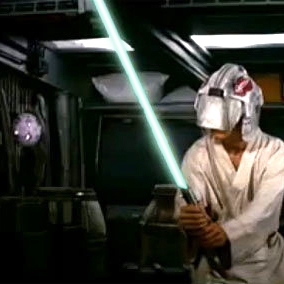
The unscientific term would be “gut reaction”

trust your feelings
Learn to trust your feelings. Even with the blast shield down.

I’ve had the experience of working with some writing, both my own and other people’s, that required a second opinion. For some of them, I was the second opinion, while the others involved my work being reviewed.

An experienced professional asked me to take a look at another writer’s script, accompanied with their excitement and enthusiasm about it. Upon reading it, I found it severely lacking in a lot of screenwriting fundamentals (bad structure, shoddy character development, etc.), and said so as part of my notes of what was needed to improve.

I like to read a script twice before giving notes on it, and it took a lot of effort to get through each one – especially the second time. That whole time I was wondering “Where is this enthusiasm coming from?” This person knows what a good script looks like, and this one, to me, didn’t meet any of the necessary criteria. And if they felt this way about this script, could I trust their judgment on others?

Last week I’d been given the offer to have my query letter reviewed. I put it together with the elements I considered vital: quick one-sentence pitch, logline, reputable contest results. As fast a read as possible.

The response read like something churned out by a machine. Their recommendation was to follow “their blueprint”, which involved a lot of fill-in-the-blanks, how it’s similar to successful films (the more recent, the better!), telling the story from only the main character’s point of view, and concluding with “why I think this will be a hit” OR the underlying theme. The end result is several big unappealing blocks of text.

All of this felt totally and absolutely wrong. If I were the intended recipient, I might start reading, but would most likely lost interest very quickly and be very hard-pressed to want to continue, let alone finish it.

(With no intention of ever actually using a letter written following their guidelines,  I put one together and submitted it for review, just to see what they would say. Their follow-up comments reinforced my doubts, but that is a topic for another day.)

As you probably guessed, I’ll be sticking with my original format.

The takeaway from both of these experiences is that a writer must not only develop their writing and storytelling skills, but also the ability to trust their instincts. Know what works, not only for you, but in an overall sense.

Don’t always assume the other person is in the right. Sometimes they’re not.

Everybody will have an opinion about something. You might agree wholeheartedly or think the other person has no idea what they’re talking about. It takes time to learn how to determine which is which. You will make mistakes and bad choices along the way, but make the effort to learn from them so you don’t do it again.

Like with writing itself, the more you work at it, the better at it you’ll become.


Still flying, still buttressing

buttresses2
Helping support writers since 2009!

The post from earlier this week was all about my excitement about my new story idea. Little did I realize what kind of effect that would have on some readers.

“The enthusiasm oozing from your blog post is contagious. I have a story line that is brewing, too! Thanks for the encouragement here!”

Shucks, folks. I’m speechless. (“Oozing”? “Contagious”? Makes me feel like I require medical attention.)

It kind of reminded me of this post from 2 1/2 years ago.

Those that have been following this blog for a while know what a big proponent I am about networking and supporting those within your network.

I’ve been extremely fortunate to have not only established solid relationships with several writers of considerable talent, but been the fortunate recipient of their advice and guidance in helping me hone my writing skills. In turn, I don’t hesitate when one of them asks me for my two cents about their latest project.

Hard as this might be for some to believe, being nice to people actually has its benefits, and isn’t that difficult.

Or is it?

As has been well documented here, I’ve had several online encounters with those who make comments of an overly negative nature (which, a majority of the time, don’t include anything that actually helps).

It truly amazes me when somebody I’ve never met, and most likely never will meet, has no problem spitting out harsh and condescending answers to what are generally simple questions, or somebody just seeking some helpful insight or advice.

Whatever their reason, what exactly is the point of acting like this? If anything, it makes me want to avoid you at all costs. I’m already doing a bang-up job being full of self-doubt. I don’t need your help.

I strive to be the opposite of that, and help people out when I can. It’s in my nature.

And if you’re reading this, I sincerely hope it’s in yours as well.

What comes after the light bulb?

light bulb
This is how it starts

Being a writer means your creativeness is always running, or at least should be. It never shuts off, and sometimes kicks in when you least expect it.

Inspiration can hit anytime, but are you prepared for when it does?

You could be doing something you do practically every day or see something seemingly normal, and all of a sudden think, “Hey! There’s a story here!” It could be whatever you can imagine: the basis for a short, an episode of a webseries, or part of a feature.

Then there’s the thrill as your mind races through all the potential possibilities. What if THIS happened? Or THIS? Ooh! I love THIS! It’s like a shot of adrenaline into the right side of your brain.

When the idea hits, do you immediately write it down, or is it suddenly burned into your brain so deeply that there’s no way you could possibly forget any part of it?

Of course, it’s one thing to come up with the idea. How far do you go with it? Does it lose its luster after a few days, and then you just give up completely? Do you hold onto it because there’s just SO MUCH POTENTIAL here? Do you tinker around with it, file it away, then come back to it weeks or months later?

How original an idea is it? Can you think of something that’s similar? Who’s your target audience? Is it something you yourself would actually pay to see?

Let’s also not forget that this is all based on your thinking. You love the idea, but what if somebody says “I don’t get it” or all you get is a shrug? Do you think the idea is worth developing? Is it one you’re prepared to slave away on for an extended period of time?

It’s easy to come up with the ideas, but definitely not easy to turn them into quality, fleshed-out screenplays. It takes a long time to get the hang of doing this, let alone doing it well. But don’t let the difficulty or length of the journey dissuade you from at least trying.

Start with the idea, and take it from there.

A workload on steroids

Man drowning in stacks of paperwork
All I need to do is cut out the non-essentials. Who needs food, sleep or oxygen anyway?

I’m in the home stretch for the November writing project. I got into Act 3 over the weekend, and think there about 10-12 pages left before I can call it a day. No reason I can’t wrap things up in the next couple of days. Estimated final page count should be somewhere in the mid-90s, so pretty much where I was hoping it would be.

My original intent was to put that on the back burner once it was done and shift my focus to another script, but something else has developed that definitely requires my attention: other people’s work.

Over the past couple of months, I’ve been very fortunate to have gotten some fantastic feedback from friends and trusted colleagues. Now it’s my turn to return the favor.

Actually, make that favors. Plural.

Every time I’ve asked someone if they’d be willing to read and give me notes, I always offer to do the same for them. And several have taken me up on the offer.

Which is totally fine. I just didn’t expect all of them to happen within such a short timeframe.  But it’s cool. Just requires a little planning.

Some script-related items, two scripts requiring special attention (with a bit of a time limitation), and at least 4-5 others getting straight-up notes. Yeah, that’s a lot, but I’d feel pretty shitty if I didn’t reciprocate the kindness all of these folks extended to me.

While I’d love to keep the 2-pages-a-day momentum going clear through to the end of December and have at least part of a draft of another script, taking care of these is now top priority.

It may take me a little longer than I expect, but I always strive to honor my commitments. I said I’d do something for you, and by gosh, I’ll do it.

It’s the least I can do.