Start with similar, venture into different

path
With one you can play it safe, while the other offers up more of a challenge

In the handful of times I’ve helped out as co-writer or script polisher on somebody else’s project, there have been variations on the following conversation:

ME: And then THIS happens!

THEM: Oh, we can’t do that. ACTUAL MOVIE did the same thing.

ME: Not exactly. ACTUAL MOVIE did THIS, and what I’m suggesting is maybe at the very foundation the same concept, but if we did it THIS WAY so THIS HAPPENS, it would be entirely different.

THEM: But won’t people think we’re just ripping off ACTUAL MOVIE?

ME: First of all, ACTUAL MOVIE has been out for a while, and you’re at least a year away from having this thing done, so I highly doubt the first thing anyone’s going to think is we’re ripping off ACTUAL MOVIE. Second, this is exactly why I think THIS is how it should happen. True, both use the basic concept, but we’re putting our own spin on it so it doesn’t resemble ACTUAL MOVIE at all. They’re similar, if you could even call it that, but still different.

THEM: (thinks it over). Well, okay. We’ll give it a try.

And…scene.

I’ve read about this in articles and seen it firsthand while reading scripts, both times usually associated with newer writers. Somebody really likes how something happens in a film or a script, so then they go and have the EXACT SAME THING happen in theirs. I get that you liked that original, but why, oh why would you want to use it practically verbatim in yours?

Doing the screenwriting equivalent of a “copy, cut, and paste” will do you no good because it’ll be painfully obvious that’s what you did. You’re trying to tell an original story, and THIS is what you do?

If anything, people will definitely think you ripped off that original thing and berate you for your total lack of originality. Was that your goal? Probably not.

Time to get analytical. What was it about that particular something that really got to you? Why do you feel the need to have the same thing happen in your script? That’s the angle from which to approach it.

But this is also where the challenge begins. Once you identify that core detail, it’s up to you, the writer, to figure out a new way to use it in such a way that not only does it serve the purpose you need, but also pays homage to what inspired it in the first place.

You know where things are going, or at least where you want them to go, but now you need to tweak how they get there. Work those muscles of creativeness! Try something new! Don’t hesitate to jump off the beaten path into new territory! If anything, you might come up with an entirely new idea that accomplishes exactly what you needed, but just a totally different way.

Sure, there’s a very slight chance it could potentially remind somebody of ACTUAL MOVIE, but they’ll definitely remember that it came from yours.

A label I wear proudly

sturges
We work wherever, whenever, and however we can

I can’t remember exactly where I saw it, but a couple of days ago there was a comment in a screenwriting forum that read something like “All you wannabe dreamers are just wasting your time”.

Oh, how I adore the encouraging words of total strangers.

But in all seriousness, I take issue with that statement. Nothing wannabe about me at all. I’m a total dreamer, through and through, and I don’t see this as wasting my time.

Far from it.

I think up stories and put ’em down on paper, and I really like that I can do that. A lot. (So much to the point that I think I could actually make a living at it. Here’s hoping, anyway.)

Other dreamers express themselves using any form of different methods. They’ll paint, draw, sculpt, compose, act, or sing. And it’s probably correct in assuming they get the same joy out of doing it that I do.

Is everybody good at it? No. Does that mean they shouldn’t even try? Of course not. We do it because we enjoy it.

One consequence about being a dreamer is that there will always be somebody like that anonymous naysayer. You don’t have to listen to them. It’s a lot easier to tear someone down than it is to build them up. That person may have had been bad experiences trying to do the same thing, and if they couldn’t do it, then nobody else can (or so the theory goes).

But you should also be realistic. Not everybody’s going to create The Most Amazing Thing Ever. Don’t let that stop you from trying. Speaking from my own perspective, even though I’ve made some forward progress for both skills and career, it’s taken a long time, with the number of setbacks and disappointments being significantly higher, but despite all that, there’s nothing else I’d rather be doing. Better to put myself through all of that rather than to have given up and not tried at all.

What can I say? It’s the dreamer in me.

So here’s to all of us dreamers. Long may our imaginations and the ability and methods in which we express them reign in an effort to make the world a slightly more enjoyable place.

Oh, and screw the naysayers.

Percolating. Always percolating.

Image result for coffee POT GIF

As writers, we fully realize that inspiration can hit at any time, and in any situation. And it’s what you do when it does that really matters.

Late last year, I was taking the dog for her last walk of the day. Something about that particular moment triggered a story idea. I won’t say the floodgates of creativeness opened wide; more like the squirt from a water pistol. It was just a sentence, maybe two, but I immediately saw so much potential in it.

We got home, I created a file for it on my computer, and I wrote down the tidbits of story I’d managed to come up with.

And in the hard drive it sat, practically untouched for months on end.

In a manner of speaking.

As is usually the case, even thought I may not actually be writing, I’m always thinking about the writing.

Although I’ve worked on several other scripts this year, every once in a while, a new detail about this story would pop up and I’d add it in. It’s definitely an ongoing work in progress, moving at a glacial pace, and there’s no rush to get it done.

It’s actually very beneficial to not put any pressure on yourself and just let the ideas show up at their convenience. And sometimes it pays off when you least expect it.

About a week ago, I came up with an idea for a short, but then realized the location would be a perfect setting for the climax of this script. Determined to hang onto that idea, I reopened the file and figured it was as good a time as any to to move things forward a little, so I started organizing the plot points. There are still a few blanks to be filled in, but it’s slowly coming together.

When the’s next time I’ll work on it? No idea. It’s still very, very early in the development process. A few other scripts currently have priority over this one, but I highly suspect the trend of occasionally adding a few details will continue.

As it should. And then when I finally get around to focusing all of my attention on this one, chances are I might be further along than I expect.

So keep on working on whatever it is you’re currently working on. But feel free to let your imagination wander about once in a while into something else, particularly something you plan to eventually work on. See what you come up with, and if you like it, stash it away for later. Hold onto it even if you’re not that crazy about it; you might find a totally unexpected use for it later.

No matter what you do, Future You will really appreciate everything Present You is doing.

Could it get made today?

psycho-house
“Another “boy and his mother” story? Pass.”

Originally, this post was going to be about the multiple changing of protagonists in PSYCHO (which is another great potential future topic), but the more I read about the film and thought about the impact it’s had since being released way back in 1960, it triggered a totally different train of thought.

Every once in a while, when a classic film is brought up in some context or another, the phrase “That could never get made today” will get thrown in. After the recent death of Gene Wilder, his talent was lauded via the mention of several of his most well-known roles. Willy Wonka. The Waco Kid. Victor Frankenstein (“That’s Fronken-steen.”). His performances were vital parts of each film, which no doubt contributed to making them “classics”.

But, as always, it starts with the script. (Incidentally, I don’t think Wilder gets enough credit for co-writing YOUNG FRANKENSTEIN.)

Examining the stories being told, each one has something truly unique about it, and then some. The writer (and subsequently the filmmaker) wasn’t afraid to take a chance and try something completely new and different. Sadly, the studios today aren’t as open to it. Better to play it safe then take too big a chance, which is why we’re seeing so many remakes and re-imaginings. Of course, that doesn’t always work out either (e.g. 2015’s PAN, the recent BEN-HUR remake).

While there are always original and innovative scripts floating around, it’s a lot of time, effort and money to make a film. The only recent original film I can think of is SWISS ARMY MAN, which I admit I haven’t seen yet.

Who hasn’t read a “truly original” script or about one getting a lot of attention, but a lot of the time the writer will go on to work on other projects while the script that started the whole thing gathers dust?

The best exception to this that I know of is Travis Beacham’s spec A KILLING ON CARNIVAL ROW, which drew a lot of heat when it sold in 2005, then continued to garner praise while it languished in development for years before ultimately becoming an upcoming series on Amazon – at last check, anyway.

Budgets are getting higher, and the gap continues to grow between microbudget features and mega-budget tentpoles. It’s getting harder for original material to get noticed, let alone something that screams out “NEW!” It also doesn’t help that the chances decrease if the script isn’t based on pre-existing material. This could be why today you’re more likely to see an original film that’s a low-budget independent, probably written by the filmmaker themselves.

Before that, your best bet of seeing something groundbreaking would have been at the hands of established filmmakers, only because they had that kind of leverage (and the budget) to get their projects made. An unknown writer doesn’t have that kind of luxury. All we can hope for is to connect with somebody who likes the script (and our writing) so much that they’re actually excited to help us take things beyond the “Sure, I’ll read it” stage.

That’s our objective as writers: to write something that’s not only compelling and involving, but so eye-openingly original that the reader is compelled to the point that they need to see this as a movie. Doable, but definitely not easy.

Homework time! Part one – find a script you really consider a game-changer for the same genre as yours and give it a read. Can you identify what made it so unique? What really stands out for you? Plot? Story? Characters? A little of everything? Another option is if that script has been produced, then watch the film and follow along with the script. Are they the same? Totally different? Do you think the changes add or take away from the script?

Part two – without blatantly copying the style of that script, work on applying a similar originality to yours. Did reading that script inspire ways for you to make yours really stand out?

Don’t be afraid to take chances. Strive to offer up something we’ve never seen before. The results might surprise you, too.

-Special offer just for you!

course-discount-maximumz

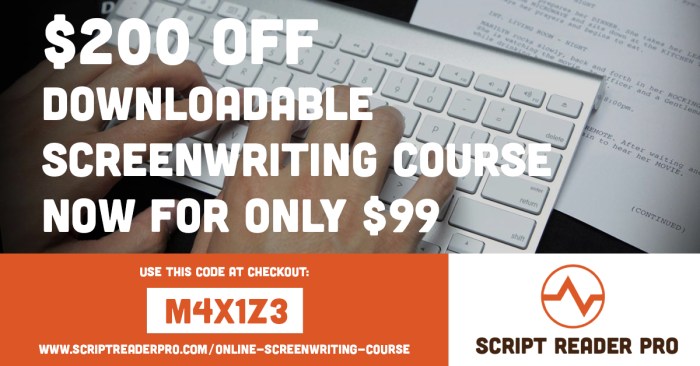
The fine folks at Script Reader Pro are running a discount for Maximum Z readers on their downloadable screenwriting course Script Hackr.

Forget all the confusing and vague “fluff” found in most screenwriting courses, coverage and books. Script Hackr will skyrocket your screenwriting skills by utilizing rarely talked about hacks and hands-on practical exercises to de-mystify theory.

The course retails at $299, but you can get it for just $99 by using the coupon code M4X1Z3 at checkout.

You can check out more details on the course here:

Thank you for being better than me

fancy pie
Mine don’t look like theirs yet, but give me time…

Via a writing colleague, I recently found myself in the possession of a pair of scripts written by a pair of pros.

“Open one and read a few words and you’ll be in for the rest of the script,” I was told.

And you know what? They weren’t far off.

I only got a few pages in, but found the writing to be extremely vivid and descriptive. No problem at all in painting those mental pictures with a powerful brush.

My only complaint – all that dazzling wordsmithing got a little too distracting, making it slightly tougher to focus on the story. Nevertheless, I’m looking forward to reading both scripts.

But I totally got my friend’s point: the writing was exceptionally engaging. It really grabbed you and made you want to keep going.

Compared to it, my writing comes across as kind of dry and might even be considered sort of dull and lackluster. Not to totally disparage my own work, but these writers are professionals. I, as it has already been established, am not.

But reading these scripts and others like them are good reminders of what I and every other writer should be trying to do. You don’t want a stick drawing. You want a finely-crafted elaborate work of art.

Speaking from experience, this isn’t easy. It’s almost like learning a new way of writing. It requires a lot of work, nor will it happen overnight.

But don’t despair. The good news is you can start working on these improvements practically immediately.

Take the last scene you wrote. How does it read to you? Does it compel you to want to know what happens next? Feel free to tinker with it until it gets to that point. Then do the same with the scene after it. And the one after that. And so on, and so on.

Think of it this way – you want the reader to “see” the scene in the same way you imagined it. Therefore, your challenge is to write it so the actions, images and dialogue in it come as close as possible to matching your version AND that no other description would do it justice.

Reading these professional scripts was at first intimidating in a “I’ll never be able to write like that!” kind of way. But with a continuous effort and a lot of work, there’s no reason to think I couldn’t come mighty close.