Finding the right next one

Progress continues for developing the story of the new spec, with a few important details solidifying, along with weighing options for the overall setting (Is it too familiar? If it changes, how much will that affect the rest of the story? Is that a good thing?)

But the one thing really coming into play this time around is figuring out the best way for one scene to lead into the next – to the point that it needs to seem like it was only logical that this next thing is the only thing that could have happened, and so on and so on. It’s challenging.

This is where watching films and reading scripts really comes in handy. Taking a look to see how other stories have accomplished this can make quite a difference. Granted, a lot of the scenes involve being set up earlier in the story, so not only is there a payoff somewhere down the line, they also tie in to how the story is developing AND move things forward.

A leads to B, which leads to C, which leads to D, etc., etc.

It’s also important to stress that the events of the story need to flow organically. B needs to be the only thing that could have followed A without it feeling forced or “this happens because I need it to”. Making sure of this is a big contributing factor to all the time being spent on the story.

I’ve discussed this with several other writers, and many said this is a positive thing. Putting so much effort into this now leans towards the story’s foundation being pretty solid, and establishing that steady A-to-B-to-C movement will help things flow.

Something else I’ve noticed in a lot of the films and scripts is that the scenes are VERY TO THE POINT. There is no time wasted whatsoever. The scene starts, they get to the point asap, then move on to the next one. I’ve seen the opposite in a lot of scripts, including some earlier drafts of my work. I’ll be making sure this doesn’t happen this time around.

Even though there is still a lot to figure out for this story, there’s also a lot coming together – at a slightly faster pace than usual, which is something I’m not used to. There’s even been a random moment of clarity or inspiration when I’m not expecting it, which is always great.

My automatic reaction to when that happens is “does this work within the context of the story and accomplish its purpose?” and if not, is there a way to adjust it so it does? Even if I end up not using it, it might still have the potential to be used in one form or another somewhere else in the story (or in an entirely different script).

And what might be the best thing of all is that I’m simply having a great time putting all of this together. Like I said, it’s challenging, but still fun. Wish it could go a little faster, but I think it’ll be worth the wait.

Did it before. Can do it again

The biggest note I’ve received on the animated fantasy-comedy is that my protagonist needs to be more involved; be the thing that drives things forward, and how what she does affects those around her.

The challenging part is figuring out how to do that while keeping a lot of important story details.

Challenging, but not impossible.

Just as I imagine this task becoming more insurmountable the more I think about it, I’m reminded that I did a major overhaul on my western that involved the same thing. The protagonist needed to be more proactive in driving the story forward.

The end result had A LOT of changes that required a new approach. It took some time, but I was able to accomplish that, and the script ended up being better for it.

No reason to think I can’t repeat it this time around.

Thus the revising is underway. Slow, but steady.

I’ll get there.

Knowing your nails and how to use them

Savvy and experienced consumer of literature I’m sure you are, no doubt you’re more than somewhat familiar with the classic piece For Want Of A Nail:

For want of a nail the shoe was lost.
For want of a shoe the horse was lost.
For want of a horse the rider was lost.
For want of a rider the message was lost.
For want of a message the battle was lost.
For want of a battle the kingdom was lost.
And all for the want of a horseshoe nail.

Sometimes we don’t realize how important something is that at first glance might seem completely insignificant.

The same concept could apply to screenwriting and the details of your story. A reader could see something and wonder “I don’t get it. Why is this in here?”

If you do the work and plan accordingly, the answer/reason will soon be obvious. That little detail is there for a reason, probably an important one, and without it, the rest of the story won’t work.

This is important on several levels.

It shows you put a lot of thought into putting the story together.

It shows you understand the concept of effective setups and payoffs.

It shows you respect the intelligence of your reader/audience and don’t feel the need to deliberately draw our attention to this sort of thing.

It always bothers me when a story sets something up and doesn’t pay it off, or has something later on in the story that comes out of nowhere.

Some writers go into it with a solid idea of how everything is set up and know how it’s going to play out, some come up with the bare bones of a foundation and fill in the blanks, and there are even those who sit down with a blank page, start writing, and see how it goes.

I tend to waver between the first two.

Sometimes you might even go back over what you’ve already written and discover an opportune moment to put in a small detail that can further enhance something later on in the story. It’s as if your subconscious was working in conjunction with your creativity and giving you an unexpected helping hand.

Are parts of your story set up that they start with a “nail” and escalate from there? Or does something happen later that could use a stronger setup?

You’d be surprised at seeing the ripple effect one little change can have on the rest of your script. Hopefully for the better.

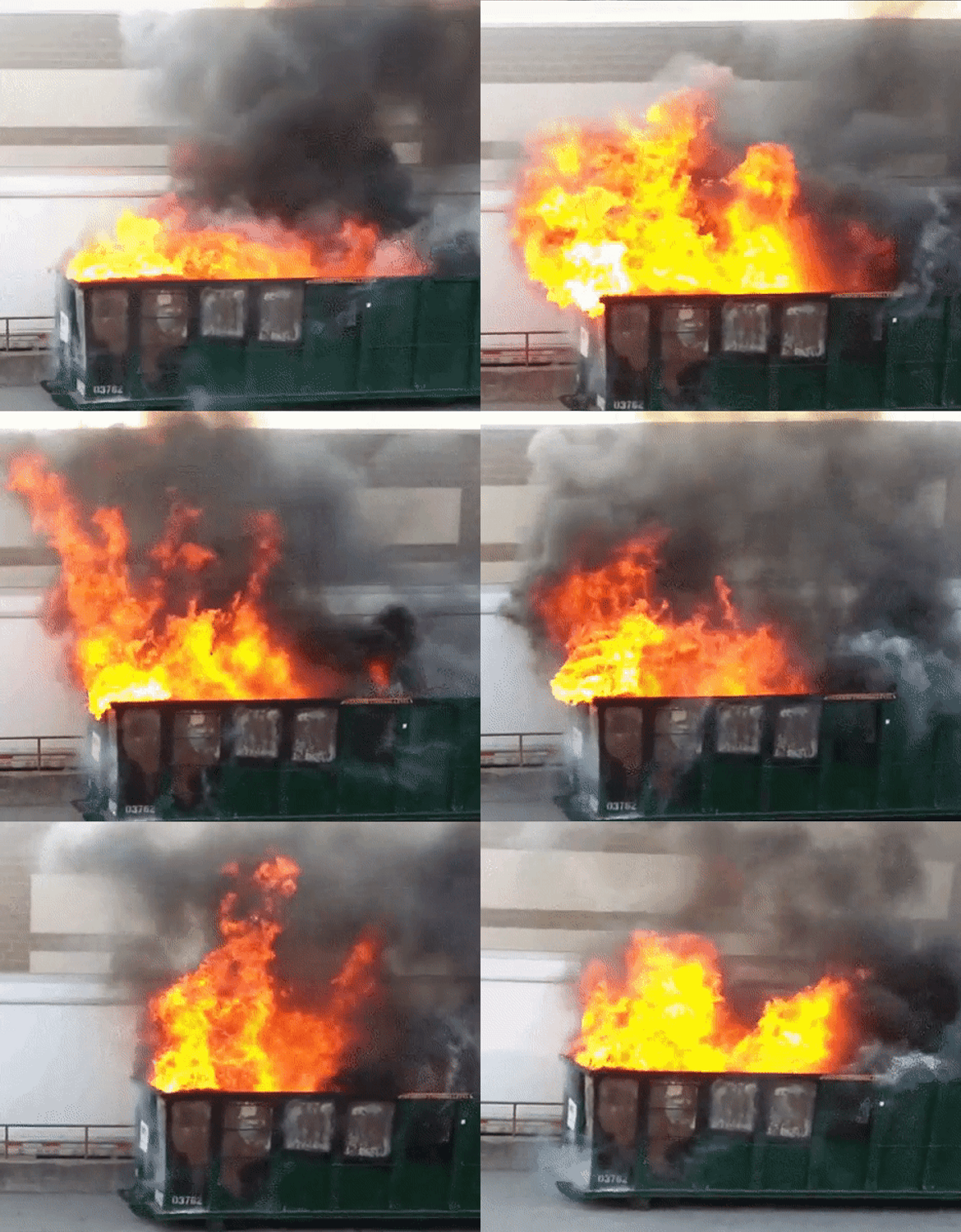
There’s gold in them thar dumpster fires!

Saw a great quote the other day that was along the lines of “Being a writer is like having homework for the rest of your life.”

From a certain perspective, that definitely has a negative connotation. Emphasizing the ‘work’ part of the word indicates drudgery and toil. Like, strictly dullsville, man.

The obvious solution is to make it a positive experience.

I know. Easier said than done, but bear with me.

(Writing should never seem like work anyway, but that’s another post.)

To be a better screenwriter, you need to read scripts and watch movies. You can see how the pros did it and figure out how that could potentially influence your work.

While watching your favorites and the classics can definitely help, I also suggest watching really shitty movies as well.

Hard as this might be to accept, there’s something be gained from it.

What was it that made them bad?

The possibilities are numerous, but a good percentage of the time – it’s the script.

As a writer, you can use that to your advantage.

Painful an experience as it might be, watch that bad movie from a writer’s perspective. Is it the writing that sucks? The story? The characters (and not the actors)? Is there a coherent sense of structure? Is there any structure at all? Does the story flow naturally, or do things happen because it seems like the story needs them to?

Maybe it feels like the writer didn’t take any chances, or worse, went for the very easy and cliched (i.e. expected) solution. Does anything in your script feel that way? If so, think about what changes you could make that would produce the same results, but get you there in a totally different way.

It may be 90-110 minutes of your life you’ll never get back, but at the very least you’ll get a better idea of what NOT to do when it comes to developing your script.

And that is a worthwhile lesson for any screenwriter.

What’s new, missing, or different?

It happens to every writer. You start the rewrite of your latest draft, and you need to figure out what needs to be cut or changed. Sometimes it ain’t that easy, and sometimes you hack and slash with wild abandon.

Part of my recent focus has been rewriting the fantasy-comedy spec, which has involved a little bit of both.

It already needed some trimming – at least 5-10 pages’ worth, so that’s just one of the many things taken into consideration as I work my way through it.

I’ve been told my writing is pretty sparse to begin with, so finding material to tighten, let alone cut, has been somewhat tough.

Tough, but not impossible.

There’s the small stuff. A widow/orphan word here, a snippet of dialogue there. Finding some way to get those three action lines down to two, or one if you can swing it.

Then there’s the big stuff. One noteworthy item was a particular story detail that had been around almost since the story’s inception that wasn’t syncing as well with the story as it was now, so that had to be changed. This caused a domino effect on all the things it impacted, which meant making sure all those connections had to be adjusted so everything still meshed in a smooth and organized manner. It was a bit of a pain to deal with, but it had to be done.

The big stuff also has its fair share of little stuff. A scene or sequence that needs a major overhaul – already dealt with a few of those, as well as a few half-page scenes that I hated to cut. Then there was a character I initially loved that proved to be ultimately unnecessary, so out they went.

If I maintain this amount of cutting, there’s no reason the finished draft couldn’t fall within the target range of the aforementioned 5-10 pages. If it ends being more than that, great (but at this point seems highly unlikely). If it’s just a few pages shorter, that’s still okay, and I’ve no doubt my beta readers will have plenty of suggestions that I probably never even considered.

No matter what gets cut or changed, it’s all for the benefit of the story. As long as the script is a tight, succinct and solid read, that’s a win.

(Turns out I’ve written about this before, waaaay back in 2013. A lot of it is still applicable, except for the part about my time in the half-marathon. Those days are long past.)

Friendly reminder: my book Go Ahead And Ask! Interviews About Screenwriting (And Pie) Volume 3 officially comes out on October 7th (two weeks from today), and the final setup of the links on Amazon and Smashwords is just about done, in case you’d like to purchase it slightly ahead of schedule. Signed copies will be available. Just let me know.