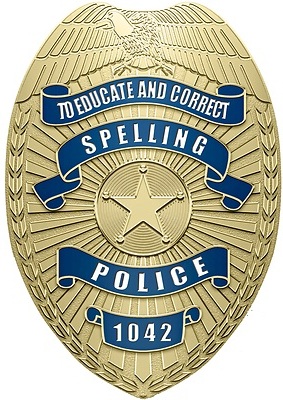
Isn’t this tuff enough already?

Proudly serving the public trust

As a screenwriter, there’s a very long list of things to cover to make sure your script really works.

Story. Characters and their arcs. Theme. Plot. Dialogue. Action.

With awl of that going on, who has thyme to pay attention too such trivial things like weather or knot a word in you’re script is spelled correctly?

See what I mean? Misspelled words are distracting and unprofessional. And these are just homonyms. Getting into stuff like “loose-lose” is part of another issue altogether.

“No problem,” you say. “I’ll just use spellcheck to fix it.”

For the love of Ernest Lehman, don’t. Spellcheck is not a cure-all. It knows spelling, not context. As far as spellcheck is concerned, every word in that sentence above is as it should be.

One or two typos in a 110-page script are understandable, but you don’t want more than that. There are many out there more than willing to pass on your script if the number of misspelled words keeps increasing.

Not sure if your spelling is up to snuff? Ask a fellow writer. Nobody’s going to think any less of you for it. Chances are their editing/proofreading skills are what you need, and they’re probably more than happy to help. Just make sure to offer to help them with their material as well.

Not everybody is a good speller, but it’s something easily fixable. Truth be told, even some of my scripts, despite my vigilance, have contained (gasp!) the occasional typo.

Emphasis on “occasional”.

Ask a Wicked-Smart Script Consultant!

Rebecca Norris copy

The latest in a series of interviews with script readers and consultants who would be worth your while to work with if you want to get your script in shape. Today’s spotlight is on Rebecca Norris of Script Authority. She works with writers, producers, and directors to consult on feature-length screenplays, TV pilots, TV specs, webseries pilots and full series, and career direction and strategy.  

1. Whats the last thing you read/watched that you thought was incredibly well- written?

My current obsession is House of Cards. At first, I didn’t care for the show. I found the device of Francis talking directly to camera a bit odd, the plot lines confusing, and I didn’t like any of the characters! However, a friend encouraged me to keep watching, and I’m so glad I pushed through. The genius of the show is in the slow reveals—they don’t hand you anything up front—you earn carefully-placed insights into the characters over time. I ended up binge-watching all of Season Two and am now deprived of new episodes until January! I should have spaced them out more.

2. Howd you get your start reading scripts?

For my first internship, I worked at a state film office that held an annual screenplay competition. They had an entire room stacked with feature-length screenplays, and it was my job to read and recommend scripts to the higher-ups for the contest. When I moved to L.A., I was able to parlay that experience into reading for a production company and then another screenplay competition, and it snowballed from there. This has included reading for Sundance, QED Entertainment (DISTRICT 9, FURY), Screen Queensland, BlueCat, ScriptXpert, Script Reader Pro, and other contests/services, and I’ve worked in development at Southpaw Entertainment (AUGUST RUSH, THE SPACE BETWEEN US).

3. Is recognizing good writing something you think can be taught or learned?

I think anyone can be taught to do anything; whether or not they have a natural aptitude for it is another matter. The thing is, we are all storytellers. It’s engrained in our psyche. And reading is a personal, subjective experience for each individual. Some stories that bore the pants of me might be endlessly entertaining to someone else, and vice versa. That’s why a film can be rejected from one contest and then go on to win first place at another.

However, the technical aspects of a script can be judged in a fairly uniform way. Is the writing concise yet descriptive, or is it overly wordy? Are there misspellings and grammatical errors? Is the script formatted to industry standards? Is the page count a reasonable length? A writer can’t control whether or not a particular reader will judge their writing as “good”, but they can control the technical aspects of the script to give it the best possible chance of impressing a reader.

4. What are the components of a good script?

A good script has a solid premise, interesting characters, a well-conceived plot, tight narration and dialogue, and is technically up to par as far as typos, sentence structure, formatting, etc. It also must be ENTERTAINING. This is something I believe writers forget about sometimes, especially if they’re writing, say, a historical drama. Audiences don’t care about facts and figures and accuracy nearly to the extent that they want to have an emotional journey—a catharsis. It’s the writer’s job to provide that journey and entertain along the way—that’s why we’re in the Entertainment Industry. I think most readers would agree with me on this—the first question I ask myself after reading a script is, “Am I bored?” If I’m bored, then the script will not get a Consider or Recommend, no matter how true to life or historically accurate it is.

5. What are some of the most common mistakes you see?

By far, the most common mistake is spelling errors. Most scripts I read are chock-full of typos and glaring grammatical errors (including sentences with missing punctuation, missing words, or only parts of words.) It’s incredibly frustrating because this is something completely under the writer’s control. What writers may not realize is that every time I come across a typo, I’m taken out of the story. When a script has multiple typos per page, as some of them do, I’m taken out of the story dozens of times by the time I read the last page, which essentially ruins the experience. As writers, the written word is our only instrument. A pianist wouldn’t perform on an out-of-tune piano, and likewise, a writer should fine-tune his or her instrument and become a master of language. Having a typo-free and correctly formatted script says to the world: “I’m a professional, and I care about the quality of my work.” In my opinion, it’s the best way to control your first impression to a reader.

6. What story tropes are you just tired of seeing?

There has been a trend over the past several years of incredibly brutal, violent, and bloody dramas. (And I’m not talking about horror movies here.) I think it’s a reflection of the dark times we’ve gone through over the past decade and the current political landscape in the world. I’ve also programmed at some film festivals, and some films I screened were sickening to the point where I had to turn them off. I’m not a prude and I enjoy a good action or horror film just as much as the next person, but it’s gone a bit overboard lately. Some of the films had gratuitous violence toward women and children, which I find disheartening and painful to read. Sometimes I long to read a comedy or something lighter that ends on a positive note, and I hope the trends change in the coming years toward lighter (and less barbaric) fare.

7. What are the 3 most important rules every writer should know?

1) Don’ t get disheartened if you aren’t getting recommends or considers on your early scripts. Take the notes, learn from them, and keep writing. Your writing will improve greatly if you just keep at it.

2) It’s okay to struggle with writing. Some writers get disheartened and give up if writing isn’t the glorious, self-expressive, free experience they think it should be. Writing can be difficult and tedious. It’s courageous to be vulnerable and put your heart out on the page, and even more courageous to then send your work to total strangers. The best thing a writer can do is show up every day and write, and when the work is ready, keep sending out those ships. One day, a ship will come back in.

3) You are in total control of your very first impression on the reader. You do so through your mastery of language, spelling, formatting, brief yet descriptive narration, etc. You can’t control whether or not a reader loves your script, but you can control your presentation. Hire a professional coverage service to proofread and get feedback before you send your scripts out—it’s the best way to test the waters and see how your script will be received, since many coverage services employ readers who have worked at contests and production companies.

Even if your script doesn’t get a recommend, the writer themselves can. Scripts and writers are tracked by production companies, and if you as a writer make a bad impression, a company is less likely to be willing to read another one of your scripts. If you made a good impression as a writer but they just passed on that particular script, a company will be much more willing to read future work from you.

8. Have you ever read a script that was an absolute, without-a-doubt “recommend”? If so, could you give the logline?

Since most of my work deals with newer writers, I have not yet personally come across a script that was an absolute Recommend with no doubts in my mind. Most scripts I read have a solid concept but need work to get them industry-ready. I have read many scripts that I would recommend if the writer made adjustments and changes, and those scripts might receive a Consider.

9. How do you feel about screenwriting contests? Worth it or not?

Absolutely worth it. They’re a great way to build up credibility and provide the ‘pitching points’ writers need to become interesting to agents, managers, production companies, etc. You don’t have to win. Even being a quarter-finalist in larger contests or fellowships can make you attractive and garner interest in your work. And if you do win or place in a major contest, it can open doors for you very quickly if you take advantage of the opportunity.

Submitting to contests also provides built-in deadlines. If you know you have regular submission deadlines you have to meet, it puts a fire under you to write every day. It’s not that expensive–you can take $400 and submit to most every major screenwriting competition and a couple of smaller ones. Think about all the things most people waste $400 on in a year (like coffee!). It’s a small investment that can have a big payoff, if even just to get you motivated to write.

10. How can people get in touch with you to find out more about the services you provide?

Contact FreebirdEntertainmentLA@gmail.com for availability and pricing.

11. Readers of this blog are more than familiar with my love/appreciation of pie. Whats your favorite kind?

Pumpkin! I’m thrilled that it’s Fall and we’re just a few weeks away from Halloween, my favorite holiday. I’m going to have to binge on all the pumpkin products over the next couple of months before they’re gone!
Venturing outside your comfort zone

Try it. You might like it.

Everybody likes different things. A universal truth if ever there was one.

Something I like may be the total opposite of something you like, and there’s absolutely nothing wrong with that.

But how willing are we to be open-minded and try something different than what we like?

Do you immediately get all defensive and resist? Do you cautiously dip in a toe and carefully proceed? Or do you embrace the opportunity and jump right in, feet first?

And what in the world does any of this have to do with screenwriting?

Easy. Good scripts can be found in so many different genres. As a constantly-learning writer, you should be reading all kinds of scripts, no matter what the genre.

Sure, you can only read scripts just like what you write, but that narrows your focus and can get a little dull after a while.

Changing things up and reading scripts you normally wouldn’t can only help you be a better writer.

A friend asked me to read his horror spec. Horror is definitely not my thing, but he’d read one of my scripts, and the least I could do was return the favor.

Even though it wasn’t a movie I would go to see, I made a point of reading it from a writer’s point of view. Was the structure sound? Were the characters developed enough? Did the plot make sense? Was it scary? Formatted correctly? Any spelling errors?

Despite my opinion of the horror genre, I enjoyed the read and told him so in my notes, highlighting what I thought worked and pointing out what didn’t. He appreciated my honesty, and thought I made some good points.

Victory for both sides.

Counter to that, I’ve had my share of feedback that could best be interpreted as simply disinterested.

One reader from a high-profile service seemed to skim to around page 30, then called it a day, filling out their notes with generic comments. In as vague terms as possible, they made it pretty clear this wasn’t for them.

It’s extremely difficult to win over the reader who’s ready to stop reading your script before they even begin. Unfortunately, there’s not much you can do about it. The best you can do is put it behind you and move on.

(Which I did. The same script would eventually go on to some moderate contest success and get me a manager.)

Fortunately, there are those who, even though your genre “isn’t their thing”, will read your script and hopefully give you some notes that will help make it better.

You just have to get out there and find them, making sure to offer to return the favor.

Ask a PAGE-winning Script Consultant!

Scott Parisien

The latest in a series of interviews with script readers and consultants who would be worth your while to work with if you want to get your script in shape. Today’s spotlight is on Scott Parisien, a mentor, analyst and writer with Script Reader Pro. He wrote the feature FOXTER & MAX in 2019, and his script INCISION was a Bronze Prize Winner in the 2013 Page International Screenwriting Competition.

1. What’s the last thing you read/watched that you thought was incredibly well-written?

There have been many movies this year I felt were actually quite well written. Sadly, most fell outside of the studio system or did not come to the big screen, and if they did, it was barely a blip on the radar. Movies like The Way Way Back, The Spectacular Now, Out Of The Furnace… these really focused on the characters and their journeys, and were filled with touching moments and emotional beats I really identified with. They had characters that were rounded and dimensional and deeply layered. This is what we don’t really get in the studio system any more. But two films that really hit that nerve in the system were The Fault In Our Stars and If I Stay, which were both adaptations, which explains why the characters were more able to be identified with. For me, it’s all about connecting with the characters on a deeper field. As far as the blockbusters, the only one I felt was well written, due to the intelligence of the script and the overall theme of the story, was Dawn Of The Planet Of The Apes. It had such heart, such an identifiable father/son struggle, and themes that worked on both the human and ape sides of the story. I found it quite powerful because of this, and the effects and action really did accent it rather than overwhelm it for me. I wish more blockbuster studio films managed to achieve the same.

2. How’d you get your start reading scripts?

Many years ago, I received a grade of Recommend on two scripts through what was then Script PIMP (now Script Pipeline). I began a great relationship with the guys who ran it and when they had a spot come open they gave me a chance to show what I could do, as I was working on my own consultant service on the side and had experience with this. I then went on to work quite successfully with them and was a senior story analyst, being there for over 5 years. I’ve been running my own service all along as well, and now work with ScriptReaderPro.

3. Is recognizing good writing something you think can be taught or learned?

I’m not sure it can be taught, or even learned. I believe certain people have an inert skill for identifying good stories and good writing, much like Simon Cowell has a knack for recognizing talent and potential in a singer’s voice. Certain people can see that special spark on the page, within that voice and writer. I don’t think just anybody can be a screenwriter. Not only does it have certain areas of craft that must be mastered and manipulated to a person’s style and form, but there’s also a very special art to it. Some people don’t believe there’s an art to screenwriting, that it’s just a blueprint for a movie, but the great writers truly do put together a masterful piece of art in their screenplays. Not everyone can do it, and that’s why 99% of screenwriters tend to fall short of becoming that professional writer we all strive to become.

4. What are the components of a good script?

This is tough because there are so many things that need to be in a script to make it really stand out and resonate above the piles of not so great stuff. Writers tend to focus so much on their “rules” like format and saving the cat: exact page beats and such. But the greats, they worry about layers and nuance and emotional connection. Things like character development, flaws, obstacles. For me, it’s all about the flow of the story, the pace at which it pulls me through the basic structure all screenplays have. That will really make me sit up and take notice. The best screenplays are the ones you never stop to see what page they’re on, or what act you may be in, because it has seamlessly pulled you deep into that world. And that happens very, very rarely.

5. What are some of the most common mistakes you see?

For me it’s not about spelling or grammar, or whether something should have been in CAPS or not. The biggest mistake I see is screenwriters not doing all they can to suck every last drop out of a scene. They are too soft, or too vague, or talking heads with no real substance. These screenwriters lay down the surface and don’t seem to take the time to really dig in and crack the surface to see what is really happening underneath.

6. What story tropes are you just tired of seeing?

I’m actually sick and tired of the main character’s motivation being a dead wife. So many scripts these days and pitches rely on the protagonist being driven toward his goal by the death of the woman he loved. Of course this creates a strong emotional connection as we’ve all lost a loved one in some way or another, but it’s now so cliché it just comes off flat and not interesting in any way.

7. What are the 3 most important rules every writer should know?

1) Take your time. If you’re writing a spec, you have all the time in the world, as well as only one chance to impress. Too many writers rush and don’t let a script really simmer and breathe before they stamp it complete.

2) Find your voice. Don’t write in every single genre because you have an idea you think is good. Choose your style and your voice. It’s hard to make your mark as a horror writer if you submit and they want more, and all you have is a children’s Christmas movie, a western and an emotional drama.

3) Choose your concepts and stories carefully. It’s hard to get read in this business as it is, but even harder if the idea you have isn’t something that will get people excited. The best way to think of it before you write your story is if you can see a movie poster. If the concept you can pitch will elicit a movie poster in our minds, we can see it as a movie. If it doesn’t, you may want to see what other ideas you plan to put 6-12 months into.

8. Have you ever read a script that was an absolute, without-a-doubt “recommend”? If so, could you give the logline?

I’ve only read one script I wish was my own. It was so good, so layered, so character-rich, and it was a heist movie as well about two bank robbers on their last run who steal a getaway car with a pregnant woman asleep in the back, so it had commercial appeal. But it had a deeper theme about human connection that ran through the entire story. The writer had a very special voice that was undeniable.

9. How do you feel about screenwriting contests? Worth it or not?

It all depends on the contest. Everything is so subjective. I won a midlevel contest and didn’t get a single request. I was a winner in one of the top 3 and the requests flooded in. It all depends on how a writer capitalizes on those wins or placements. Using them to pump up your credibility in a query can help it get noticed.

10. How can people get in touch with you to find out more about the services you provide?

https://www.scriptreaderpro.com/our-script-coverage-services/

11. Readers of this blog are more than familiar with my love/appreciation of pie. What’s your favorite kind?

Saskatoon Berry Pie. These little dark blue berries, like a blueberry but totally different, grow in central Canada and into Montana and North Dakota. These are little gems if you can ever get your taste buds on them, in a crust with a gratuitous pile of whipped cream on top.

Ask a Mega-franchise-experienced* Script Consultant!

Phil Clarke
*Jedi, Hogwarts, & MI-6, if you need points of reference

The latest in a series of interviews with script readers and consultants who would be worth your while to work with if you want to get your script in shape. Today’s spotlight is on Phil Clarke.

Phil Clarke is a UK-based script consultant and screenwriter with over twenty years’ service to cinema. After years working on such features as Sleepy Hollow, Enigma, The Beach and two of the biggest box-office franchises: Star Wars and Harry Potter, he turned to writing – both for the screen and the page. His screenplays have spent time with production companies both in the UK and Hollywood, including a James Bond ‘scriptment’ considered for the twentieth entry in the franchise. As a script consultant for over a decade, his clients have won or placed highly at major script competitions, had their projects optioned, while others have gone on to be produced, the best débuting at Cannes.

1. What’s the last thing you read/watched that you thought was incredibly well written?

The last film I thought was particularly well put together was Palm Springs — a kind of Groundhog Day rom-com featuring Brooklyn 99’s Andy Samberg. That felt very fresh and kept me deeply engaged. I’ve also recently watched the Johnny Worricker trilogy starring Bill Nighy and written by the playwright David Hare – Page Eight, Turks & Caicos, and Salting the Battlefield. These are three espionage dramas in the vein of Le Carre rather than Ian Fleming with superb dialogue (as you’d expect from an award-winning writer for the stage.)

2. How’d you get your start reading scripts?

I started reading screenplays as work following my years working on the sets of movies like Sleepy Hollow, Enigma, Star Wars and Harry Potter. For example, on the latter I was Chris Columbus’ on-set personal assistant.

3. Is recognizing good writing something you think can be taught or learned?

Absolutely. But you do need to be willing to be taught. Many aspiring screenwriters seem too keen to find a shortcut and bypass the learning side.

4. What are the components of a good script?

Tough to answer succinctly in a Q&A like this, but a good script tends to be well structured, have a well-executed and compelling premise along with engaging, relatable protagonists.

5. What are some of the most common mistakes you see?

Generally speaking, I see too many new writers wanting to rush through the process. Consequently, they submit their work too early when several rewrites would have immeasurably improved the project. More specifically, I see poor grammar and spelling, inadequate formatting, poorly defined characters with unclear goals and a lack of conflict in the scenes and in the story as a whole.

6. What story tropes are you just tired of seeing?

Personally, my heart always sinks when I see a script open with a voice-over narration. It’s often a sign that the entire script will be uninspiring and derivative. While it’s a way to convey a lot in a small amount of time, most writers don’t use it in the right way.
 Dream sequences and flashbacks more often than not annoy because of the way they’re usually handled. Cutting back unnecessarily to explain or overload with exposition certainly grates.

7. What are the 3 most important rules every writer should know?

It’s hard to limit it to just three, but I would say:

1) know your story inside out and the reason for your story

2) above all else, make your story entertaining

3) never stop trying to improve your writing. Continue to hone your craft, and never think you’re the finished article.

8. Have you ever read a script that was an absolute, without-a-doubt “recommend”? If so, could you give the logline?

Yes, of course. I would be most disenchanted with my job if I hadn’t. But these stick-on, guaranteed ‘recommend’ reads are rare. As for the loglines, I’m afraid I am unable to give you one.

9. How do you feel about screenwriting contests? Worth it or not?

It depends on the contest. Some are beneficial, others – not so much. Make sure to research which ones offer you the most for your time and money. If they can guarantee your script will be read by those who can help get your script sold then they’re definitely worth it as that’s what all writers are aiming for.

10. How can people get in touch with you to find out more about the services you provide?

People can find me all over the internet. I’m on Twitter (@philmscribe) and Instagram (@philmscribe), Facebook (@philmscribeconsultancy), Stage32.com and LinkedIn. Or they can reach me via my website: www.philmscribe.com

11. Readers of this blog are more than familiar with my love/appreciation of pie. What’s your favorite kind?

I also love my pie. Anything from Key Lime to Raspberry Crumble. I’m also partial to a quality Tarte Tatin.