Knowing your nails and how to use them

Savvy and experienced consumer of literature I’m sure you are, no doubt you’re more than somewhat familiar with the classic piece For Want Of A Nail:

For want of a nail the shoe was lost.
For want of a shoe the horse was lost.
For want of a horse the rider was lost.
For want of a rider the message was lost.
For want of a message the battle was lost.
For want of a battle the kingdom was lost.
And all for the want of a horseshoe nail.

Sometimes we don’t realize how important something is that at first glance might seem completely insignificant.

The same concept could apply to screenwriting and the details of your story. A reader could see something and wonder “I don’t get it. Why is this in here?”

If you do the work and plan accordingly, the answer/reason will soon be obvious. That little detail is there for a reason, probably an important one, and without it, the rest of the story won’t work.

This is important on several levels.

It shows you put a lot of thought into putting the story together.

It shows you understand the concept of effective setups and payoffs.

It shows you respect the intelligence of your reader/audience and don’t feel the need to deliberately draw our attention to this sort of thing.

It always bothers me when a story sets something up and doesn’t pay it off, or has something later on in the story that comes out of nowhere.

Some writers go into it with a solid idea of how everything is set up and know how it’s going to play out, some come up with the bare bones of a foundation and fill in the blanks, and there are even those who sit down with a blank page, start writing, and see how it goes.

I tend to waver between the first two.

Sometimes you might even go back over what you’ve already written and discover an opportune moment to put in a small detail that can further enhance something later on in the story. It’s as if your subconscious was working in conjunction with your creativity and giving you an unexpected helping hand.

Are parts of your story set up that they start with a “nail” and escalate from there? Or does something happen later that could use a stronger setup?

You’d be surprised at seeing the ripple effect one little change can have on the rest of your script. Hopefully for the better.
A verbal solution for a writing problem

Even despite a temporary lapse, output on the sci-fi adventure rewrite was progressing at a decent pace.

I already knew there’d be more work to do once it was done, but something still felt off. A piece of the puzzle was missing, and it felt weird to keep pushing forward. Like building a house with incomplete blueprints.

Although my original intent was to finish the rewrite, I wanted to take care of the missing puzzle piece. This in itself was quite challenging.

Once again, my network of savvy writing colleagues comes to the rescue.

I’ve been doing more one-on-one Zoom calls with writers I’ve only known through social media. It’s a great opportunity to get to know them as people, as well as talk a lot of shop about screenwriting.

Such was the case earlier this week. Another writer and myself were discussing some of our current projects, and the sci-fi adventure came up. Despite my stumbling through the “pitch”, my friend got really into the concept, prompting them to ask a lot of thought-provoking questions about the story and the characters. Some I had an answer for, some I didn’t.

(side note – I used to be embarassed about not having all the answers when it came to my stories, but have since embraced it and am now willing to say “I don’t know” or “no idea” because this usually leads to a discussion where everybody involved helps me come up with an answer.)

This led me to realize that some aspects of the story weren’t as defined as I thought. That, in turn, had a ripple effect on the rest of the story. The same story of which I had just passed the halfway mark with rewriting.

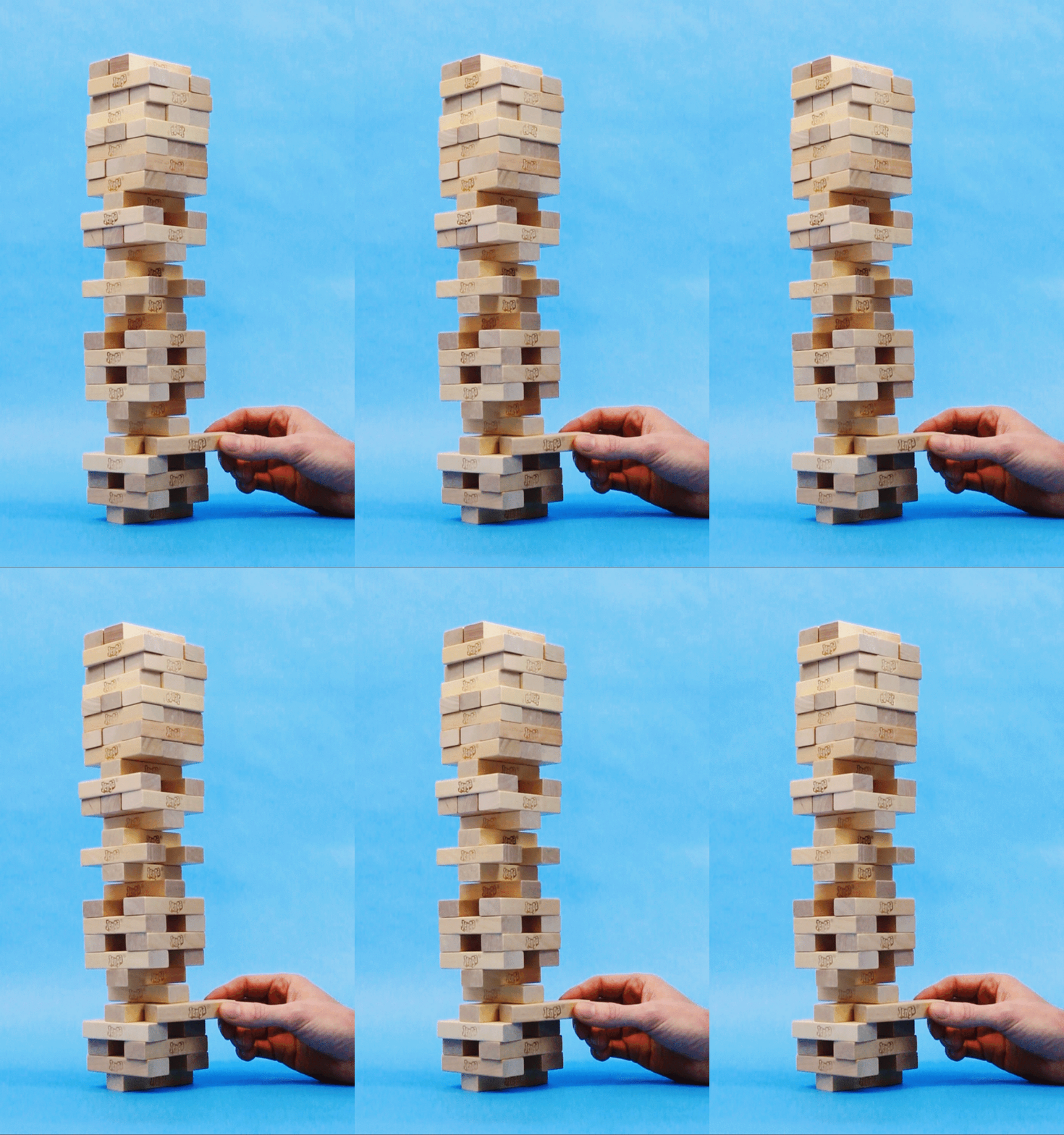
It was like taking a piece out near the bottom of the tower in a game of Jenga. Not that everything came crashing down; more like things got a whole lot more wobbly.

We talked things through some more, and did some impromptu brainstorming, all of which which helped point me in the right direction.

Long story short: the rewrite’s on hold and the reset button’s been pushed. But like I mentioned during the discussion, once those fixes are worked out and implemented, it shouldn’t be too difficult to get back on track.

While I originally hoped to be done with the rewrite around now, or at least mighty close to it, I don’t mind making another trip to the drawing board to take care of this. I’m already looking forward to taking this on and seeing how it goes.

Bonus – the chance to make any other fixes in the 50+ pages I’ve already written.

Yet another reason to be active and interactive within your personal writing community.

The final chapter in the Indiana Jones series opens today. The characters and storytelling have been a huge influence for me and my writing, and I can only hope that my scripts can someday be compared to them.

I also hope the movie’s good.

Enjoying it – while it lasts

Slight shorty today.

The latest draft of the animated fantasy-comedy spec is in the hands of some beta readers.

One has already gotten back to me with some suggestions of minor fixes, but overall very positive comments.

Which is really, really nice.

And they also liked a lot of the jokes, which is definitely nice to hear.

I can’t really explain it, but there’s something about this script that’s giving me a real positive vibe.

It’s been a while since I’ve felt this way about a script this early in the process, so like the title of the post says, I’m riding this wave of positivity as long and as far as it’ll take me.

I’m sure it’ll require at least another pass, maybe two, until it gets to the quality I want it to be, but for now, I really like how it turned out.

Like with each of my scripts, I had fun writing it, and hope the reader has an equally great time reading it. This is something every writer should experience. It really does make a difference.

As the wait for the remaining notes continues, the focus shifts to cranking out pages for the microbudget feature, which is coming along nicely, thanks for asking.

Hope you have an exceptionally productive weekend.

3 months in, and…?

2022 is now 1/4 over. How’s it been for you, productivity- and results-wise?

Are you making the progress you’d hoped you would? Any goals achieved or finish lines crossed?

If so, great!

If not, don’t be so hard on yourself. Sometimes things take longer than we’d like them to.

The important thing is that you’re putting in the effort, and that any progress is good progress.

It can probably said with absolute certainty that lots of writers started the year with the mindset of “I’m going to accomplish X, Y and Z!”. Like with most things, numerous factors play a role, so results will vary.

It’s great to give yourself some long-term goals, but setting up some short-term ones can really help boost your morale. Create goals you know can achieve, like setting aside a specific amount of time per day for writing and writing-related activities, or that you’re going to write X pages a day.

Accomplishing something is all about putting in the work, and that takes time.

Look at it from this way. If you’re not where you thought you might be around now, you still have 9 months to work on getting there.

It’s a marathon, not a sprint.

This applies to more than just writing a script.

Pace yourself. Know what you’re capable of, but don’t be afraid to give those limits a little extra push.

Good luck, and hope you have a wonderfully productive next three months.

Getting your time to work for you

Most of this week for me has been splitting time among a few projects, with notable progress on each. Especially notable was that two of them had felt somewhat stalled, so to have broken through that wall and kept going was quite the endorphin rush.

Since I was feeling rather accomplished about this relatively minor feat, I put out on social media how nice it was to have done so. A number of writing associates offered up congrats and encouragement, as well as one person who asked “How do you find the time to do all this?”

I’ve gotten this question before.

How DO I find the time? How does any writer?

I guess the simple answer is: I make the time, whenever I can.

Some writers are able to have a designated window of when they work. Maybe they wake up a little earlier than they need to and write for an hour or two before they need to get ready for the day job.

Or they have mini writing sprints at the day job; 10 minutes here or there, during the second cup of coffee or lunch, what have you.

Or maybe they wrap up their day with writing before going to bed.

It really depends on what works best for you.

As much as I’d love to have a big block of time each day to be all about the writing, some days that just isn’t possible, so I make do. I have a little downtime during the day job, so I try to squeeze something in when possible.

But I’m also trying to get in better shape, so a certain amount of my day might involve an hour-plus at the gym or going out for a run. This in turn means I’d have less time to write, but if I don’t exercise, I’ll feel lousy mentally and physically, which in turn won’t help me be productive for the writing. If that means a slight extension of how long it takes to finish a project, I’m okay with that.

(One exception – if I’m on a deadline, all bets are off and it’s all about the writing.)

Sometimes it’s not about how much time I have to write, but how much I plan to write in that time. More than once I’ve sat down thinking “I want to write at least three pages today.” If I write three, great. A lot of the time I’ll push myself to do at least a little more, depending on how productive I’m feeling. Anything beyond the original objective is a bonus.

It’s all about setting up your own goals and expectations. Be realistic. What do you think you can accomplish each day with the time you have to work with? You know better than anybody how you operate, so plan accordingly. Write for an hour and see how far you get? Set an achievable goal (the aforementioned three pages) and see how it goes?

It’s easy to feel negative when you see other writers proclaiming things like “Woo-hoo! Another dozen pages done today!”, and all you could manage was two or three.

Don’t. Everybody runs at their own pace. Like I remind myself when I take part in a race:

It’s the distance, not the time.

It’s more important to do this – and finish – on your own terms, rather than pushing yourself too much and running yourself ragged, resulting in collapse and/or burnout. And I’m not just talking about running.

Know what you want to accomplish, and knowing how much time you have to do it, you can plan accordingly.

Repeat as long as necessary until the damned thing’s finished.

Until the next draft, where you go back and find the time to do it all over again.