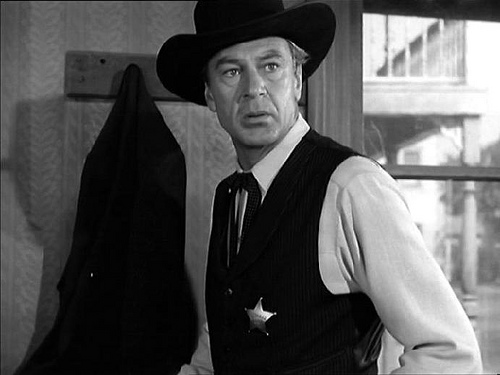
Is your story worth fighting for?

Will Kane knows what it's like to feel like one against everybody else
Follow Will Kane’s example (except without all the shooting and stuff)

The rewrite of my mystery-comedy has been put on hold because I’m teaching myself how to write a mystery, or at least how to be better at writing one. I bought a book and everything.

But I also don’t want to not be writing, so I’ve also decided to return to the low-budget comedy. It’s been a while since I’d read the outline, but it holds up more than I thought. Sure, it needs work and there are some spots where it says something like “SOMETHING FUNNY HAPPENS!,” but overall, I like it (hold onto that statement for just a bit).

Several months ago, I’d had the opportunity to have a brief chat with a writer who specializes in comedy. He asked what I was working on, so I pitched him the idea. He liked the concept, but was quick to poke holes in the story vis-a-vis the logline (which has since been rewritten), and didn’t care for how I had the story play out (as delivered in my thumbnail presentation).

“X should happen instead of Y! Having THIS CHARACTER connect with THAT CHARACTER is all wrong!” Plus some additional words to that effect.

Gosh.

I wasn’t expecting a standing ovation, nor did I expect it to be proclaimed a work of genius, but if this guy didn’t care for what I had, did that mean it was doomed before I even started?

Nope. Quite the contrary.

Several key things I had to remember:

-this was his opinion. One person, which is not a majority.

-his sense of humor and comedy stylings could be totally different from mine.

-it’s a work-in-progress in its very early stages. The end result will most likely be very different from the starting one.

-I think it’s a good story. Always have, always will. I have no intention of abandoning it or making any significant changes so as to gain his approval. I’m not writing this for him.

Every writer spends a lot of time coming up with story ideas, and then developing them as far as they’ll go. Stick to your guns if you believe in your story, but don’t totally block out advice and suggestions. Use what you think works best. Remember – this is YOUR story. If you think it works, then by all means, do what you can to make things happen.

It’s great when you get encouragement, but you’ll also encounter a lot of naysayers (“I don’t get it/like it, so it must be a bad idea.”). It’s all subjective. Everybody likes different things. If you believe wholeheartedly in your story, you have to do your absolute best to get the rest of us to be just as interested in reading it.

Just make sure to tell that story in the most entertaining, original and professional way possible. That’s all.

Let’s get those brains stimulated, people!

You mean movies can be smart AND good?

One of my favorite things to do as a parent is go to the movies with my daughter. It’s a nice feeling knowing I’ve instilled in her the appreciation of the whole moviegoing experience. It also helps that there’s a fantastic two-screen (one of a handful of similar small neighborhood theatres in San Francisco) a few blocks from us.

And as she’s getting older, our choices are growing in number. Strictly kid-based animation has given way to PG-13 fare, so we try to see what we can when possible.

Earlier this summer, we caught JURASSIC WORLD and INSIDE OUT within a week’s time. She really enjoyed the dinosaur flick. I thought it was fun, but felt it relied more on the nostalgia factor rather than smart storytelling (“Remember when we helped Grandpa fix that old car?”). I found the latest offering from Pixar to be pure genius, while she found it to be simply “okay”. I asked why she liked the first movie more than the second.

“I think I like movies where you don’t have to think too much.”

Gasp.

I won’t go so far as to say it was a dagger in my heart, but you can probably understand my being taken somewhat aback.

I could easily chalk it up to that she’s still relatively young and hasn’t latched on to my love of the movies to the extent that I have. Like I said, the list of what she’s seen is somewhat limited. I’ve done what I can, and hopefully can continue to contribute to it.

But as a writer, what’s my biggest takeaway from this?

Obviously I want to write scripts for films that will be embraced by the general public, which means they’d have to be simple enough that anybody could follow along, but also written in a way that the reader/audience doesn’t feel insulted or talked down to.

All this talk about needing to appeal to the lowest common denominator has always bothered me. It makes it sound like there’s no point in trying to write something smart.

I beg to differ.

Getting the reader/audience to really think about the story gets them more involved. You hooked with them with the beginning, kept them intrigued throughout the middle, and now they’re compelled to find out how it all ends. Isn’t that what it all comes down to?

I love it when I read a script where it’s obvious a writer knows what they’re doing when it comes to telling a story. Setups and payoffs. Multi-dimensional characters. Plotlines where I know what the endpoint is, have no idea how we’re going to get there, and am getting a real kick out of taking the journey.

This is the kind of writing we should all strive to create.

It’s easy to write something that doesn’t try to challenge the reader/audience, and the reaction will probably be similar. “Boring.” “Unoriginal.” “Meh.”

Push yourself to write something that offers up something new, or at least a new twist on an old standard. Give us something we haven’t seen before, or totally weren’t expecting. Not just one part. THE WHOLE THING. There’s something exhilarating about venturing into new territory. Take us there.

We’re writers. It’s what we do.

Ask a Decidedly Ingenious Script Consultant!

Ryan Dixon

The final installment in a series of interviews with script readers and consultants who would be worth your while to work with if you want to get your script in shape. Today’s spotlight is on Ryan Dixon.

Ryan Dixon is a writer, producer and the founder of Tartan Valley Ventures,  a Los Angeles-based creative development consulting firm that works with writers, producers and financiers. As a screenwriter, Dixon has written projects for studios including Disney, Amazon, Universal and WWE Films. Dixon has also worked in film/TV creative development at such companies as Paramount, MGM/UA, IMAX,  Good in a Room, The New York Times and Tribune Media.

1. What’s the last thing you read/watched that you thought was incredibly well-written?

EX MACHINA’s screenplay was masterful. It reminded me of a sci-fi version of those great meta-thriller plays of the 1970s, like DEATHTRAP and SLEUTH. P.T. Anderson did an extraordinary job with INHERENT VICE. His adaptation added a layer of depth and Los Angeles historicity that was missing in Pynchon’s fun, but flawed and rather juvenile novel.

2. How’d you get your start reading scripts?

As a movie-obsessed child, I used to buy shooting scripts at the late and belated Suncoast: The Movie Store. In college at Carnegie Mellon’s School of Drama, reading scripts was part of the curriculum. My first job in Hollywood was interning for Tom Cruise’s former company CW Productions, so from that point on, I’ve been reading and covering scripts professionally in one form or another.

3. Is recognizing good writing something you think can be taught or learned?

I think it’s a matter of taste. Of course, one must have a certain degree of training and skill in order to fully recognize and appreciate any craft. A classically trained musician or a fine arts scholar is better able to pinpoint the minutiae of Beethoven or Picasso. At the same time, taste is a separate sort of knowledge and instinct. A layman can find beauty if they’re a person who can digest and appreciates art for art’s sake. Nickelback’s members are studied musicians, Lisa Frank is a trained artist, and both are wildly successful in their fields. Study can hone and illuminate the elements of a craft but that can only take you so far.

4. What are the components of a good script?

The basic elements (structure, character, theme) must be superiorly executed. Next, there should be something special in the piece. Even if it’s basic genre fare, the script should include elements that make the reader sit up and say, “Wow! I haven’t seen that before.”

5. What are some of the most common mistakes you see?

From young writers it’s always basic mistakes: mechanics, too much dialogue and/or scene direction. Sadly, these mistakes are also the easiest to avoid. What they reveal is that that writer hasn’t bothered to learn the fundamentals. This is fascinating because I can’t think of any other vocation where a similar incident would occur. If one were serious about learning to cook, a cookbook would be the first purchase. If you wanted to scuba dive, you’d take lessons before jumping head first into the ocean. While all the fundamentals are usually outstanding in the work of veteran writers, there is often a lack of courage and conviction in terms of content, as if they’re afraid to try something different for fear of being tossed out of another development meeting. If you are going to make the huge time commitment needed to write a spec script, swing for the fences. The creative dilution process can come later, once the script’s been optioned.

6. What story tropes are you just tired of seeing?

One is when characters (particularly female characters) are described solely on their looks. It tells you nothing about who a character is and often times a bit too much about the writer’s psyche.

Another is the oversaturation of beautiful people playing everyday characters. Even if you look at a movie from as recently as the 90’s, a man could be a regular guy with full chest and back hair and a woman could do a nude scene with a soft, everyday body. In contemporary films, everyone is sculpted, plucked and dyed to perfection. In this renewed Golden Age of Television, character actors are able to once again shine and it really strengthens the storylines and characters (Breaking Bad and Mad Men are obvious examples).

My wife is a screenwriter as well (and very opinionated to boot), so for better or worse, this is a constant discussion and analysis in our household. A big one for her is that men can have high-risk jobs and a strong drive, but if it’s a woman is in the same position, she needs a tragedy or a backstory. GRAVITY most recently did this—George Clooney is an astronaut because of his skill but Sandra Bullock is an astronaut because her kid died.

7. What are the 3 most important rules every writer should know?

-The believability of characters is often more dependent upon the execution of other elements in the script (e.g., plot, theme, dialogue) than anything else. A trap writers (myself included) often fall into is to confuse “believable” with “realistic.” Thus the ever-present tendency to write characters who are mill workers, teachers, office drones, etc. While there’s nothing wrong with this if that’s what your script dictates, it’s also important to remember that some of the most believable characters in cinematic history were also some of the most unrealistic: E.T., Yoda, Kermit the Frog, Mickey Mouse, Bugs Bunny, etc. They’re believable not because you could see them walking down the street, but because the creators of those characters did an amazing job of creating the world in which they existed.

-Master the art of writing a “skimmable” script. We all dream of studio execs, producers, agents, etc sitting down in a quiet space and focusing fully on our script, but the truth is that they are often read in a rush during limited time frames. This is why it’s important to craft your script in a way that a decision maker can easily understand it if they are forced to skim it. You want your script to FEEL like a movie. That means, a reader should be able to zip through it in about 90 minutes. If a first time reader can’t do that, they won’t be able to envision you script as a movie no matter its other strengths.

-This is stolen but golden: “Amateurs sit and wait for inspiration, the rest of us just get up and go to work.” (Stephen King, a favorite author, from ON WRITING). Lightning doesn’t just strike and no one will just hand you anything in Hollywood. Nothing comes easy in writing and you have to work yourself to the bone to get success. I track my time using my iPhone timer and a writer’s log. I make sure to always get in 6 to 8 hours of writing a day. If I’m blocked, I take a brainstorming walk. I’m not perfect. I can procrastinate with the best of them and it took a few years to build to that point. But like any exercise, it works if you keep working at it and pushing yourself.

8. Have you ever read a script that was an absolute, without-a-doubt “recommend”? If so, could you give the logline?

Elizabethtown by Cameron Crowe. I read the script while it was in development and was never so moved or in awe of a piece of screenwriting. In the end however, the final lesson I gained from the experience was that great scripts don’t always make great movies. For whatever reason, the alchemy needed to successfully transform material from page to screen failed. This specific incident was doubly disappointing since the writer directed the piece himself and has shown time and again that he’s an immensely talented director.

9. How do you feel about screenwriting contests? Worth it or not?

There are only a handful of contests that will have an impact on your career if you are a top finisher. I’m hesitant to state that all the others aren’t worth it if only because placing high can be a great confidence boost to any young writer (if they have the money to spend). But if you are cash-strapped, go for the big guns and ignore the others.

10. How can people get in touch with you to find out more about the services you provide?

Go to my website for Tartan Valley Creative Ventures.

11. Readers of this blog are more than familiar with my love/appreciation of pie. What’s your favorite kind?

Boston Cream. As a writer and eater, I like synergy and mixing genres. There’s no pie that does this better.

Ask a Getting-Down-to-Brass-Tacks Script Consultant!

OLYMPUS DIGITAL CAMERA

The latest in a series of interviews with script readers and consultants who would be worth your while to work with if you want to get your script in shape. Today’s spotlight is on writer-consultant-contest reader Jim Sarantinos.

Jim Sarantinos is the Editor-in-Chief of Creative Screenwriting Magazine, and writer of Gideon’s Way, a highly popular and acclaimed screenwriting blog which he started in 2009. He’s guest blogged for MovieBytes and other sites, and placed in various high-profile screenwriting contests including Scriptapalooza, Fade In, and most recently, Happy Writers with a TV sitcom pilot.

Jim has also read for various screenwriting contests and is currently developing several film and TV projects.

1. What’s the last thing you read/watched that you thought was incredibly well-written?

I’d have to say Nightcrawler, and I’m still mad it wasn’t recognized at the Oscars. TV-wise, I just watched my first episode of The Americans. Riveting stuff.

2. How’d you get your start reading scripts?

Going through film school, it was considered vital to our training; perhaps even more important than watching films themselves. I decided to consult because I was getting too many random scripts flooding my inbox demanding/requesting I read them and provide feedback within 24 hours.

3. Is recognizing good writing something you think can be taught or learned?

You can teach the basic building blocks of screenwriting, but recognizing good writing is learned from experience, intuition and taste.

4. What are the components of a good script?

Style and character. I love deeply flawed characters that straddle good and evil simultaneously. There’s so much scope for them to grow and interesting places to take them. I also love worlds I’m not familiar with; not necessarily fantasy or supernatural. A wonderful story can be set in an abattoir, a funeral home or a country club.

5. What are some of the most common mistakes you see?

Lack of story focus. Know exactly what you want to say before you start writing. Sure there is some discovery during writing, but know your theme and central message early on.

6. What story tropes are you just tired of seeing?

Car chases, explosions, shootouts. Give me a cop disarming a criminal solely with his/her mind and wit any day. You can only paper over the story cracks with CGI for so long.

7. What are the 3 most important rules every writer should know?

-Know yourself.

-Know your story.

-Know the audience.

8. Have you ever read a script that was an absolute, without-a-doubt “recommend”? If so, could you give the logline?

I can’t give you a logline, but I recently read a contained thriller about a heist gone wrong. Two-thirds of the movie was set in an office where the hostages and criminals were barricaded in. It was so vivid and real, which made it easy to visualize it.

9. How do you feel about screenwriting contests? Worth it or not?

They’re a double edged sword for me. I’ve heard of success stories which have launched careers and also stories of writers winning major contests and not getting anywhere. There are also too many cash cow contests with dubious readers. If you enter a contest, go big or go home. Preferably enter one that gives notes, so you know the reader has actually read your script. Practice due diligence.

10. How can people get in touch with you to find out more about the services you provide?

My blog Gideon’s Way is at www.gideonsway.wordpress.com and Script Firm Consultancy is at www.scriptfirm.wordpress.com

11. Readers of this blog are more than familiar with my love/appreciation of pie.

What’s your favorite kind? Humble. Preferably organic, sugar and gluten free.

Ask a Master of the Ultimate Editing Tool Script Consultant!

Erin Whittemore

The latest in a series of interviews with script readers and consultants who would be worth your while to work with if you want to get your script in shape. Today’s spotlight is on agency reader-turned-consultant Erin Whittemore of Red Pen Script Consulting.

“I have a B.A. in film and screenwriting from the University of Michigan, and am also the proud recipient of the Hopwood Award in screenwriting that boasts such alumni as Arthur Miller and Lawrence Kasdan. After graduating, I relocated to Los Angeles, where I worked for United Talent Agency as a freelance script reader. Two of my own scripts have been produced as short films and premiered at film festivals.”

1. What was the last thing that you read/watched that you thought was incredibly well‐written?

I loved Nightcrawler and The Lego Movie as scripts. Nightcrawler’s story was really lean and mean and practically seamless, and The Lego Movie was not only a great narrative in itself, but was also incredibly cheeky and self‐aware at the same time. In terms of TV, Marvel’s Agent Carter put other network shows to shame. In my humble opinion, of course.

2. How did you get started reading scripts?

After spending two arduous years as a pre‐med undergraduate, I finally became so miserable that I switched to film and never looked back. I learned to do coverage through screenwriting courses, and was lucky enough that UTA was hiring part-timers after I graduated. Full disclosure: I did know somebody in the story department, but even then I almost didn’t get the job due to the amount of competition for the position. It all comes down to your “test coverage.” (When an agency gives you a sample script to cover.) If you’re aiming for reading professionally, make sure you have your own sample coverage ready to go as well, preferably showcasing two different genres.

Eventually, though, I needed a better‐paying and more stable job, but I wanted to continue reading scripts as well. Having been a part of “the system” I knew it could take up to three months for writers to get any feedback on their submissions, which is kind of agonizing, especially if the writer ends up getting rejected. I figured, why not give writers a chance to see what a professional script reader would say about their material before sending it out to agencies and production companies? Thus, Red Pen was born!

3. Is recognizing good writing something you think can be taught or learned?

I believe if you’re willing to be taught, you can learn. You have to watch a lot of movies and read a lot of scripts, and you have to learn to think critically about what you ingest. It’s not enough to say “I like this” or “I don’t like this,” you have to think about why. If it doesn’t come naturally to you, you have to ask questions like “why does this work” or “why doesn’t this work?” and “how could I make it work?” Some people naturally think this way, others have to train themselves to make it a habit.

4. What are the components of a good script?

A good script generally has an intriguing premise, strong characters, and an original and compelling execution. As a script reader, I look at character, story, theme, dialogue, visuals, and tone to determine what areas need work. In general, a great script knows exactly what it is and what it’s trying to achieve

5. What are some of the most common mistakes you see?

-Unlikable, uninteresting characters that do uninteresting things. This doesn’t mean your protagonist can’t be an unlikable character, but they must be at least be interesting and do interesting things. (See There Will Be Blood, Nightcrawler.)

-Exposition in dialogue. The golden rule of screenwriting is “SHOW, DON’T TELL.” A little exposition is usually necessary, but too often I see writers trying to cram entire backstories or plot elaborations into a talking scene. Firstly, we only need to know what’s relevant at the time, part of the fun of watching a story unfold is piecing things together. Secondly, remember, it’s a movie. It’s much more dramatic and emotionally immediate to watch a sequence about something important than to hear a character talk about it.

-Inconsistent tone. Is your script Silence of the Lambs or Fargo? Guardians of the Galaxy or Interstellar? 12 Years A Slave or Django Unchained? When a script yo‐yo’s back and forth between tones, or spends the first half of the movie a comedy only to turn serious drama it can be very confusing for the audience and takes us out of the story. Know what tone you want your script to have and stick with it.

-No structure. A story is more than just a series of events, it’s a series of events that influence each other. If you’ve ever had a friend who is terrible at telling stories, they most likely sound something like this: “So Jack and Jill fall down this hill. No, wait, sorry, first they go up this hill. Then Jack falls down. And then Jill falls down. And then they get married.” As opposed to someone who might say, “Jack and Jill grew up together as next door neighbors and they hated each other. They were mean and played pranks on one another until Jill left for school. Jill married an orthodontist, but got divorced soon afterward because life became too predictable for her. Jack had a string of girlfriends but nothing ever seemed to stick, especially since none of them seemed to appreciate his sense of humor. Having both moved back to their hometown at a low ebb in life, one day Jack spotted Jill on top of a hill while walking his dog in the park. Jack smacked Jill in the back of the head with a snowball. Jill yelped, slipped, and tumbled headfirst down the hill. Alarmed, Jack rushed to her aid only to slip and fall, himself. The two ended up in adjacent hospital beds and wouldn’t speak to each other, until they both started laughing. Soon after, they fell in love, and have been married for 35 years.” In other words, remember that each beat of your story should make sense and be relevant in the larger context.

-It’s a movie not a book. Give us just enough flavor text so we get the atmosphere and the characters, but don’t go overboard. I should be able to read your script in the same amount of time it would take to watch the movie, if not less. Don’t bog the reader down in unnecessary description. That doesn’t mean what you write can’t be poetic and evocative, but just remember to keep it lean and mean. If you’re lucky, the type of person reading your material will give it their full attention, but this is not often the case.

6. What story tropes are you just tired of seeing?

Okay, first a disclaimer: most stories are tropes in one way or another. There’s an adage in Hollywood that goes “give me the same thing, only different!” What that basically boils down to is, “give me something I can latch onto, but surprise me!” It’s okay if you have an “everyman protagonist” (The Lego Movie) or if your story is about a rag‐tag bunch of people in space (Guardians of the Galaxy, or alternatively, Star Wars) – what really matters is the execution, or what you do with those characters and set‐ups. That’s where the originality comes in. That being said, here are a few that leap to mind:

-Women with no agency! Or alternatively, women who are portrayed with agency only to have it stripped from them at important points in the story by male counterparts.

– Actually, on that note: stereotyping certain genders, races, or sexual orientations into negative tropes like “the magical ethnic minority” or “token black person” or “exceptionally shallow and flamboyant gay best friend” at all. For a comprehensive list, Google “gender/racial/ethic/gay/transgender/bisexual tropes in media.”

-“You were really working for the bad guys all along.”

-Gritty for the sake of gritty, not because it actually works or makes sense.

-Teen love triangles.

-The ex (Marine, Army, Navy, etc.) whose family or significant other is kidnapped or killed, and must rescue them/seek vengeance. (Sorry, but I’ve read this script a hundred times)

-Scripts that are mostly music‐video segments strung together without much story.

-Manic Pixie Dream Girls

-Inexplicably bloodthirsty military males

-The scientist who knows everything. Ever.

-The brooding, emotionally unavailable romantic interest with no reason to be brooding or emotionally unavailable.

-The hacker who can hack into anything. Ever. Also, it’s probably a guy who lives in his parents’ basement.

-The magical cure‐all that can bring everybody back to life if they die, so there are no consequences or stakes!

-The love interest because there needs to be a love interest.

-The unnecessary cliffhanger, because it’s an unnecessary trilogy!

7. What are the 3 most important rules every writer should know? 

-Write.

-Rewrite. One of the most common things I hear is “I hate rewriting my material.” Nobody likes taking a chainsaw to their baby, but more often than not it’s a vital part of the creative process. Let’s face it, we’d all like to believe we’re capable of writing a perfect first draft, but in reality turning out something great takes a lot of work and usually a good number of drafts. As a script reader, I see that squeamishness about rewriting get in the way of some good scripts, and that’s a real shame when they could be great scripts. Just “polishing” your material is sort of like watering around a sick plant and expecting it to improve.

-For screenwriters: make every scene worth watching. Almost every scene should a) have some sort of conflict, be it internal or external, b) move the story forward, and c) tell us more about the characters involved.

8. Have you ever read a script that was an absolute, without‐a‐doubt, “recommend?” If so, could you give the logline?

I have actually read several, but most of them were under an NDA, so unfortunately I can’t share any loglines. Sorry.

9. How do you feel about screenwriting contests? Worth it or not?

The Nicholl is definitely worth submitting to, as there is some fairly significant exposure in the industry the farther you make it into the competition. I would also recommend submitting a polished script to the Black List.

10. How can people get in touch with you to find out more about the services you provide?

You can get more information at www.redpenscriptconsulting.com or send me an email at redpenscriptconsulting@gmail.com. I also have LinkedIn, Facebook, and Twitter accounts. If you’re just looking to get your script proofed, though, I would check out my friend’s fantastic service at www.scriptproofed.com

11. Readers of this blog are more than familiar with my love/appreciation of pie. What’s your favorite kind?

Strawberry‐rhubarb is always an instant win with me, but sometimes I like a good old-fashioned apple topped with vanilla ice cream. Am I allowed to have two favorites?