I see what you did there, Mr. Kasdan

Marion Ravenwood
A handful of lines + a solid right hook = insight into 2 key characters

Of all the notes I’ve received about my western, the ones that really stood out the most were about developing the characters a little more – especially the titular protagonist.

I’ve also been spending some time reading, watching and analyzing the scripts and films that influenced it. Namely, RAIDERS OF THE LOST ARK (along with its sequels) and a few others involving female leads who kick ass.

It’s a great opportunity to explore what makes a character tick. A lot’s been written about the “exposition without being blatantly expository” scene in RAIDERS with Indy and the government men, but I’ve been paying more attention to other scenes; the ones that offer up a bit more about what kind of person Dr Jones is as seen through his interactions with other characters.

-Indy discussing with Marcus the implications of finding the Ark.

-The reunion with Marion (see photo above)

-The encounter with Belloq in the cafe in Cairo.

All of these (and a few more) present an aspect of Indy’s character WHILE ALSO advancing the plot. It takes a lot of effort to do that and do it well.

I’ve also been working my way through the infamous story conference transcript, where Spielberg, Lucas, and Kasdan work out the story based on Lucas’ idea of a “swashbuckling archaeologist”. While you can easily find the memo itself, check out this phenomenal post that also analyzes some key points of what’s being discussed.

A lot of this is what I’ve been focusing on during this rewrite. More than a few of my notes highlight certain scenes and say something like “This would be a great place to show us more about her.” So that’s part of what I’ve been trying to do.

I originally thought it would be really tough to implement those kinds of changes, but using RAIDERS et al as guidelines and knowing my objectives for each scene, it actually hasn’t been as challenging. Sometimes all it requires is a few extra lines of dialogue or a modified action line. It’s not always easy, but it definitely feels a little less daunting. Also helping – working on one scene at a time.

In the meantime, progress on the rewrite/polish continues at a healthy pace and I really like how this new draft is shaping up. I suspect the end result will be a little more than just slightly different from previous ones, and hopefully the changes will really take the script to the next level.

One last ride

cowboys
Saddle up

Last week, work on the comedy outline wrapped up a bit earlier than expected, so while I wait for the notes on that, I’ve decided to venture back into some territory I’d considered over and done with.

My western.

Although it’s done alright in some contests (and I suppose top 15 percent in the Nicholl isn’t too shabby), I really think it can be better. Plus, more than a few opinions and comments from totally non-biased outside parties confirm this.

As one set of notes so succinctly put it, “Don’t get me wrong. The story’s a lot of fun and the structure is solid. It’s the characters that could use more development. Nothing too drastic, but just enough to flesh them out a little more.”

Makes sense to me.

On top of that, a recent conversation with another writer, who is starting on their new western script, included mention of how I should read the script for UNFORGIVEN – even though that and my script are worlds apart.

I downloaded it and started reading it. Just a few pages in, and it absolutely confirms I need to step up my game. There’s no reason I shouldn’t strive to present that kind of quality, even in a script that would most likely be labeled a “popcorn-tentpole” kind of story.

Luckily for me, I’ve always enjoyed working on this story and am actually kind of psyched about jumping back into it. I thought it was pretty good before, and now hope to make it even better.

Safe to say this should be pretty interesting.

Change is inevitable. Embrace it.

edited page
All that red is a really good thing

A few more sets of script notes have come in. Comments in general are favorable (Thanks, everybody!), along with lots of suggestions about potential fixes. Nothing too drastic, but just enough to slightly alter things and still achieve the same results. Nevertheless, it’ll require a fair amount of rewriting.

Which is totally fine by me.

As much as I like what I’ve written, as do a lot of my readers, both sides know it can always be improved – especially my side. As the writer, it’s not as easy for me to recognize what those improvements could be and where they should go, which is why I ask for feedback. The readers start with only what’s on the page and use their knowledge and experience to deduce what works and what doesn’t, and then pass it all back to me for analysis and selective implementation.

A less experienced writer might be hesitant or even reluctant to do anything drastic that could change anything about their script.

Me, not so much. I know what the story is, and if somebody points out something that doesn’t work or suggests a different way to present it, I’m not going to say no. In fact, I’d probably be grateful for it. I might not always agree with what somebody says or suggests, but I still appreciate it and can totally see why they said it. Sometimes it might even inspire a totally new approach. Whatever works.

Used to be I would dread having to rewrite, but due to an effort of trying to write on as regular a basis as I can, which also involves rewriting, I’ve gotten to the point where I now actually look forward to it. (Helpful tip – the more you write, the easier it gets – albeit to a certain degree. Overall, it’s still tough.)

Will later drafts of my scripts be exactly the same as the first? Of course not. That’s the whole point of rewriting: to make it better than it was before. And that requires making whatever changes are necessary.

I recently got to sit in on a friend’s script review group where a new writer received some pretty brutal notes about their script (which I believe was also the first draft). If they wanted it to be better, they had a lot of work to do. They had this somewhat annoyed look and said “Guess that means I’ll have to rewrite most of the script.”

Well, yeah. This is no “one-and-done” kind of operation.

If you think the first or second draft of your script is perfect as is and doesn’t need any more work, then good for you, but I sincerely hope you never, ever show it to a writer with more experience because you will be severely disappointed with what they have to say.

As for me, I’ll be keeping busy with the usual hacking, slashing, and overall rehashing of my scripts. And enjoying every second of it.

-If you’re a fan of sci-fi adventure, then please consider contributing to writer/producer Marc Zicree’s crowdfunding project Space Command: Redemption. Among the cast of sci-fi luminaries are Doug Jones (HELLBOY), Robert Picardo (STAR TREK: VOYAGER), Bruce Boxleitner (TRON, BABYLON 5) and Bill Mumy (LOST IN SPACE), Space Command: Redemption is “a bold, new sci-fi adventure with a retro feel and an optimistic view of the future.” Donate if you can!

A small matter of interpretation

princess bride
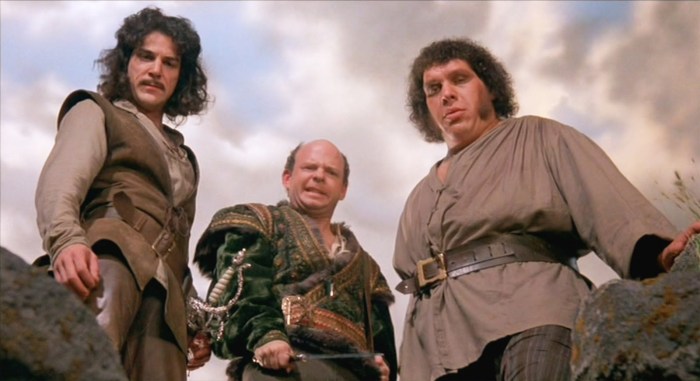
“You keep using that word. I do not think it means what you think it means.”

Amidst all the hubbub currently surrounding my ongoing rewriting efforts, I’ve been extremely fortunate to have received some high-quality feedback on each of them.

(Incidentally, concurrently working on three scripts may be a good exercise in productivity, but it sure is an exhausting one.)

Among this trio of projects is a round of notes on the pulp sci-fi.

Some great stuff being provided by my legion of savvy readers, which includes a comment made by more than one person.

But first, a little background…

As I mentioned, I refer to this script as “pulp sci-fi”. To me, it’s reminiscent of old-timey adventure (Flash Gordon, Doc Savage, etc), which is the kind of story I enjoy reading. It’s also the filter through which I wrote it, and had a great time doing.

What’s been extremely interesting is how people interpret that phrase.

A few readers tended to share my same opinion/viewpoint, and felt the story and script reflected that. Others thought calling it a “pulp” story indicated it would be somewhat darker and grittier (which it really isn’t). And there’ve also been some who weren’t sure if what’s on the page was supposed to be taken at face value or if I was intentionally satirizing the genre.

Quite a wide variety of opinions and reactions, all of which are perfectly valid. But the responsibility falls squarely on my shoulders to provide the story with the tone I find the most applicable.

Don’t underestimate the importance of tone. This may not be the best explanation, but I see it as the story’s attitude; how it presents itself. The writing should reflect not only the components of the genre, but also the emotions the story seeks/needs to invoke in the reader.

So while I offered up what I considered to be a fun romp of a tale through the fantastic, maybe with tongue slightly pressed against cheek, that’s not what how others saw it.

Admittedly, I probably could have cleared up a lot of the confusion at the outset by adding something like “It’s pulpy sci-fi in the vein of MEN IN BLACK, HELLBOY, and THE ADVENTURES OF BUCKAROO BANZAI,” as opposed to leaving it open to interpretation. For all I know, someone saw “pulp sci-fi” and thought, “Oh, like BLADE RUNNER.” Which it most definitely is not.

Laying down that kind of foundation lets the reader know what to expect before they start, but then it’s up to the writer to consistently maintain that tone for the entirety of the script.

Keep your ego out of it

vintage lady writer
As much as she loved that scene, she eventually accepted the fact it would have to go.

I’ve received notes on three separate scripts in the past week or so, and each set is of  very high quality. Each does a very thorough and insightful job of spotlighting What Needs Work for each script.

Daunting and somewhat overwhelming at first, I’ve begun the slow and somewhat laborious process of analyzing and breaking down all the comments and suggestions. I won’t use everything, but there is definitely a lot of good material to work with.

I provided a total stranger with material, and they’re offering up their honest opinions about it. At first glance, some of the comments might be interpreted as negative, but they’re really not. This is what they saw/thought while reading my script.

No axes to grind. No vendettas. No hidden agendas. Just pure, honest opinions. I take what they said, figure out which parts I consider the most helpful, and proceed from there. Ten times out of ten, the result is a better script.

I was told once that getting critically constructive notes and being willing to accept them were signs of a quality writer. Honestly, that was a little surprising.

As much I’d like to think my stuff is great, the reality of the situation is that it’s more along the lines of “it’s okay/pretty solid, but could still use some work”, which is fine. That’s what rewrites are for. From my experience, the final draft is always different from the first. I wouldn’t have been able to produce that final draft without all those helpful notes.

Many times I’ll see a writer ask for feedback on their script, which they get, but might not be the high words of praise they were expecting. Are they ever? Then they respond with something along the lines of “You just don’t get my genius!”, and promptly reject any and all notes. The end result: a lousy script that’s not much better.

Helpful tip: don’t do that.

The whole reason you want notes is to find out how to make your script better. Hard as it is to believe, you can’t make it better if you’re not willing to accept criticism. You can be super-proud of the script you have, but don’t fool yourself into thinking it’s perfect just the way it is now.

Chances are it’s not.

What’s more important to you: having what you think is a good script, or having somebody give you tips that would actually help make it better?

Would we love to see our scripts play out onscreen, just the way we wrote them? Of course. But what you see is up there is usually a lot different from what how it originally read on the page. Happens all the time. Getting upset about it and decrying the sacrilege committed by altering even one letter or syllable from your precious text is definitely the wrong way to go.

In the next couple of days, I’ll be having separate in-depth discussions about two of my scripts with some of the people who gave me notes on them. My emotional state could probably be summed up with “excitedly nervous”. It’s a combination of looking forward to and feeling a bit anxious about hearing what they have to say.

But in the end, it’s not about the writer. It’s about the script and doing what’s necessary to make it better.