The silver lining of a bad movie

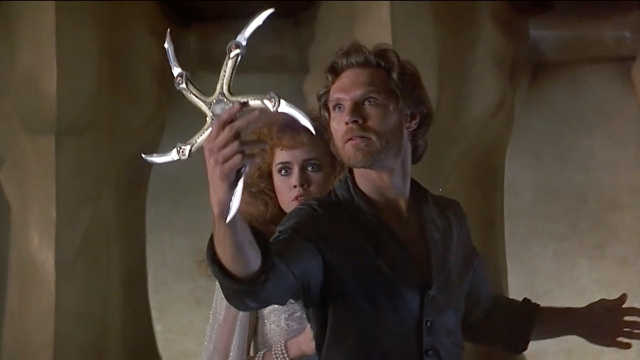
Krull
A definitive shining example (AND a prime candidate for a remake)

Since the screenwriter’s education is ongoing, there’s always something for you to work with or study to get a better grasp and understanding of what constitutes good writing, which can then be applied to your own.

Read scripts. Attend or take part in a table read. Watch movies.

While there are countless examples of exemplary writing and filmmaking to see it done properly and effectively, there are even more examples of crappy writing and lousy filmmaking to see it done poorly and ineffectively.

Nobody starts out with the intention of making a bad movie. What starts out as a great script can easily be messed up along the way to the point that there’s no salvaging it. It happens.

Is watching one waste of time? Not necessarily.

As enjoyable, informative and educational as the good stuff is, the bad stuff is actually just as good, possibly even more so. Because from these cinematic travesties you can learn what not to do with your own scripts. Lessons abound with all the glorious misfires regarding story, characters, and dialogue.

Regrettably, bad acting is a category all by itself and there’s nothing that can be done about it. Do what you can to ignore it (which can border on the impossible, depending on the quality of badness) and focus on the non-tangibles.

It’s especially helpful to work with something from the same genre as your script. See how they did it, then compare it to your own. Can you see why theirs didn’t work? Is it riddled with plotholes you could drive a truck through? Is the dialogue pure on-the-nose? Do the characters come across as unrealistic caricatures?

Look at it as a whole. Does it respect the reader/audience’s intelligence? Is the structure solid? Do you care about what happens to these characters over the course of the story?

Now bring your script into the equation – and be objective! How much of a similarity or difference is there between that story and yours? Did that other material open your eyes to some previously unforeseen flaws and potential problems within your script, so much that it made you realize “this needs work”?

Once you identify these problems, your writer’s mind goes to work, figuring out how to make sure your script doesn’t repeat the mistakes you just read or watched.

It may not be easy to endure having to watch a bad movie just for the educational experience, so just keep reminding yourself “It’s to help me become a better writer”.

Good luck!

Question time! What’s your favorite bad movie? Feel free to list it in the comments.

Shakin’ things up so much it registers on the Richter Scale

richter scale
Brace yourself

I recently took part in a group conversation with some other writers, and naturally, the topic came around to “So what else are you working on?” I always enjoy this sort of thing. So many great ideas out there.

When it was my turn, I mentioned some of what’s been occupying my time, which included the Christmas-themed mystery-comedy.

“A Christmas mystery-comedy? What’s that about?”

I launched into my 30-second elevator pitch. “LA Confidential with an all-elf cast.” The seedy underbelly of the world of Santa’s workshop. Guns. Sassy dames. Tough-talking gangsters. Intrigue. Double-crossings. The whole gin-soaked ball of wax.

While most thought it sounded like a lot of fun, one person looked absolutely horrified.

“Oh no!” they exclaimed. “My kids and I love Christmas. It’s supposed to be sweet and wonderful! I can’t believe you’d want to write something like that.” (All that was missing was them sprawled on a fainting couch, claiming to have the vapors while frantically fanning themselves.)

How could I not want to write this? Sweet and wonderful doesn’t make for good storytelling. I love this kind of story, and think it would make a great script.

This person makes it sound like trying something new is a bad idea because it messes with the comfort of the familiar. Yet one of the most common tenets is “Familiar, but different.” A story you’ve seen before, but told in an entirely new way. It’s what we should all work towards.

Everybody’s looking for something truly original and unique. Why in the world would you want to write something that doesn’t offer up anything new?

Every script you write is a golden opportunity to push your creativity to the limit so you really catch ’em off-guard. You know the story you want to tell, but it’s on you to truly surprise your reader/audience. Take things in an entirely different direction. They may think they know what’s coming, but you know better and look forward to how they’re going to react.

No matter what genre your story falls into, there will be certain expectations that come with it. The challenge of every writer is to not just meet those expectations, but toss them out the window and offer up a totally new and unexpected way of telling that story. Some people may not like it, but it’s most likely they’re in the minority, and therefore not your target audience.

Think about it. What kind of script are you more likely to take notice of and remember? One that goes for new and original, or one that plays it safe with the tried, true and predictable?

I know which one I’d pick, and will be waiting over by the window for your answer.

The good bad of your antagonist

mitchum
Few better examples than this guy

My original goal for February was to complete the second draft of the low-budget comedy. But as always, things didn’t go as planned.

I’d finished the initial edit, but then got hit with a nasty cold that put me out of commission for about a week, followed by all the activity involved with my daughter’s Bat Mitzvah (where she did a fantastic job), so writing-wise, things came to a screeching halt.

But we’re in a new month, so lots of new opportunities abound. Here’s hoping I can work this script into shape by the 31st.

I’d gotten some very helpful notes on it, the most notable of which was “Your antagonist is too nice. They need to be more at odds with the other characters.”

And they were right. Looking at it with fresh eyes, it’s easy to see how that observation rings true. During that read-through edit, I found at least three places where the character’s badness could definitely be ramped up, and expect more will be found over the course of this rewrite.

Sometimes I’ll even surprise myself by having the antagonist do something unexpected (in terms of behavior, not the story), especially if I personally find it very off-putting. But if it works within the context of the story AND further builds on the difference between them and the protagonist, all the better.

The challenge in writing a solid antagonist is really putting the emphasis on the “antagonize” part. What they want is most likely the opposite of what your protagonist wants, and they are determined to get it – possibly at all costs. To them, they’re the hero of the story, and your protagonist is what’s standing in their way.

I’ve always hated when I read a script and the antagonist is a stereotypical cookie-cutter villain who’s bad for no apparent reason, or because the story requires them to be. Why do they want what they want? I know what the hero wants, but what about them? Just because they’re the antagonist doesn’t mean there’s no story behind who they are.

So the next couple of weeks should be pretty interesting. There’s still a lot of work to do on this, but no doubt one of the high points will be the fun of coming up with ways to make my antagonist even more devious.

Because that’s the kind of character she is.

Two evils. No waiting.

choices
Either way, things aren’t looking good

Good conflict makes for good story, right?

There’s the overall conflict of the story (hero vs antagonist), but there’s also the conflict that must be present in each scene. That metaphoric moment where the two opposing forces collide on some level.

And sometimes that conflict comes from choices your hero must make.

Given the choice between an easy solution and a difficult one, the easy one is…well, easier. You’ll see this in a lot of new-writer scripts.

But easy’s dull, no fun and makes for a boring story.

Conflict is key. Showing how your hero deals with it shows what kind of person they are. Without it, how can they end up different than when they started? We want to see how they deal with all of the conflicts they encounter over the course of the story.

How about if your hero didn’t have any alternative but to make the difficult choice? They could make the easy choice, but that would take them further away from their goal, whereas making the difficult choice gets them closer to it, albeit in a now-tougher set of circumstances.

You’ve created a bigger conflict, and made things more interesting.

Now let’s take it a step further. What if both choices were difficult? A is bad, but B is worse, and the only viable option is B. Don’t just make things tough for them. Take those circumstances to the edge of impossible.

You’ve just multiplied the level of interesting, not to mention grabbed your reader/viewer’s attention, with them guessing “what happens now?”

The best conflict comes from when a character has no choice but to choose the option that makes their situation worse.

Bonus points if you can organically tie those tough options into the whole story, rather than have them seem like isolated incidents.

Not perfect, but getting closer each time

reaching
Almost…

It’s that magical time of year once again: screenwriters are entering their works in some of the major contests. And I plan to be among their number. At least for a few of them.

Buoyed by some recent success (thanks, Screencraft!) and dismayed by the even more recent lack thereof (WTF, Bluecat?), I’m taking one more look at my western before sending it out. Nothing major; just seeking out any necessary last-minute fixes (of which there was at least one, which totally caught me off-guard and has since been taken care of).

I’d considered sending the end result out for some feedback, but quickly opted not to because I actually don’t need to. The script is pretty rock-solid as it is (at least in my opinion),  and is exactly what I want it to be.

How will it do in any of these contests? Beats me, but I believe it’s a quality script about unique characters in a fun, original story. I hear those are pretty popular. Is it the best you’ll ever read? Probably not, but I bet you’d still remember it long after reading it.

It’s taken me a while to trust that gut instinct about my own work. Sometimes the self-doubt and second-guessing is there, but definitely not as much as it used to be.

Ever get that feeling that truly amazing things are going to happen for you?

I do. Quite often. Especially lately.

And I intend on doing everything I can to make them happen.