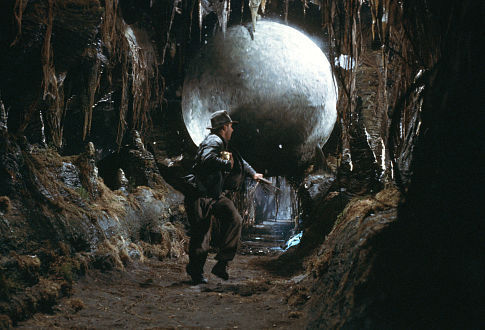
Isn’t a rock a hard place to begin with?

Gotta pick one, but which one?

Hard choices. That’s what it comes down to for your protagonist.

Someone in my old writing group put it very succinctly: each scene should force the protagonist so they have no choice but to go with the option that makes things harder for them.

If things were easy for your protagonist and everything went right for them, it wouldn’t be much of a story, would it?  We’d be bored silly.

It all stems from the necessary key word: conflict. Something must be opposing them reaching their goal.

This doesn’t mean it’s someone or something physically blocking them, although that is one option. It could be something out of nature, like a great white shark, a hurricane or a killer virus, or something from the grand scheme of the universe, like time, fear or silence.

One of the great things about conflict is there are countless ways to present it. It comes in all forms, but it really boils down to something in the scene (as well as the overall story) preventing your protagonist from moving things forward.

Taking it one step further, not only do you have to make sure they do, but they have to be the one doing it. Anything else is a cheat, and totally negates their development as a character.  Imagine if Dumbledore said, “Here’s a step-by-step list of what you have to do, Harry.” The mentor figure is there to guide the protagonist down the right path, not take the path for them.

The protagonist has to endure all of these conflicts in order to not only accomplish their goal, but grow or change from what they were when we first met them.

So go ahead and put ’em through the ringer. It’s the way it must be.

-I had the pleasure of doing an interview with Henry Sheppard, aka Adelaide Screenwriter. Check it out here.

What happened to the action movie?

Often imitated, rarely equaled

A little over a week ago, a friend posted the following question on Facebook – “Is RAIDERS OF THE LOST ARK the best action movie of all time?”

As would be expected, this led to a somewhat lengthy discussion. Several other titles were bandied about (DIE HARD, ALIENS, several John Woo HK films), and was summarized quite succinctly with “The main lesson here is that the 80s were a goldmine for high-quality action films.” (mea culpa – I’m the one who said it).

All I can think of for the 90s are TERMINATOR 2: JUDGMENT DAY and SPEED.

While you’re thinking about those, compare them to some more recent ones, such as:
-THE EXPENDABLES – a nostalgic remembering of the genre itself
-THE EXPENDABLES 2 – silly, over the top parody
-PACIFIC RIM – cool to look at, but that’s about it
-FAST & FURIOUS 6 – haven’t seen it, but I’ve heard nothing but good things about it
-THE LONE RANGER – couldn’t bring myself to see it, but will catch it on home video. Is it as bad as they say?

Now there’s this. Oy. Someday I’ll discuss how much I dislike reboots.

So why do action films from 20-30 years ago still hold up?

Looking at strong examples of the genre, they all have: Original stories. Smart writing. Three-dimensional characters. Action that enhances and supports the story.

If you’re writing an action spec, these should be your goals and objectives. Yes, it’s a lot of fun to blow shit up, but don’t use an explosion or shootout just for the sake of having one. It’s pointless.

Make the action part of the story, not what the story’s about. Use it to move things forward. Ratchet up the tension and create more conflict for your hero.

Need a refresher course in how it’s done? Pick one you’ve always liked, and watch it as a writer. Take notes. See how it all fits together. Then see if any of it can be applied to your story and rewrite accordingly.

If only all learning could be this enjoyable.
The fine art of world-building

Tell us what we need to know about this place
Now that you’ve created it, what do we need to know about it?

One of the primary functions of the first act is to establish the current situation of your protagonist. You, the writer, have to convey to us, the reader/audience, what’s going on around our hero and how they fit into this scenario.

Tell us what we need to know about them, but don’t overwhelm us. Give us the details relevant to the story; anything else is totally unnecessary.

Show us why this character is worth our time and attention. What is it about them we can relate to?  Make us care about them. Pique our interest and curiosity.

This is also your chance to establish the rules of this world you’ve created and how it works. If it’s something other than the world as we know it (i.e. science fiction or fantasy), then you definitely need to explain how things work here. Don’t expect us to know what you’re talking about; just because you know doesn’t mean we’re going to. Keep things simple.

Now that you’ve presented us with our protagonist and the world they live in, SOMETHING HAPPENS around page 10 that drastically changes their everyday routine and gets the story going. It also raises the central question of the story – “Will the protagonist achieve their goal?”

Some may say the protagonist should be the one that makes something happen, which is possible, but it seems more likely this disrupting-of-the-everyday-routine event happens to them, rather than because of them.

What’s great about this next stretch of pages is it offers you the opportunity to show a little more of this world, especially how your protagonist reacts to what’s happened to them as well as how their world responds to it. Explore the consequences and ramifications of how their life is changing as they leave their old situation behind and become more involved with the new one.

By the time we get to the end of the first act, the protagonist is totally immersed in this new world and has to figure their way out/through it. Everything we need to know has been taken care of, so now we can focus on following the story.

The writing sprint: no training necessary

race
It’s not about speed; it’s how you handle the course

Finally, finally got to type in those illustrious words FADE OUT, which brings the first draft of the western spec to a satisfying close.

It’s very tempting to read it and see what needs work, but at this point, I’m opting to let it sit in hibernation while shifting the focus to the rewrite of the mystery-comedy.

While the previous draft is a more solid foundation than I thought, there are still some ideas I’m looking to incorporate.

Rather than jot a few down at a time, or hope inspiration hits every once in a while, I’m opting for a method that’s proven quite helpful in the past: the writing sprint.

Set aside 30 minutes. Just you and a blank page (paper or digital – doesn’t matter, although digital might be easier & faster to work with). Once that timer starts, write out scene ideas as fast as you can.  Don’t stop to think if they’re good or not. Just crank ’em out.

It’s not a bad thing to write what you already have, but maybe you’ll come up with something you never thought of, or suddenly hit on a solution to a problem that’s been bothering you.  Feel free to even take things a totally new direction. For now, there are no bad ideas.

It’s possible you could run out of gas before time runs out, but push yourself to keep going.

Once the 30 minutes is up, take a look at what you’ve got: a ton of (mostly) new material.

Pick and choose what works for you now, but make sure to hold on to the rest. Inspiration could hit from any of them, and you never know what might come in handy later.

Hardhats required beyond this point

Safety goggles are optional, but typing in work gloves is darned near impossible

This is a time of overlap, chums.

The final wrap-up of the western spec draws closer, despite realizing a new wrinkle – I need to show what happens to one of my supporting characters, rather than tossing that info out via a line of dialogue. This will also require a little set-up somewhere in the latter half of Act Two, but I think I’ve found a good spot for it.  Then off it goes into the digital waiting room that is my hard drive.

As that door closes, the one into the rewrite of the mystery-comedy spec reopens. As much as I’d like to really jump into it, this is definitely going to require baby steps and lots and lots of planning. Since it’s been a very long time since I read it, I opted to start completely fresh, which meant figuring out my plot points.

I can’t recommend this enough. It doesn’t matter if you’re starting a new story or rewriting an old one: KNOW YOUR PLOT POINTS!

You know that expression about how a screenplay is like a blueprint for a building? Think of the plot points as the load-bearing support beams that hold everything up. Without them, everything will come crashing down.

So get yourself a blank page and, based on how well you know your story, jot down the following:

page 3 – statement of theme. You may not know it when you start, but having a general idea about it can help shape the story AND influence each scene
page 10 – inciting incident. Serves multiple purposes – gets your main story started, shakes up your protagonist’s world, raises the main question of the story
page 17 – a little twist in the action that continues to push your protagonist out of their comfort zone
Act 1 turning point – your protagonist enters a totally new environment; the main story question is once again raised
page 45 – another twist for your protagonist
Midpoint/Point of No Return – your protagonist becomes fully committed to achieving their goal
page 75 – another twist (yes, seems redundant, but each one of these has to make things harder for your protagonist)
Act 2 turning point – ALL IS LOST. Looks like your protagonist has no chance whatsoever of reaching their goal
Climax – your protagonist starts to turn things around, leading to a final showdown with the antagonist
Resolution – main story and assorted subplots are tied up
Denouement – how the protagonist’s life is different now

(For some great examples of these from well-known films, check out Dave Trottier’s THE SCREENWRITER’S BIBLE.)

Something else to keep in mind – MAKE SURE YOUR PROTAGONIST IS THE ONE DRIVING THE ACTION! Why would we be interested in a passive main character who just reacts to things, or even worse, does nothing at all?  Your protagonist should always have to go with the harder of two choices – don’t look for the easy way out.

Don’t get frustrated if you can’t figure it all out right away. You’re creating an original story, which isn’t easy to begin with. Take your time and think your way through it at your own pace.  Ask yourself “What’s the best way to get from HERE to HERE?”

Once you know your plot points, then it’s on to the fun stuff: filling in the spaces between them.