Knowing your nails and how to use them

Savvy and experienced consumer of literature I’m sure you are, no doubt you’re more than somewhat familiar with the classic piece For Want Of A Nail:

For want of a nail the shoe was lost.
For want of a shoe the horse was lost.
For want of a horse the rider was lost.
For want of a rider the message was lost.
For want of a message the battle was lost.
For want of a battle the kingdom was lost.
And all for the want of a horseshoe nail.

Sometimes we don’t realize how important something is that at first glance might seem completely insignificant.

The same concept could apply to screenwriting and the details of your story. A reader could see something and wonder “I don’t get it. Why is this in here?”

If you do the work and plan accordingly, the answer/reason will soon be obvious. That little detail is there for a reason, probably an important one, and without it, the rest of the story won’t work.

This is important on several levels.

It shows you put a lot of thought into putting the story together.

It shows you understand the concept of effective setups and payoffs.

It shows you respect the intelligence of your reader/audience and don’t feel the need to deliberately draw our attention to this sort of thing.

It always bothers me when a story sets something up and doesn’t pay it off, or has something later on in the story that comes out of nowhere.

Some writers go into it with a solid idea of how everything is set up and know how it’s going to play out, some come up with the bare bones of a foundation and fill in the blanks, and there are even those who sit down with a blank page, start writing, and see how it goes.

I tend to waver between the first two.

Sometimes you might even go back over what you’ve already written and discover an opportune moment to put in a small detail that can further enhance something later on in the story. It’s as if your subconscious was working in conjunction with your creativity and giving you an unexpected helping hand.

Are parts of your story set up that they start with a “nail” and escalate from there? Or does something happen later that could use a stronger setup?

You’d be surprised at seeing the ripple effect one little change can have on the rest of your script. Hopefully for the better.

It may not pretty, but at least it’s something

This isn’t saying the Mona Lisa isn’t pretty. It was just tough to find a picture of people looking at art.

Some exceptionally helpful notes continue to come in on the latest draft of the animated fantasy-comedy spec. For the most part, very supportive and encouraging, along with some great suggestions for small fixes here and there.

But one note really hit home – not because it was overly negative, but because it touched on something that I’d been uncertain about.

I won’t go into too much detail, but it involves how in one sequence the focus shifts from my protagonist to set up the backstory of some important supporting characters. Even while I was putting it together, it seemed kind of odd and I wasn’t entirely sure it worked, but felt it was “good enough for now”.

Nevertheless, something about it still didn’t seem right.

Numerous options rolled around in my head as I strained to come up with a solution, but still nothing. Also not helping was that constant trepidation when dealing with a rewrite. Would I be able to come up with something that works the way I need it to?

So I decided follow one of the most important tips for writing, screen or otherwise:

I just sat down and started writing. I knew what I wanted to accomplish – have the protagonist be part of it, which helped guide things along.

And thus the words did flow.

Revised and totally new scenes were churned out over the next 60 minutes or so. As is my usual m.o., there’s probably more in the new stuff than I’ll need. Trimming the fat later shouldn’t be too challenging, but I’d rather have more than I need than come up short.

I also managed to come up with a few details that I could plant early on in the story that would pay off later, and came up with a joke that actually made me laugh out loud. Hopefully others have the same reaction.

Overall, I’m quite pleased with how it turned out. Confidence and enthusiasm for this script continue to build.

But don’t get me wrong. There’s definitely more work that needs to be done, but this is a pretty encouraging step.

A friendly reminder – just two weeks to go until the Maximum Z Winter ’22 Script Showcase goes up (Dec 2), so make sure to send in the details about your spec screenplay or TV script ASAP.

All the info is right here: https://wp.me/prjnO-8yJ

Same destination, different route

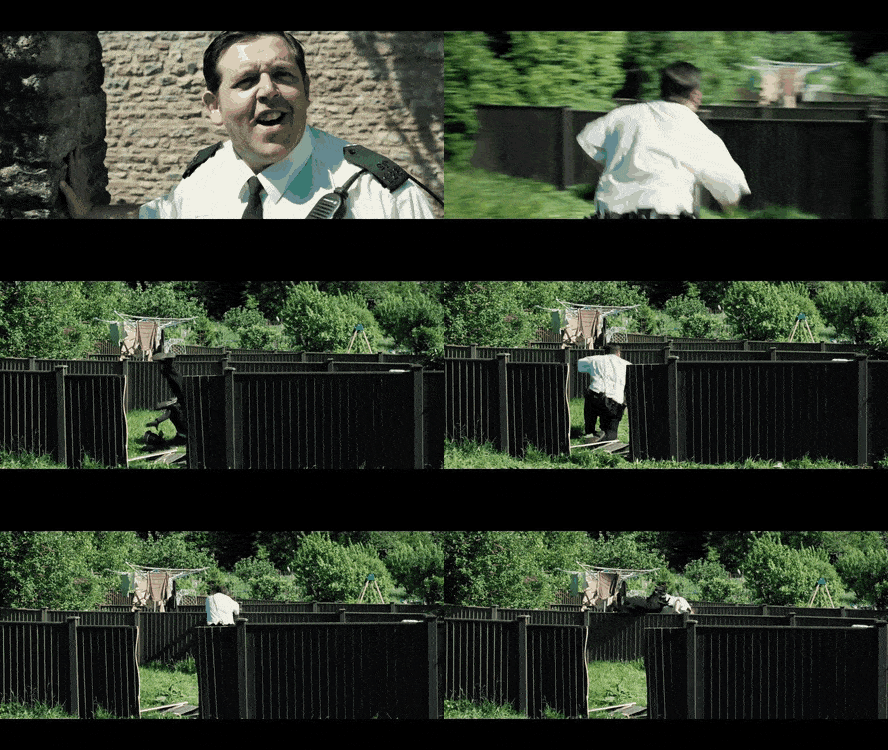
hot fuzz

Even though I got some great notes back on the previous draft of my sci-fi adventure spec, one aspect of the script had always bothered me.

As much as I loved the opening sequence, it still felt out of place.

Its primary goal for existing was to establish and set up several plot elements and story details. It does that, but something just didn’t feel right.

Would the story still work if I took it out? Sure, but finding new ways to present all the relevant info would require some major rewriting and revising. Time-consuming (to a point), but necessary.

But that got the gears turning…

The more I thought about it, the more the idea appealed to me. Trust me, it killed me to even just consider killing all those darlings, but doing so would definitely force me to find new and original ways to tell this story.

Added bonus – a new opening would also enable me to do a better job of establishing the protagonist AND set the tone of the story.

So out all those pages went, with an ever-expanding list of all sorts of new ideas regarding How To Do It currently in development.

A writer may know what they want to happen in their script, but sometimes it doesn’t work out that way. The characters might unexpectedly guide you in a different direction, or maybe you realize what the story really needs is to take a sharp turn off to the side, or you decide that this is the perfect opportunity to go in a totally opposite direction.

Nothing is set in stone. You’re the ultimate creator. Everything that happens is under your control, and you can do with it what you will.

Something not working for you? Change it. Give yourself options.

Follow-up to that – go with options that still work within the context of the story and characters. Your characters still want the same thing they did before, but now you’ve drastically altered how they get there.

It’s a savvy writer who eagerly anticipates taking on the task of devising these kinds of changes. And once they’re all implemented, you’ll barely remember how it used to be because EVERYTHING WORKS SO MUCH BETTER NOW.

Suggestion – no matter how or when you come up with a new idea, WRITE IT DOWN. IMMEDIATELY. Even if you’re in the middle of working on the same script. Everybody says “Oh, I’ll remember that later.”

You won’t.

Do whatever you have to in order to preserve it.

*Apologies for a lack of post last week. I had some kind of bug that put me out of commission for a few days; didn’t even have the strength to compose a “sorry, no post this week” post.


Your world. We’re just visiting.

tour group
Ooh! That looks like a vital piece of exposition!

Since you’re the one creating the world of your script, you know exactly what’s going on within it. Or at least you should. This doesn’t just refer to the events of the story. It’s a bit more extensive than that.

You know the world in which your story takes place. We don’t. It’s up to you to show us how things work in here. Some writers write under the impression that everything we need to know is right there on the page for us to see. They do, so how could we possibly not?

Sometimes the information we need to follow the story is presented gradually, or it might be thrown at us all at once in one big info dump (which runs the risk of too much too fast, resulting in something being skipped over). There are also times when we get nothing, so we and the protagonist experience everything firsthand as it happens.

Who hasn’t read a script and found themselves confused about “how things work here” because it wasn’t there, or only got a fraction of what they needed? Without that, your reader’s going to spend more time playing catch-up while trying to figure out what’s going on, which will take away from them being able to focus on the story itself.

You don’t want that.

This goes beyond genre. While stories of a more fantastical nature will require a little more explanation and/or exposition, even a story that takes place in the present day with normal, everyday people will require some kind of “get us up to speed”-type scenes.

One counterpoint to this – the lack of filling us in is intentional. Part of the enjoyment of the story comes from the gradual learning of information. An ideal setup for mysteries, but that’s all I can think of.

Personally, I find it more effective to fill us in as we go along rather than just dropping us in the middle of this new environment with the attitude of “You’re on your own. Good luck.”

Make it as easy for the reader to be able to follow along with what’s going on in your story as you do. Potentially difficult, but not impossible.

It requires some planning ahead

planning-ahead_4
Sometimes mapping it out by hand can prove most beneficial

Lots and lots going on within the hectic hallways of Maximum Z HQ, what with all the writing, note-giving, and career-developing taking place.

Much as I would love to offer up an original composition, my current schedule is a bit tight, so instead I humbly present a trio of posts, all plucked from the archives, and all dealing with what I consider to be a most important aspect of telling a story.

Enjoy.

Set up, pay off

Strong rope & solid knots required

Tying it all together