Let’s get those brains stimulated, people!

You mean movies can be smart AND good?

One of my favorite things to do as a parent is go to the movies with my daughter. It’s a nice feeling knowing I’ve instilled in her the appreciation of the whole moviegoing experience. It also helps that there’s a fantastic two-screen (one of a handful of similar small neighborhood theatres in San Francisco) a few blocks from us.

And as she’s getting older, our choices are growing in number. Strictly kid-based animation has given way to PG-13 fare, so we try to see what we can when possible.

Earlier this summer, we caught JURASSIC WORLD and INSIDE OUT within a week’s time. She really enjoyed the dinosaur flick. I thought it was fun, but felt it relied more on the nostalgia factor rather than smart storytelling (“Remember when we helped Grandpa fix that old car?”). I found the latest offering from Pixar to be pure genius, while she found it to be simply “okay”. I asked why she liked the first movie more than the second.

“I think I like movies where you don’t have to think too much.”

Gasp.

I won’t go so far as to say it was a dagger in my heart, but you can probably understand my being taken somewhat aback.

I could easily chalk it up to that she’s still relatively young and hasn’t latched on to my love of the movies to the extent that I have. Like I said, the list of what she’s seen is somewhat limited. I’ve done what I can, and hopefully can continue to contribute to it.

But as a writer, what’s my biggest takeaway from this?

Obviously I want to write scripts for films that will be embraced by the general public, which means they’d have to be simple enough that anybody could follow along, but also written in a way that the reader/audience doesn’t feel insulted or talked down to.

All this talk about needing to appeal to the lowest common denominator has always bothered me. It makes it sound like there’s no point in trying to write something smart.

I beg to differ.

Getting the reader/audience to really think about the story gets them more involved. You hooked with them with the beginning, kept them intrigued throughout the middle, and now they’re compelled to find out how it all ends. Isn’t that what it all comes down to?

I love it when I read a script where it’s obvious a writer knows what they’re doing when it comes to telling a story. Setups and payoffs. Multi-dimensional characters. Plotlines where I know what the endpoint is, have no idea how we’re going to get there, and am getting a real kick out of taking the journey.

This is the kind of writing we should all strive to create.

It’s easy to write something that doesn’t try to challenge the reader/audience, and the reaction will probably be similar. “Boring.” “Unoriginal.” “Meh.”

Push yourself to write something that offers up something new, or at least a new twist on an old standard. Give us something we haven’t seen before, or totally weren’t expecting. Not just one part. THE WHOLE THING. There’s something exhilarating about venturing into new territory. Take us there.

We’re writers. It’s what we do.
Wanted: wonder, fun & excitement

Seeking this kind of vibe

This was parent-teacher conference week, so my after-school parenting schedule was shaken up a bit. As a result, not as much time to work on the mystery spec rewrite.

So in an attempt to make the most of my limited time, and without my laptop with me, I opted to tinker with the outline for the monster spec.

Like any good writer, I had my ever-present notebook and story notes with me. Seriously.  I keep them in my bag for just such a situation.

The first act is really coming together, with most of the focus now on working out the details of the gaps between the plot points of Act Two. And as happened before, I’m having a blast.

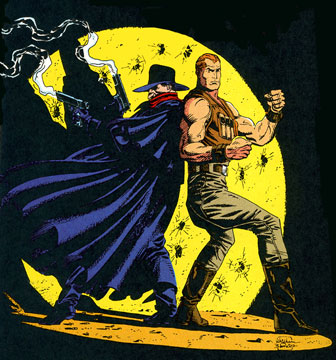
At its heart, this story is a pure pulp adventure, which is exactly the mood I’m going for. Grab you from page one and not let go as it gains momentum from there on, building and building until finally culminating in a jaw-droppingly amazing, can’t-believe-I-just-saw-that finale.

Simply put, my objective is to create a simple-yet-solid story with three-dimensional characters, using the spectacle aspect as support that keeps things interesting.

Similar to how it was with the western, I’m a huge fan of the genre and know what I as a member of the audience would want to see. I’m not looking to reinvent the wheel here; just tell a fun story. Hopefully my appreciation and knowledge of this kind of material will come through on the page.

What it really boils down to is the more I can make this a smart and exciting thrill ride, the better.

As I work out the story details, I’m keeping this in mind: If there was a free-of-plot-details trailer for this, you’d be overwhelmingly compelled to want to see it.  (Sort of what they’ve done for GODZILLA and GUARDIANS OF THE GALAXY.)

What it’s about, not what happens

bttf theme

A usual part of my daily routine is helping V with her homework. This week, they’re learning about how to identify the theme of a story.

Nothing like starting with the basics.

After reading the one-page story together, I asked her what she thought the theme was. Her response was more focused on one part of the story, rather than the whole thing, so I tried another approach.

“What’s the message of the story? What is it trying to teach us?”

That made things clearer to her, which made finding the theme of the next day’s story a little easier (with a little guidance from me).

This of course made me think about finding, or at least knowing, the theme of the story of your script.

Some writers start writing and figure out the theme later. I’m the total opposite of that. I don’t think I could even start on the outline if I didn’t at least have an idea of what the theme was.

A lot of the time it’s just a single word or a short phrase, but it still plays a key part in putting my story together.

Knowing the theme of your story is vital; it influences how the story’s told and what it’s about. If you don’t know what your story’s really about, how can you put the rest of it together? That would be like doing a jigsaw puzzle without knowing what the final picture is.

A great example of a theme on display is BACK TO THE FUTURE. Look at the dialogue exchange in the picture up top, which takes place just a few minutes in. Jump forward to Act Two, where, after all the setup in Act One, we get to see how history does indeed change, all thanks to Marty. (Just another reason why this is a phenomenally bulletproof script)

So as you work on your latest draft, take a look at each scene, even if it’s just a few lines long. Does it advance the story, the characters and the theme?

If so, great and keep up the good work. If not, take a moment to figure out what could be changed so it does.

Once you learn how to do this, hopefully your writing process will be just a little bit easier.

Making the most of a limited timeframe

Fortunately, I'm not doomed when the sand runs out
Fortunately, I’m not doomed when the sand runs out

My schedule is probably a bit different than yours.

A job in broadcasting, getting around a large metropolitan city via bicycle or public transit, and escorting V to her numerous afterschool activities means not a lot of time to sit and write. Maybe a little over an hour a day. Maybe one and a half to two, if I’m lucky.

Since it’s all about getting stuff done, I’ve learned how to jam as much productivity as possible into that short window. Sometimes it’ll be “write until the end of this particular scene” or “crank out X number of pages.” Other times it might be “write until this point in time” or “write until you just can’t do it anymore”.

An hour may not seem like a lot of time to work with, but you work with what’s available.

Plus, setting up this kind of work habit is extremely beneficial on several levels:
-compels you to concentrate
-regular work pattern can improve skills and boost creativity
-problem-solving becomes easier and less necessary
-productivity may be slow, but remains steady
-that sense of accomplishment from having actually written something (very important)

These extremely unscientific results are how it’s worked out for me. I can’t speak for others, but I would imagine the results have been similar.

Find a system that works best for you, and keep at it. Make the commitment and stick with it. A few pages a day, and before you know it, you’ll be done.

Then you reset the clock and start all over again.

Passing the cinematic torch

This kind of education begins at home
Family Movie Night – fun AND educational!

It’s no secret my daughter is semi-obsessed with Harry Potter. The movies, specifically.  Such to the point that this past weekend she printed out a whole bunch of pages from Google Images and taped them to her wall.

We own the movies on DVD, and she’s watched them multiple times. I don’t have a problem with that. I’ve done the same thing with other franchises.

But lately I’ve been suggesting maybe she could expand her horizons and try something new. 99.9 percent of the time, those words fall on deaf ears.

This past Saturday, K suggested we watch a movie as a family. Maybe something more or less kid-friendly V had never seen, and might possibly really enjoy.

So we opted for John Carpenter’s classic BIG TROUBLE IN LITTLE CHINA. Martial arts, Chinese ghosts & magic, set in San Francisco, and James Hong . What more could you ask for?

I think “meh” sums up her reaction. She didn’t hate it, but wasn’t crazy about it.

What was especially interesting was that there were some scenes that scared her, or at least made her uncomfortable (kissing scenes notwithstanding – she’s always hated those).  We reminded her it was all make-believe, and that the Harry Potter movies can sometimes be just as scary, if not more so.

Didn’t help much.

But onward we will continue, undeterred in attempting to open her eyes to the almost limitless number of movie choices out there.  As a parent who happens to be a film afficionado and writer of movies, it’s my job, nay, obligation, to carry on.

We’ve made some progress in the past with silent movies, musicals and STAR WARS, but there’s so much more to go.  Looking ahead, how would she react to BACK TO THE FUTURE? Or RAIDERS OF THE LOST ARK? Would she develop the same appreciation for NORTH BY NORTHWEST like I did?

I would love to find more films we could watch and enjoy together.  One of my fondest movie memories is my dad and I seeing STAR TREK II: WRATH OF KHAN at the local theater while a thunderstorm was raging outside.

I want to introduce her to films that require you to pay attention and follow along, rather than insulting your intelligence.  Some of these stories are a real rollercoaster ride, and I look forward to sharing the experience of savoring that kind of thrill with her.

I’ve got a really long list of favorite films, and can’t wait to see them again with her for the first time.