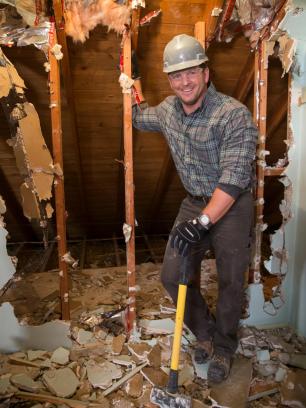
Break out the sledgehammers!

renovation
Just like me during a rewrite

A few more sets of notes on the comedy spec have come in, and they are good. And helpful. Which is very good.

The value of having connections with experienced and knowledgeable writers once again proves to be a huge asset. Networking, people!

But back to the topic at hand…

It doesn’t appear that a major reworking is in order, but there’s still a lot to do. This is definitely more than just a new coat of paint; more like a thorough renovation. More than a few comments covered the same issues, so working on those and the resulting ramifications will be the starting point.

One of the biggest obstacles when it comes to a rewrite (for me, anyway) is that nagging thought of “How am I going to make this better?” Especially when there’s already something there on the page.

It’s tough to get rid of the old stuff. You worked so hard on it, and now you have to get rid of it? Or change it? Sometimes you gotta just jump right in, totally let go and kill all those darlings. Sounds gruesome, but it has to be done.

And as I have often found in the past, once those changes are made, the new version is usually significantly better to the point that you barely remember that much about the old one. Plus, making those changes gets a little bit easier each time.

Into the breach!

A few additions to the Maximum Z Bulletin Board:
-The filmmakers behind the short film Goodbye, NOLA have set up their crowdfunding project. Donate if you can.

-Author Jeff Guenther proudly announces the release of his new World War 2 thriller In the Mouth of the Lion.

Got something you’d like to promote? Drop me a line.

Commencing transfer to second horse

horses
All these new ideas were really starting to nag at me (C’mon. They can’t all be gems)

Notes continue to come in for the low-budget comedy spec. I am very fortunate to benefit from the insight of such savvy folks. Lots and lots of great notes that will come in handy for the next batch of rewrites.

Taking a look at all the notes, along with the new ideas they trigger, makes me think about what changes could be made in future drafts. Changes that would strengthen the script on several levels, especially those where it’s been indicated the most work is needed.

This isn’t saying that I’ll blindly accept every single suggestion that’s been made. More like a combo of taking the ones I think work best and some of my own new ideas. That’s one bonus of getting multiple sets of notes.

I’m also expecting to alter parts of the story just enough that it’ll be slightly different from these earlier drafts while still retaining a lot of what originally appealed to me about the overall story/concept. There are a few new factors being thrown in, some of which I’m looking forward to begin implementing (and also fall into the category of “why didn’t I think of that before?”)

Thus the fun and thrillingness of it all continues…

Not everybody’s going to like it

pie
Astonishing as it is, some people actually don’t like pie. Heathens.

Notes and comments continue to come in for the comedy spec. I’m seeing some very insightful stuff that will prove most beneficial for the next draft.

Reactions range from “I loved it!” to “I was very disappointed with this.” The author of the latter even started things out by saying “I wanted to like it, but just couldn’t. I guess our senses of humor are just too different”.

And you know what? They’re right, and that’s totally fine. Comedy is subjective. Everybody likes different things. If it’s not for you, it’s not for you.

Would I have preferred they liked it? Of course. But they didn’t, and that’s all there is to it. I still value their opinion and will continue to ask them for feedback in the future.

But I also shouldn’t totally disregard what they had to say. They made some valid points and suggestions in their explanation of why it didn’t work for them, a lot of which could potentially be applied to the aforementioned rewrite.

Nor should I take one person’s rejection as the final word. They didn’t like it, but in no way does that mean everybody else will have the same opinion. For all I know, this one dislike is the exception to the rule.

This is one of those things that a lot of writers, especially newer ones, fail to grasp. You slave away on a script, and then you send it out, convinced it’s a work of genius. And you don’t get the reaction you were hoping for. PASS. Thanks, but no thanks. We’re working with something similar.

Heartbreaking, ain’t it? “How could they not have liked it?” you cry out to the writing gods. It’s just the way it is. Remember – it’s not about you. It’s about the script.

So you’ve got two choices. Obsess over the rejection, or accept it, put it behind you, and keep pushing forward. Maybe figuring out why their reaction was negative could help.

But don’t let that negative slow you down. Do what you can to turn things to your advantage. Like with practically everything connected to screenwriting, it won’t be easy.

Start by making sure you like it, and then take it from there.

Beware the monsters with green eyes!

green eyes
And done without the benefit of contact lenses

Not one, but two, count ’em – TWO, fantastic get-to-know-you chats with some fellow local writers over the past week. (Eight days if you want to get technical about it)

As part of one of these discussions, the topic of dealing with criticism came up. In particular, criticism that seems to come from a harsh, angry place. They go way beyond “This needs work”, and potentially surpass the purpose of notes to the point of simply being downright cruel.

“This is shit. Whoever told you you could write?”

“Any attempt to fix this would be a waste of time. Just give up now.”

Chances are you’ve been on the receiving end of these kinds of notes. I certainly have.

When we’re first starting out, we don’t realize how much we don’t know, and that’s reflected on the page. There’s not one experienced writer who thinks their first script or two was perfect.

So you work at it. You toil away, constantly putting in the effort to improve. And over time, you do. You know you’ve gotten better, and that also comes through on the page. Maybe you’ve even gotten compliments or (gasp!) praise about your work.

But despite your progress, you might still get a note like those above that totally trashes what you’ve written. This has also happened to me. Fairly recently, I might add.

What myself and the other writer discussed was “Where does this anger come from?” We’ve both been doing this for a while, so neither of us is a total noob. We each had more than a few scripts under our respective belts, so what could possibly be the basis for such a mean-spirited rant?

I casually threw out something I’d only read about and heard in the occasional mention: Could the person giving the notes be jealous of the material, and they were venting their anger and frustration about it via their notes?

Let me set one thing straight. I think I’m a good writer, but I will never claim to be the be-all and end-all. In fact, I’d be amazed if somebody was jealous of my work.

When I read somebody else’s script and find it totally amazing, I’ll tell them so. Do I wish I could write something that good? Sure, but it makes me want to work harder so I can. I don’t think “I’ll never be as good as them, so I’ll shit all over their material in order to make myself feel better.”

Taking this kind of negative approach can only result in a lose-lose scenario for you. You make yourself look bad and the other person will most likely not want anything to do with you anymore. And don’t think they’re going to forget you. To them, you’ll always be that angry asshole.

Something else to keep in mind – you never know who’s going to succeed, so the person whose script you just trashed could potentially be the next big thing. Wouldn’t you rather be on their good side, and not their shit list?

I work really hard to establish and maintain my network of connections, and value each one too much to do that. I want everybody to succeed and actually enjoy helping if and when I can.

But then again, I’m just a nice guy to begin with. Even if I do occasionally end sentences with a preposition.

But that’s nothing to be jealous about.

The silver lining of a bad movie

Krull
A definitive shining example (AND a prime candidate for a remake)

Since the screenwriter’s education is ongoing, there’s always something for you to work with or study to get a better grasp and understanding of what constitutes good writing, which can then be applied to your own.

Read scripts. Attend or take part in a table read. Watch movies.

While there are countless examples of exemplary writing and filmmaking to see it done properly and effectively, there are even more examples of crappy writing and lousy filmmaking to see it done poorly and ineffectively.

Nobody starts out with the intention of making a bad movie. What starts out as a great script can easily be messed up along the way to the point that there’s no salvaging it. It happens.

Is watching one waste of time? Not necessarily.

As enjoyable, informative and educational as the good stuff is, the bad stuff is actually just as good, possibly even more so. Because from these cinematic travesties you can learn what not to do with your own scripts. Lessons abound with all the glorious misfires regarding story, characters, and dialogue.

Regrettably, bad acting is a category all by itself and there’s nothing that can be done about it. Do what you can to ignore it (which can border on the impossible, depending on the quality of badness) and focus on the non-tangibles.

It’s especially helpful to work with something from the same genre as your script. See how they did it, then compare it to your own. Can you see why theirs didn’t work? Is it riddled with plotholes you could drive a truck through? Is the dialogue pure on-the-nose? Do the characters come across as unrealistic caricatures?

Look at it as a whole. Does it respect the reader/audience’s intelligence? Is the structure solid? Do you care about what happens to these characters over the course of the story?

Now bring your script into the equation – and be objective! How much of a similarity or difference is there between that story and yours? Did that other material open your eyes to some previously unforeseen flaws and potential problems within your script, so much that it made you realize “this needs work”?

Once you identify these problems, your writer’s mind goes to work, figuring out how to make sure your script doesn’t repeat the mistakes you just read or watched.

It may not be easy to endure having to watch a bad movie just for the educational experience, so just keep reminding yourself “It’s to help me become a better writer”.

Good luck!

Question time! What’s your favorite bad movie? Feel free to list it in the comments.