A red flag if ever there was one

'nuff said.
Nope. Nothing suspicious about this whatsoever.

One of my earliest paid writing jobs came from a listing on craigslist. It was for a 10-minute student film, and I got $20 in cold, hard cash. Living the high life, baby!

Since then, every once in a while, I’ll peruse the “writing gigs” section just to see what’s out there. There’s the occasional “looking for a writing partner” or “need help with a screenplay” or “seeking screenplay”. Compensation is usually no or very little pay, or screen credit. Par for the course.

Earlier this week, there was a listing (since removed) that read something like:

“Experienced literary agent with Hollywood connections. I can get your script or manuscript sent throughout the industry for $3500/year (flat rate)”

Urgh. Where to even begin?

Maybe that you should not be paying an agent?

Maybe that this “experienced” agent is seeking clients on the online equivalent of the classified ads?

Maybe that they’re charging an exorbitant amount for something, given time and research, you can do yourself for free, if not a much smaller fraction of the cost?

But the saddest part is that there are gullible writers out there who think is a legitimate offer, and will enthusiastically pay, thinking it’s a shortcut to success.

Nope, because there are no shortcuts. Only one surefire path – write a phenomenal script. People will find it.

“But I’m a total outsider!” they argue. “How else am I going to get people to read my stuff?” The same way the rest of us do. Through your writing and networking (and maybe a contest or two).

Not sure if something’s legitimate? If you even have to think about it, then it probably isn’t.

Do your homework. Take advantage of the many online resources just a few keystrokes away. Get the info you need before you make a big (and potentially costly) mistake. Ask writers with more experience. Don’t be shy.

This is how you learn so it never has to happen to you.
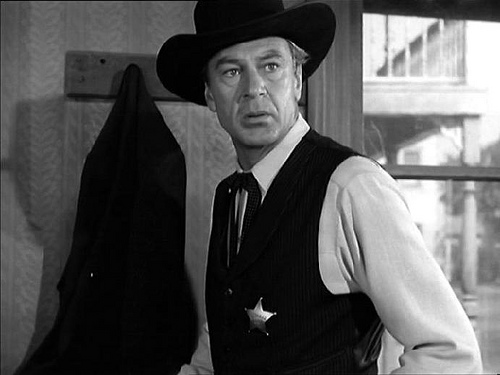
Is your story worth fighting for?

Will Kane knows what it's like to feel like one against everybody else
Follow Will Kane’s example (except without all the shooting and stuff)

The rewrite of my mystery-comedy has been put on hold because I’m teaching myself how to write a mystery, or at least how to be better at writing one. I bought a book and everything.

But I also don’t want to not be writing, so I’ve also decided to return to the low-budget comedy. It’s been a while since I’d read the outline, but it holds up more than I thought. Sure, it needs work and there are some spots where it says something like “SOMETHING FUNNY HAPPENS!,” but overall, I like it (hold onto that statement for just a bit).

Several months ago, I’d had the opportunity to have a brief chat with a writer who specializes in comedy. He asked what I was working on, so I pitched him the idea. He liked the concept, but was quick to poke holes in the story vis-a-vis the logline (which has since been rewritten), and didn’t care for how I had the story play out (as delivered in my thumbnail presentation).

“X should happen instead of Y! Having THIS CHARACTER connect with THAT CHARACTER is all wrong!” Plus some additional words to that effect.

Gosh.

I wasn’t expecting a standing ovation, nor did I expect it to be proclaimed a work of genius, but if this guy didn’t care for what I had, did that mean it was doomed before I even started?

Nope. Quite the contrary.

Several key things I had to remember:

-this was his opinion. One person, which is not a majority.

-his sense of humor and comedy stylings could be totally different from mine.

-it’s a work-in-progress in its very early stages. The end result will most likely be very different from the starting one.

-I think it’s a good story. Always have, always will. I have no intention of abandoning it or making any significant changes so as to gain his approval. I’m not writing this for him.

Every writer spends a lot of time coming up with story ideas, and then developing them as far as they’ll go. Stick to your guns if you believe in your story, but don’t totally block out advice and suggestions. Use what you think works best. Remember – this is YOUR story. If you think it works, then by all means, do what you can to make things happen.

It’s great when you get encouragement, but you’ll also encounter a lot of naysayers (“I don’t get it/like it, so it must be a bad idea.”). It’s all subjective. Everybody likes different things. If you believe wholeheartedly in your story, you have to do your absolute best to get the rest of us to be just as interested in reading it.

Just make sure to tell that story in the most entertaining, original and professional way possible. That’s all.

Just a moment of your time, please

It’ll only take this long, right?

Even though I don’t actively participate on a lot of online forums, I still enjoy reading them, occasionally throwing in my two cents when I think I have something worth saying.

On one such forum, an experienced writer offered to provide detailed notes on the script with the logline he liked the most. He was very detailed and meticulous in laying out the guidelines and rules, including that the script “MUST be ready to read NOW. No exceptions.”

Up until that caveat, I’d thought about submitting the logline for my mystery-comedy, but knew the script still needed work, so instead opted to hold off and wait until I thought the script was ready. And I said words to that effect in the comments.

Much to my surprise, he responded almost immediately.

“Now that’s what I love to see. Writers respecting the investment of time and energy of others. I’m taking about five hours out of my life to do this and I want to feel the script I’m about to read will be worth it. Good on you, Paul, for being so conscientious. It’s one of the responsibilities of a writer no one tells you about, but it’s absolutely vital for building and sustaining a career.”

I never thought of it that way because I was looking at it from my perspective: I didn’t want offer up a script I didn’t consider ready yet. But he makes a very good point – the other person has their own schedule, and you need to be respectful of that.

It’s easy to forget that even though you’ve put a lot of time and effort into your script, now you’re imposing on somebody else to devote a sizable chunk of their time to giving it a solid read-through. That’s a lot to ask, especially when they’ve offered to do it for free.

When somebody asks me if I can take a look at their script, I always let them know it’ll probably take me longer than I think to get those notes to them – and it usually does. Nobody’s complained about it (to my face, anyway). And when the situation is reversed and someone’s giving me notes, I’ll send the script with a note of thanks and that there’s no rush. I’ll distract myself from the waiting game by working on another project or two.

We all only have so much time to spare to devote to work on our own material, let alone someone else’s. Just be grateful and appreciative that someone’s willing to sacrifice some of their time to help you out, and definitely be just as willing to return the favor.

In a timely manner, of course.

A refresher course we can all use

Okay, class. Who needs more time to work on their script?

I’ve had a lot of goings-on with loglines over the past couple of days, which prompted me to re-post this gem from a little over 2 years ago.

Enjoy.

“Scenario:  You’re at a social function, engaged in idle chit-chat. The topic of you being a screenwriter comes up.

“What’s your story about?” they will undoubtedly ask.

The chance you’ve been waiting for!  What do you say?

You want to pique their curiosity, and not bore them.

In the simplest of terms:  provide a quick summary of the main characters(s) and what happens in the main storyline.

Avoid too much information, non-essential characters, intricate subplots, how it’s a metaphor for this totally different other thing, or generic phrases like “and learns about themselves” or “stumbles into a world she wasn’t prepared for” or the ever-dreaded “wackiness ensues.”

What are the components of an effective logline? Just the following:

1. A protagonist with a flaw.

2. An antagonist with a goal.

3. The situation that pits them against each other

4. What’s at stake/what happens if the protagonist fails?

That’s pretty much it. Keep it simple. Nothing too specific or generic.

Make sure you emphasize the genre. If it’s a comedy, play up the comedic angle. A thriller, go for the suspense. That sort of thing.

And most importantly, make it sound interesting. This is your best chance to grab their attention, so make the most of it (and make sure the script is just as good).”

-3rd half-marathon of the year this weekend. Training’s been more sporadic than I would have liked, so hoping to break 1:55, but will settle for under 2 hours.

Hey kids! Time for a fun & easy experiment!

No lab coats or bunsen burners necessary
No lab coats or bunsen burners necessary!
  1. Go onto your social media network(s) of choice.
  2. Find 5-10 people whose work you enjoy, admire or just think is plain awesome.
  3. Connect to or follow them (if you haven’t already)
  4. Send them a brief note saying exactly what it is you like about their work. Nothing too gushy.
  5. Enjoy the rest of your day knowing that you were very likely a bright spot in theirs.
  6. (optional) Enjoy a piece of pie for having accomplished step 5.