Lots of resolutions and goals being bandied about today, but that’s just the first step.
All the things you want to accomplish this year as a screenwriter. What are you doing to make them a reality?
It’s going to take a lot of work. It’ll be frustrating at times, but isn’t this something you’re willing to put yourself through hell for in order to see happen?
Give yourself some goals, but be realistic.
Write. Edit. Rewrite. Polish.
Watch. Analyze.
Read. Study. Learn. Hone.
Network. Connect. Share. Support.
Enter contests. Attend conferences. Pitch.
Research. Query. Reconnect.
Keep trying.
Don’t give up.
Enjoy yourself.
Make 2016 the year you make something happen for you.
The post from earlier this week was all about my excitement about my new story idea. Little did I realize what kind of effect that would have on some readers.
“The enthusiasm oozing from your blog post is contagious. I have a story line that is brewing, too! Thanks for the encouragement here!”
Shucks, folks. I’m speechless. (“Oozing”? “Contagious”? Makes me feel like I require medical attention.)
It kind of reminded me of this post from 2 1/2 years ago.
Those that have been following this blog for a while know what a big proponent I am about networking and supporting those within your network.
I’ve been extremely fortunate to have not only established solid relationships with several writers of considerable talent, but been the fortunate recipient of their advice and guidance in helping me hone my writing skills. In turn, I don’t hesitate when one of them asks me for my two cents about their latest project.
Hard as this might be for some to believe, being nice to people actually has its benefits, and isn’t that difficult.
Or is it?
As has been well documented here, I’ve had several online encounters with those who make comments of an overly negative nature (which, a majority of the time, don’t include anything that actually helps).
It truly amazes me when somebody I’ve never met, and most likely never will meet, has no problem spitting out harsh and condescending answers to what are generally simple questions, or somebody just seeking some helpful insight or advice.
Whatever their reason, what exactly is the point of acting like this? If anything, it makes me want to avoid you at all costs. I’m already doing a bang-up job being full of self-doubt. I don’t need your help.
I strive to be the opposite of that, and help people out when I can. It’s in my nature.
And if you’re reading this, I sincerely hope it’s in yours as well.
Being a writer means your creativeness is always running, or at least should be. It never shuts off, and sometimes kicks in when you least expect it.
Inspiration can hit anytime, but are you prepared for when it does?
You could be doing something you do practically every day or see something seemingly normal, and all of a sudden think, “Hey! There’s a story here!” It could be whatever you can imagine: the basis for a short, an episode of a webseries, or part of a feature.
Then there’s the thrill as your mind races through all the potential possibilities. What if THIS happened? Or THIS? Ooh! I love THIS! It’s like a shot of adrenaline into the right side of your brain.
When the idea hits, do you immediately write it down, or is it suddenly burned into your brain so deeply that there’s no way you could possibly forget any part of it?
Of course, it’s one thing to come up with the idea. How far do you go with it? Does it lose its luster after a few days, and then you just give up completely? Do you hold onto it because there’s just SO MUCH POTENTIAL here? Do you tinker around with it, file it away, then come back to it weeks or months later?
How original an idea is it? Can you think of something that’s similar? Who’s your target audience? Is it something you yourself would actually pay to see?
Let’s also not forget that this is all based on your thinking. You love the idea, but what if somebody says “I don’t get it” or all you get is a shrug? Do you think the idea is worth developing? Is it one you’re prepared to slave away on for an extended period of time?
It’s easy to come up with the ideas, but definitely not easy to turn them into quality, fleshed-out screenplays. It takes a long time to get the hang of doing this, let alone doing it well. But don’t let the difficulty or length of the journey dissuade you from at least trying.
True, normally I’m a pie kind of guy, but I’ve really been craving these for a while…
Happy times around these parts, chums. The November writing project was a success. The first draft of the low-budget comedy is complete.
I listen to Pandora for white/background sounds while I write, and – this is absolutely true, swear to God – Handel’s Hallelujah Chorus was playing as I typed in “The End”. A pretty solid good omen, if you ask me.
So the draft is done, and now gets tucked away for a couple of weeks. It’ll definitely need a lot of work when I come back to it, but it’s great to know I have a completed draft to come back to.
This is that feeling that every writer should savor when they achieve a specific milestone like this. A lot of would-be writers start a project, then abandon ship when it “just gets too hard” or “don’t have time”. It’s those of us who are truly dedicated that toil away no matter what. You’ve had a long day at work. Stuff around the house needs to get done.
Through it all, we find the time and make the effort. Even if it’s only 30 minutes or one page a day. We do it not just because we want to, but because we have to. We consider not writing unthinkable.
There are good days and bad days, but you learn to work your way through both. You have a goal in mind, and do what you can to get there. And once you do, there’s nothing that can compare to that feeling of accomplishment.
Enjoy it. You’ve earned it. The first of what will probably many rewrites awaits, but it can wait just a little bit so you can reward yourself in a small but appropriate manner.
A friend told me that whenever they finish a first draft, they celebrate with scotch. Scotch really isn’t my thing, but I wouldn’t say no to a cannoli from this great Italian bakery down on the Peninsula…(diet be damned)
Have a great weekend, and get some great kickass writing done.
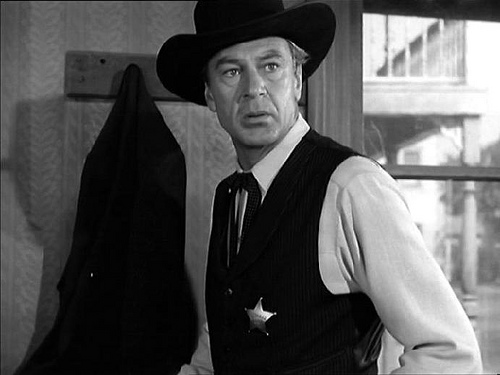
Follow Will Kane’s example (except without all the shooting and stuff)
The rewrite of my mystery-comedy has been put on hold because I’m teaching myself how to write a mystery, or at least how to be better at writing one. I bought a book and everything.
But I also don’t want to not be writing, so I’ve also decided to return to the low-budget comedy. It’s been a while since I’d read the outline, but it holds up more than I thought. Sure, it needs work and there are some spots where it says something like “SOMETHING FUNNY HAPPENS!,” but overall, I like it (hold onto that statement for just a bit).
Several months ago, I’d had the opportunity to have a brief chat with a writer who specializes in comedy. He asked what I was working on, so I pitched him the idea. He liked the concept, but was quick to poke holes in the story vis-a-vis the logline (which has since been rewritten), and didn’t care for how I had the story play out (as delivered in my thumbnail presentation).
“X should happen instead of Y! Having THIS CHARACTER connect with THAT CHARACTER is all wrong!” Plus some additional words to that effect.
Gosh.
I wasn’t expecting a standing ovation, nor did I expect it to be proclaimed a work of genius, but if this guy didn’t care for what I had, did that mean it was doomed before I even started?
Nope. Quite the contrary.
Several key things I had to remember:
-this was his opinion. One person, which is not a majority.
-his sense of humor and comedy stylings could be totally different from mine.
-it’s a work-in-progress in its very early stages. The end result will most likely be very different from the starting one.
-I think it’s a good story. Always have, always will. I have no intention of abandoning it or making any significant changes so as to gain his approval. I’m not writing this for him.
Every writer spends a lot of time coming up with story ideas, and then developing them as far as they’ll go. Stick to your guns if you believe in your story, but don’t totally block out advice and suggestions. Use what you think works best. Remember – this is YOUR story. If you think it works, then by all means, do what you can to make things happen.
It’s great when you get encouragement, but you’ll also encounter a lot of naysayers (“I don’t get it/like it, so it must be a bad idea.”). It’s all subjective. Everybody likes different things. If you believe wholeheartedly in your story, you have to do your absolute best to get the rest of us to be just as interested in reading it.
Just make sure to tell that story in the most entertaining, original and professional way possible. That’s all.