All these new ideas were really starting to nag at me (C’mon. They can’t all be gems)
Notes continue to come in for the low-budget comedy spec. I am very fortunate to benefit from the insight of such savvy folks. Lots and lots of great notes that will come in handy for the next batch of rewrites.
Taking a look at all the notes, along with the new ideas they trigger, makes me think about what changes could be made in future drafts. Changes that would strengthen the script on several levels, especially those where it’s been indicated the most work is needed.
This isn’t saying that I’ll blindly accept every single suggestion that’s been made. More like a combo of taking the ones I think work best and some of my own new ideas. That’s one bonus of getting multiple sets of notes.
I’m also expecting to alter parts of the story just enough that it’ll be slightly different from these earlier drafts while still retaining a lot of what originally appealed to me about the overall story/concept. There are a few new factors being thrown in, some of which I’m looking forward to begin implementing (and also fall into the category of “why didn’t I think of that before?”)
Thus the fun and thrillingness of it all continues…
A hard-at-work pre-Internet server keeping things up and running
There’ve been several previous posts here regarding the benefits and necessity of networking. It can’t be stressed enough how incredibly helpful and effective it can be, especially if you’re not in Los Angeles or somewhere you don’t have a lot of in-person access to other writers.
But it’s not enough to just make a connection. An effort needs to be made by at least one of you (most likely you) to maintain that connection and keep it healthy. And it’s not as hard as you might think.
While it can be extremely easy and tempting to get sucked into the never-ending rabbit hole of the internet, designate a portion of your non-writing time to be just as productive and try to get some networking stuff done.
Are you connected to another writer in your area, but you’ve never actually met in person? Ask them if they’re up for a get-to-know-you coffee or lunch chat.
If you’re limited to online communication, send them an email or tweet asking how they’re doing, and how their latest projects are coming along. Be helpful, or at least offer to help. They might just take you up on it.
*Important – if it’s been a while since you’ve been in touch, don’t start things off by straight-out asking for something. Would you want someone to do that to you? Didn’t think so.
If something good (career or otherwise) has happened for them, send a note of congratulations. Likewise, if something not-so-good has happened, express your sympathies accordingly.
Cliched as it may sound, keeping the lines of communication open really can help you out. I’ve been extremely fortunate to have established strong relationships with several local writers and filmmakers, and exchanged notes with writers scattered across the globe.
I reconnected with a consultant I hadn’t been in touch with for several months, and that conversation led to them offering up coverage (which I still paid for) that proved to be quite helpful.
A writer I know who works in TV and film emailed me, wanting to discuss her latest concept because she thought I was a good match for it.
None of these would have happened if I hadn’t taken the time to keep each relationship going. Rather than taking a “how can you help me?” approach, I go in with the mindset of “maybe I can help you?”
One of the things you hear so often when it comes to establishing a screenwriting career is “It’s not what you know, it’s who you know”. I’ve found both parts to be true. You definitely have to know what you’re doing in terms of craft and writing ability, but it’s equally important to establish and maintain solid, professional relationships with as many people as you can.
Because you never know who’s going to suddenly be a person of influence willing to help you out because you did the same for them.
So here’s your voluntary assignment:
1. Contact five of your connections.
2. Ask them how things are going.
3. Take it from there.
Not one, but two, count ’em – TWO, fantastic get-to-know-you chats with some fellow local writers over the past week. (Eight days if you want to get technical about it)
As part of one of these discussions, the topic of dealing with criticism came up. In particular, criticism that seems to come from a harsh, angry place. They go way beyond “This needs work”, and potentially surpass the purpose of notes to the point of simply being downright cruel.
“This is shit. Whoever told you you could write?”
“Any attempt to fix this would be a waste of time. Just give up now.”
Chances are you’ve been on the receiving end of these kinds of notes. I certainly have.
When we’re first starting out, we don’t realize how much we don’t know, and that’s reflected on the page. There’s not one experienced writer who thinks their first script or two was perfect.
So you work at it. You toil away, constantly putting in the effort to improve. And over time, you do. You know you’ve gotten better, and that also comes through on the page. Maybe you’ve even gotten compliments or (gasp!) praise about your work.
But despite your progress, you might still get a note like those above that totally trashes what you’ve written. This has also happened to me. Fairly recently, I might add.
What myself and the other writer discussed was “Where does this anger come from?” We’ve both been doing this for a while, so neither of us is a total noob. We each had more than a few scripts under our respective belts, so what could possibly be the basis for such a mean-spirited rant?
I casually threw out something I’d only read about and heard in the occasional mention: Could the person giving the notes be jealous of the material, and they were venting their anger and frustration about it via their notes?
Let me set one thing straight. I think I’m a good writer, but I will never claim to be the be-all and end-all. In fact, I’d be amazed if somebody was jealous of my work.
When I read somebody else’s script and find it totally amazing, I’ll tell them so. Do I wish I could write something that good? Sure, but it makes me want to work harder so I can. I don’t think “I’ll never be as good as them, so I’ll shit all over their material in order to make myself feel better.”
Taking this kind of negative approach can only result in a lose-lose scenario for you. You make yourself look bad and the other person will most likely not want anything to do with you anymore. And don’t think they’re going to forget you. To them, you’ll always be that angry asshole.
Something else to keep in mind – you never know who’s going to succeed, so the person whose script you just trashed could potentially be the next big thing. Wouldn’t you rather be on their good side, and not their shit list?
I work really hard to establish and maintain my network of connections, and value each one too much to do that. I want everybody to succeed and actually enjoy helping if and when I can.
But then again, I’m just a nice guy to begin with. Even if I do occasionally end sentences with a preposition.
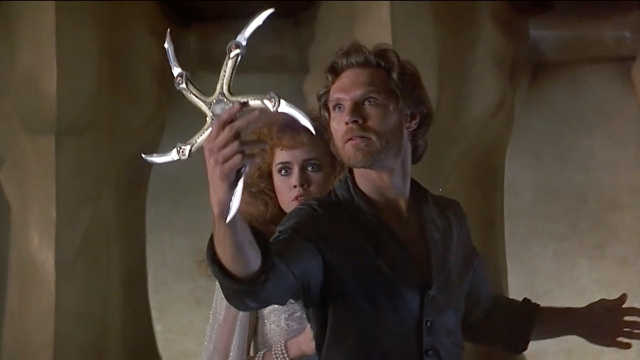
A definitive shining example (AND a prime candidate for a remake)
Since the screenwriter’s education is ongoing, there’s always something for you to work with or study to get a better grasp and understanding of what constitutes good writing, which can then be applied to your own.
Read scripts. Attend or take part in a table read. Watch movies.
While there are countless examples of exemplary writing and filmmaking to see it done properly and effectively, there are even more examples of crappy writing and lousy filmmaking to see it done poorly and ineffectively.
Nobody starts out with the intention of making a bad movie. What starts out as a great script can easily be messed up along the way to the point that there’s no salvaging it. It happens.
Is watching one waste of time? Not necessarily.
As enjoyable, informative and educational as the good stuff is, the bad stuff is actually just as good, possibly even more so. Because from these cinematic travesties you can learn what not to do with your own scripts. Lessons abound with all the glorious misfires regarding story, characters, and dialogue.
Regrettably, bad acting is a category all by itself and there’s nothing that can be done about it. Do what you can to ignore it (which can border on the impossible, depending on the quality of badness) and focus on the non-tangibles.
It’s especially helpful to work with something from the same genre as your script. See how they did it, then compare it to your own. Can you see why theirs didn’t work? Is it riddled with plotholes you could drive a truck through? Is the dialogue pure on-the-nose? Do the characters come across as unrealistic caricatures?
Look at it as a whole. Does it respect the reader/audience’s intelligence? Is the structure solid? Do you care about what happens to these characters over the course of the story?
Now bring your script into the equation – and be objective! How much of a similarity or difference is there between that story and yours? Did that other material open your eyes to some previously unforeseen flaws and potential problems within your script, so much that it made you realize “this needs work”?
Once you identify these problems, your writer’s mind goes to work, figuring out how to make sure your script doesn’t repeat the mistakes you just read or watched.
It may not be easy to endure having to watch a bad movie just for the educational experience, so just keep reminding yourself “It’s to help me become a better writer”.
Good luck!
Question time! What’s your favorite bad movie? Feel free to list it in the comments.
Learn to trust your feelings. Even with the blast shield down.
I’ve had the experience of working with some writing, both my own and other people’s, that required a second opinion. For some of them, I was the second opinion, while the others involved my work being reviewed.
An experienced professional asked me to take a look at another writer’s script, accompanied with their excitement and enthusiasm about it. Upon reading it, I found it severely lacking in a lot of screenwriting fundamentals (bad structure, shoddy character development, etc.), and said so as part of my notes of what was needed to improve.
I like to read a script twice before giving notes on it, and it took a lot of effort to get through each one – especially the second time. That whole time I was wondering “Where is this enthusiasm coming from?” This person knows what a good script looks like, and this one, to me, didn’t meet any of the necessary criteria. And if they felt this way about this script, could I trust their judgment on others?
Last week I’d been given the offer to have my query letter reviewed. I put it together with the elements I considered vital: quick one-sentence pitch, logline, reputable contest results. As fast a read as possible.
The response read like something churned out by a machine. Their recommendation was to follow “their blueprint”, which involved a lot of fill-in-the-blanks, how it’s similar to successful films (the more recent, the better!), telling the story from only the main character’s point of view, and concluding with “why I think this will be a hit” OR the underlying theme. The end result is several big unappealing blocks of text.
All of this felt totally and absolutely wrong. If I were the intended recipient, I might start reading, but would most likely lost interest very quickly and be very hard-pressed to want to continue, let alone finish it.
(With no intention of ever actually using a letter written following their guidelines, I put one together and submitted it for review, just to see what they would say. Their follow-up comments reinforced my doubts, but that is a topic for another day.)
As you probably guessed, I’ll be sticking with my original format.
The takeaway from both of these experiences is that a writer must not only develop their writing and storytelling skills, but also the ability to trust their instincts. Know what works, not only for you, but in an overall sense.
Don’t always assume the other person is in the right. Sometimes they’re not.
Everybody will have an opinion about something. You might agree wholeheartedly or think the other person has no idea what they’re talking about. It takes time to learn how to determine which is which. You will make mistakes and bad choices along the way, but make the effort to learn from them so you don’t do it again.
Like with writing itself, the more you work at it, the better at it you’ll become.



 Maximum Z