Writing in your own voice

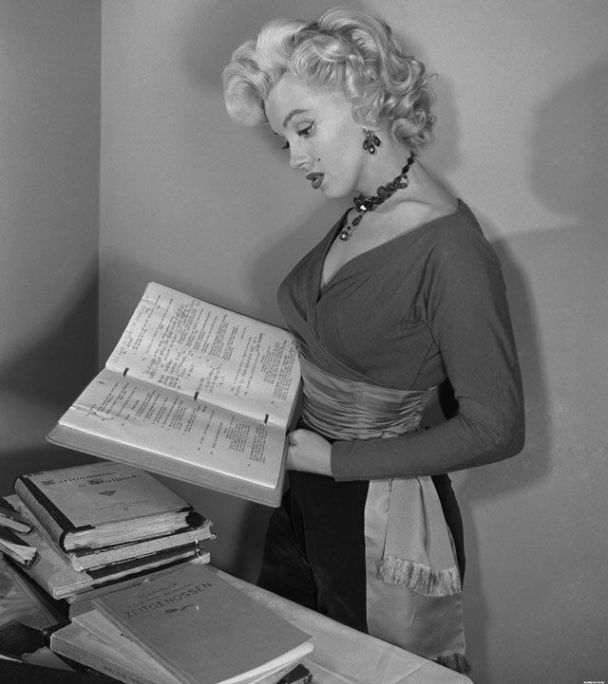
Marilyn script
“Hmm. Billy’s new script. Men dressing up as women to hide from gangsters? Sounds funny.”

When I’ve done script notes for writing colleagues, no matter what the genre is, I can usually tell who wrote it – because of the way it reads. Each writer has their own particular style, so each of their scripts has its own corresponding “sound”. Or I’ll get notes back on my material which often includes a comment along the lines of “this sounds like something you’d write”.

This isn’t just about dialogue. It’s about a writer’s overall style, or how they tell the story of their script. You don’t just want the reader to read your story; you want them to experience it. Which can be accomplished by adding that extra layer.

Everybody develops their own individual style, and it takes time to find it. The more you write, the more you’ll be able to hone your writing to reflect your own individuality.

Just a few things to think about:

-How does your script read? Is the writing crisp and efficient, or are you wasting valuable page real estate with too many lines of  your loquacious verbosity? Taking it one step further, do you use the same words over and over, or do you relish any opportunity to give your thesaurus a solid workout?

-How is your story set up and how does it play out? Is it simple and straightforward, or complex and full of deliciously tantalizing twists and turns? Are you working that creativeness to show us things we haven’t seen before, or is just page after page of the same ol’, same ol’?

-Is it a story somebody besides you would want to see? Just because you find the subject matter interesting doesn’t mean it has universal appeal. However, there is the counter-argument to that in which you could attempt to have your story include elements that would satisfy fans of the genre while also appealing to newcomers.

-Can’t ignore the population within the pages. Are your characters well-developed and complex, or do they come up lacking? Do we care about them, or what happens to them? Can we relate to them?

-What are your characters saying, or not saying (subtext!)? How are they saying it? Do they sound interesting or dull as dishwater? Very important – do they sound like actual people, or like “characters in a movie”?

Remember – the script is a reflection of you. A solid piece of writing shows you know what you’re doing. Offering up something sloppy is simply just sabotaging yourself.

Who hasn’t heard a variation on the line about a script being a cheap knockoff of a more established writer? While I can understand admiring a pro writer’s style, why would you attempt to copy it? It probably took them a long time to find their own voice, and by trying to write like they do, you’re denying yourself the opportunity to do the same thing for yourself.

Or to put it another way: they didn’t take any shortcuts to become the writer they are today, so why should you?

All that on a single piece of (digital) paper?

bad 1st impression
It can only go downhill from here

You only get one chance to make a good first impression. And that also applies to a screenplay. If your first page doesn’t make us want to keep going, why should we? Chances are the rest of it is exactly the same.

The first page is your golden opportunity to start strong straight out of the gate. Show us from the absolute get-go you know what you’re doing. A lot of the time, I’ll know by the end of the first page what kind of ride I should be expecting.

Just a few items to take into consideration.

-First and foremost, how’s the writing? No doubt you think it’s fine, but face it. You’re biased. You want a total stranger to find it fault-free, so look at it like one. Is it easy to follow and understand? Does it flow smoothly? When I read it, do I get a clear mental image of what you’re describing? Does it show, not tell?

-Is there a lot of white space? Are your sentences brief and to the point, or do they drone on and on with too many words?

-Do you point the reader in the right direction and let them figure things out, or at least get the point across via subtext, or do think it’s necessary to explain everything, including what a character is thinking or feeling? Yes, that happens on the first page.

-If your protagonist is introduced here, are they described in the way you want me to visualize them for the next 90-110 pages? Does a notable physical characteristic play a part in the story? Are they behaving in such a way that it establishes the proper starting point for their arc? Are they doing something that endears them to us, making us care about them?

-If your protagonist ISN’T on the first page, does it do a good job in setting up the world in which the story takes place? Do the characters introduced here play any kind of role later on in the story?

-Are there any mistakes regarding spelling or punctuation? Are you absolutely sure about that? SPELLCHECK IS NOT YOUR FRIEND. A team does not loose a game, nor do I think they should of won either. Two glaring errors that your software will not recognize. But a reader will.

-Does it properly set up the genre? If it’s a comedy, should I be prepared to have my sides ache from laughing too hard? If it’s a horror, should I make sure the lights are on, even if it’s 12 noon? If it’s a drama, should I have a box of tissues within arm’s reach to dry the expected river of tears?

-Do your characters sound like people saying actual things, or are they spouting nothing but exposition and overused cliches?

Not sure about any of these? Read it over with as critical an eye as you can muster, or get help from somebody within your network of savvy writing colleagues. DO NOT go to somebody who doesn’t know screenwriting.

Think I’m being overly critical? Ask any professional consultant or reader, and I bet 99 out of 100 will say they know exactly what kind of read they’re in for by the end of the first page. And number 100 might also agree.

Then again, there’s also the possibility that the first page could be brilliant and it stays that way until FADE OUT.

Or the wheels could fall off anywhere between page 2 and the end.

Your mission, and you should choose to accept it, is to make that first page as irresistible as you can, grab us tight, and not let go. Make us want to keep going. Then do the same for page 2, then page 3, page 4, etc.  Make us totally forget what page we’re on.

Take a look at the first page of your latest draft. Does it do what you and the story need it to?

-Didja notice the spiffy new look? Had to make some behind-the-scenes changes, and this is the result.

A few words about dialogue

So when your characters speak, does what they say SOUND like something people would actually say, or does it come across as “too movie-like”?

Do they say EXACTLY what they mean?

Dialogue is a very tricky part of screenwriting that takes a lot of practice to make the words being spoken sound totally natural. When we listen to what the characters are saying, you don’t want to make us aware we’re watching a movie.

Too many times we’ll read the characters’ dialogue, and it leaves us totally flat. Maybe it’s pure exposition. Or nothing but cliches. Or exactly what you think they’ll say. There’s no subtext. No implying. Just straight-out “this is what I want to say”.

All of this makes for some boring and, in all honesty, awful reading. And if the dialogue isn’t good, it’s pretty likely the rest of the script isn’t that good either.

(And the less said about parentheticals, the better. In short – DON’T!)

A lot of writers will jot down lines of dialogue because they think that’s what the characters should be saying. But it goes a lot deeper than that. The dialogue is just one way for the character to express themselves. In fact, sometimes the most effective dialogue is where the character doesn’t say a word.

Do the lines read like the writer put a lot of thought into the content or intent of what’s being said? Audiences and readers are smarter than you give them credit for. They will get nuance and innuendo, which are both more effective than just saying the actual words.

How many writers say the lines out loud to see how it sounds? You may think that monologue is nothing short of genius, but in reality it probably makes the reader’s eyes glaze over for how much it rambles. There’s a lot to be said for organizing a table read of your script (where you will quickly learn to identify most problems, let alone having them pointed out to you by the actors).

Going back to one of the earlier questions, does what the characters are saying sound like not only something they would say, but something you would say? There’s a little bit of you/the writer in every character, so you know them better than anybody, which therefore makes you the most likely to know what they would say and how they would say it.

Like with the scene itself, you want the dialogue to deal only with the point of the scene, or at least be integrated into the context of the story. Anything extra is just going to slow things down, and the more unnecessary dialogue you have, the more it’s going to drag. Cut what you don’t need so you’re not wasting anybody’s time. Get in late, get to the point as soon as possible, get out.

There’s no secret formula for writing good dialogue. It just takes time to learn how. Read scripts and watch movies similar to yours. See how they did it, and work on applying the same principles to your material. Use what the characters are saying (and aren’t saying) to help tell the story of your script, with the challenge being keeping the words spoken and unspoken true to both characters and story.

And again – stay away from parentheticals. Please.

Ask a Most Excellent Script Consultant!

Wayne McLean

The latest in a series of interviews with script readers and consultants who would be worth your while to work with if you want to get your script in shape. Today’s spotlight is on Wayne McLean of Wayne’s Movie World.

-update on May 4, 2018 – Wayne passed away on April 30th from congestive heart failure. He provided me with some great notes for my western, and enjoyed getting my updates regarding its progress. He was very savvy when it came to writing advice, extremely generous with offering it, and overall just a very nice guy.

1. What’s the last thing you read/watched that you thought was incredibly well-written?

The Imitation Game, Nightcrawler, Whiplash.

2. How’d you get your start reading scripts?

I fell into it by accident. I was in a writers’ group. One of the guys was produced and went to Toronto for a pitchfest. He brought back 95 or 100 scripts. I read them all and called each writer to give input. No charge. After about 90 phone calls I said, “I can do this.” My 25-year career in broadcasting really helped. That was about 10 years ago.

3. Is recognizing good writing something you think can be taught or learned?

I work with writers and their scripts to provide the focus necessary to perfect the skills required for the CRAFT of screenwriting in relation to their scripts. Then, through a careful process, the writers and I work together to develop their talents to enable them to become proficient in the ART of screenwriting.

4. What are the components of a good script?

Amazing writing with a unique point of view. Compelling, riveting characters. Crackling dialogue. Powerful subtext on all levels. Scenes and situations that are fresh. Marketable.

5. What are some of the most common mistakes you see?

Clichés. Sending out a script that isn’t ready for the market.

6. What story tropes are you just tired of seeing?

Characters waking up from a dream. Fragmented concepts. Two-dimensional characters.

7. What are the 3 most important rules every writer should know?

I don’t ascribe to the idea of ‘rules’. I prefer to see a writer following guidelines and principles. The script must be entertaining, entertaining and entertaining.

8. Have you ever read a script that was an absolute, without-a-doubt “recommend”? If so, could you give the logline?

I cannot disclose loglines. All materials submitted are confidential and conform to my rules of privacy. I do have some clients with million dollar concepts.

9. How do you feel about screenwriting contests? Worth it or not?

If a writer can afford it, enter as many contests as possible. Use them as an opportunity to develop writing skills and ask if there is input available from the judges.

10. How can people get in touch with you to find out more about the services you provide?

(See note above. Wayne’s website & email have been shut down.)

Check out my website waynesmovieworld.com or email me at wayne@waynesmovieworld.com.

11. Readers of this blog are more than familiar with my love/appreciation of pie. What’s your favorite kind?

Pumpkin.