Working in a timely manner

train conductors
“Now that’s something you don’t see every day, Chauncey.” “What’s that, Edgar?” “A writer setting a schedule and sticking to it.”

Following the lead of some of my writing colleagues, I’m making more of an effort to establish a sense of order and structure when it comes to my writing and all things connected with it.

It used to be “Write when you can!,” which in a way it still is, but more layers and categories have been added to the mix.

-First and foremost, the setting aside of at least an hour a day to work on one of my own projects continues, be it outlining, writing, editing, rewriting, or polishing. This remains the primary objective.

-Networking. While connecting with people is easy, maintaining those relationships takes effort, and can quickly become time-consuming. As much as I enjoy conversing (albeit online) with people, I try to keep it to a minimum – unless it’s relevant to the project of the moment.

-Related to that is the reading and note-giving for other writers, especially those who were equally as generous with their time to do the same for me. I may not always be on schedule about it (something I’m trying to improve), but I make a point of getting it done.

-Career-building. This mostly involves researching potential recipients for pitching and queries, which means diving head-first into the scavenger hunt that is IMDB Pro. While most of the time the contact info is accurate, sometimes it’s out of date (people move on), or there’s no contact info whatsoever, or the person or company in question hasn’t existed for years.

*True story – researching an agent, I’d discovered they’d apparently died several years before but the email was still in operation. I opted not to query them.

-Overall stayin’ organized. I’ve started jotting down each day’s objectives and “must do’s” in a little notebook, and checking off items as they are accomplished. It’s been very helpful in making me stay focused on what needs to get done, rather than hoping I remember later on.

All of this is still somewhat early in the process, but so far, so good. That feeling of being in control helps make the whole thing seem a little easier, as well as feeling like stuff is actually getting done.

How about you? What steps are you taking to be more organized with your writing?
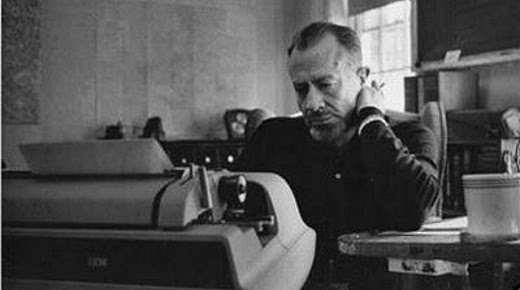
If only I were getting paid to be this busy…

Steinbeck typing
There are worse role models

It’s been a busy couple of days with no sign of letting up, so another shorty today.

-Sorry to say a lot of my time recently has been taken up dealing with technical issues for my email and this blog. Many’s the time I wanted to fling my laptop against the wall due to something not doing what it was supposed to be doing.

-Latest batch of query letters sent. A handful of “send it!” (fingers crossed for that one to the big prodco), a handful of “thanks, but no thanks” and a lot of silence from the rest. Undeterred, I’ve got a few new lists ready to go.

-Got some great suggestions and feedback on my 1-pagers, so rewrites are underway.

-A hearty thanks to those who’ve contacted me about “scripts wanted” listings which are potentially solid matches for some of mine. Follow-ups are in progress.

-Still working on script notes for a few of you. Your patience is greatly appreciated.

-Huge thanks to those offering their support and words of encouragement during some recent times of feeling lousy, confidence-wise. Knowing you’re in my corner means a lot.

-Even though I’ve been super-busy, I’m still doing what I can to do some actual writing, both for my own projects and some outside ones I’m involved with. It’s not always easy, but really making the effort to get something done each day.

Have a great weekend, and hope you get some kickass writing done.

Don’t open that door!

doors

Another busy week around Maximum Z HQ, with a significant part of it involving waiting to hear about the potential future of some of my projects.*

I hate the waiting. It opens the door to allow fear and anxiety to stroll on in.

A friend who’s a director put it very succinctly: It’s all about control. A lot of that stuff is out of your hands now, which makes you nervous about the outcome. You have to redirect your attention to anything and everything for which you can take charge, and do something with it. The sooner the better.

How absolutely true, and it was exactly the reminder I needed.

In my case, that comes down to the work and all things related. It’s easy to forget how many things with which I’m involved. My own stuff (which is a growing category unto itself), giving notes, networking, sending out queries, just to name a few.

Sure, it would be great for everybody to respond quickly, preferably with news of a positive nature, but it doesn’t work that way. These things are known to drag out for excruciatingly long periods of time, and me fretting over it is the last thing I need.

I wouldn’t even be surprised if I get an email in a few months about one of these that I’ll probably have totally forgotten. It’s happened before.

Keeping busy really does help you stay focused and keep the negatives at bay. It might not be easy, but do what you can to slam that door shut, lock it and throw away they key.


*heard back from a producer soon after posting this. They passed on my script, which sucks, but will now re-double my efforts with the other projects.


The unscientific term would be “gut reaction”

trust your feelings
Learn to trust your feelings. Even with the blast shield down.

I’ve had the experience of working with some writing, both my own and other people’s, that required a second opinion. For some of them, I was the second opinion, while the others involved my work being reviewed.

An experienced professional asked me to take a look at another writer’s script, accompanied with their excitement and enthusiasm about it. Upon reading it, I found it severely lacking in a lot of screenwriting fundamentals (bad structure, shoddy character development, etc.), and said so as part of my notes of what was needed to improve.

I like to read a script twice before giving notes on it, and it took a lot of effort to get through each one – especially the second time. That whole time I was wondering “Where is this enthusiasm coming from?” This person knows what a good script looks like, and this one, to me, didn’t meet any of the necessary criteria. And if they felt this way about this script, could I trust their judgment on others?

Last week I’d been given the offer to have my query letter reviewed. I put it together with the elements I considered vital: quick one-sentence pitch, logline, reputable contest results. As fast a read as possible.

The response read like something churned out by a machine. Their recommendation was to follow “their blueprint”, which involved a lot of fill-in-the-blanks, how it’s similar to successful films (the more recent, the better!), telling the story from only the main character’s point of view, and concluding with “why I think this will be a hit” OR the underlying theme. The end result is several big unappealing blocks of text.

All of this felt totally and absolutely wrong. If I were the intended recipient, I might start reading, but would most likely lost interest very quickly and be very hard-pressed to want to continue, let alone finish it.

(With no intention of ever actually using a letter written following their guidelines,  I put one together and submitted it for review, just to see what they would say. Their follow-up comments reinforced my doubts, but that is a topic for another day.)

As you probably guessed, I’ll be sticking with my original format.

The takeaway from both of these experiences is that a writer must not only develop their writing and storytelling skills, but also the ability to trust their instincts. Know what works, not only for you, but in an overall sense.

Don’t always assume the other person is in the right. Sometimes they’re not.

Everybody will have an opinion about something. You might agree wholeheartedly or think the other person has no idea what they’re talking about. It takes time to learn how to determine which is which. You will make mistakes and bad choices along the way, but make the effort to learn from them so you don’t do it again.

Like with writing itself, the more you work at it, the better at it you’ll become.


The significance and heartbreak of almost

Tim Love/Hellmanns Recipe shoot.
You celebrate your way. I’ll celebrate mine.

Well, that’s that. The results are in, and it looks like it was mighty close. Practically a photo finish. One that will be debated by scholars far and wide long after the fact.

Actually, I have no idea what the results were.

All I know is that the 2015 Screencraft Action/Thriller contest announced its Grand Prize winner and First Place winner, and my western was neither.

(I almost said it failed to get either, but opted not to. More on that in a sec.)

It did, however, place among the top ten finalists, so I guess that’s something.

An honor to be part of this elite group? Most definitely. All ten finalist scripts are being distributed to Screencraft’s network of industry contacts, so all I can do now is hope for the best (while working on new scripts, of course).

That being said, how can I not feel pangs of frustration from not achieving either of the top two? Could the script have been better? Probably. Is it solid enough now? I like to think so. For all I know, it came in third.

I totally get how this is part of the process and should be thrilled the script made it this far. Believe me, I am. Very much so. But I’d be lying if I didn’t say I, along with every other writer who entered the contest, wasn’t entertaining daydreamy thoughts of being proclaimed the winner. But that’s not how it worked out.

Honestly, it hurts. Or maybe stings is more fitting. Either way, it feels like “I tried my best, but it still wasn’t good enough.” This sensation will linger for about a day, eventually fading but not totally disappearing. By that time I’ll have dusted myself off, ready to jump back into my normal routine of full speed ahead. I’ve got a few irons in several fires, plus a few projects I prefer to keep on the QT. For now, at least.

I mentioned being tempted to say the script failed to win. True, it didn’t win, but maybe “fail” is too harsh a word. The script did exceptionally well, which I suppose is a reflection of my writing ability and how it’s developing. This is the third consecutive year I’ve had a script place in some manner in a contest, so I must be doing something right.

So for now I’ll keep in mind that sage piece of wisdom uttered after all competitions:

Just wait ’til next year.