The silver lining of a bad movie

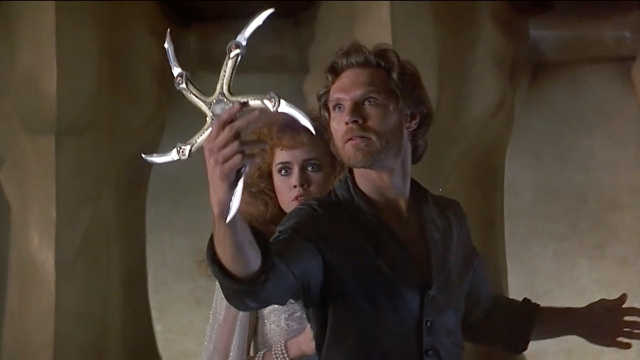
Krull
A definitive shining example (AND a prime candidate for a remake)

Since the screenwriter’s education is ongoing, there’s always something for you to work with or study to get a better grasp and understanding of what constitutes good writing, which can then be applied to your own.

Read scripts. Attend or take part in a table read. Watch movies.

While there are countless examples of exemplary writing and filmmaking to see it done properly and effectively, there are even more examples of crappy writing and lousy filmmaking to see it done poorly and ineffectively.

Nobody starts out with the intention of making a bad movie. What starts out as a great script can easily be messed up along the way to the point that there’s no salvaging it. It happens.

Is watching one waste of time? Not necessarily.

As enjoyable, informative and educational as the good stuff is, the bad stuff is actually just as good, possibly even more so. Because from these cinematic travesties you can learn what not to do with your own scripts. Lessons abound with all the glorious misfires regarding story, characters, and dialogue.

Regrettably, bad acting is a category all by itself and there’s nothing that can be done about it. Do what you can to ignore it (which can border on the impossible, depending on the quality of badness) and focus on the non-tangibles.

It’s especially helpful to work with something from the same genre as your script. See how they did it, then compare it to your own. Can you see why theirs didn’t work? Is it riddled with plotholes you could drive a truck through? Is the dialogue pure on-the-nose? Do the characters come across as unrealistic caricatures?

Look at it as a whole. Does it respect the reader/audience’s intelligence? Is the structure solid? Do you care about what happens to these characters over the course of the story?

Now bring your script into the equation – and be objective! How much of a similarity or difference is there between that story and yours? Did that other material open your eyes to some previously unforeseen flaws and potential problems within your script, so much that it made you realize “this needs work”?

Once you identify these problems, your writer’s mind goes to work, figuring out how to make sure your script doesn’t repeat the mistakes you just read or watched.

It may not be easy to endure having to watch a bad movie just for the educational experience, so just keep reminding yourself “It’s to help me become a better writer”.

Good luck!

Question time! What’s your favorite bad movie? Feel free to list it in the comments.

Happy to be done with it

jump-for-joy
Yeah, kind of feels like this

Another chapter has closed in my ongoing quest to become a working writer, or at least an annoying wrinkle has been ironed out.

Following the latest but not-surprisingly disappointing results, my involvement with the  “pay to pitch” practice has come to an end. A person can only take so much before totally abandoning the ship in question.

Simply put: I ain’t doin’ it no more.

How did I end up here? Easy. Desperation.

Despite all my efforts on several fronts, nothing was happening with any of my scripts. I got to the point that I’d try anything.

So I tried this. A few times, each with the same result – PASS, accompanied with a few classic chestnuts. “Couldn’t get excited about the story.” “Didn’t really care about the characters.” “No specificity of the throughline.” (This last one will stick with me until the end of time.)

I even went so far as to do one via video streaming, but technical issues really mucked things up. It’s kind of tough to pitch to someone when they can see you, but YOU CAN’T SEE THEM. Did the best I could, but still another PASS.

I got a survey/questionnaire about this one, and didn’t pull any punches in airing my frustration about it, adding how I couldn’t in good conscience recommend the service to anybody.

A representative contacted me soon afterward, expressing their sympathy and understanding, as well as an explanation that “their policies regarding responses were different now”, and offered a free pitch. I considered it, and decided to hold off unless something too irresistible came along. The rep also offered to help me with the pitch so as to get maximum results.

A few months went by, and what seemed like a solid match popped up. I contacted the rep, asking for their help, which they provided in the form of suggested edits. Each subsequent draft had to be uploaded to a file-storing program for the rep to read it, but I didn’t know if each new draft was replacing the old one, or just sitting there next to it. My emails to the rep were going unanswered, and the deadline was drawing near fast. In the end, there was nothing I could do.

The deadline came and went. Days went by, and no response. Days turned to weeks, and still nothing. As it neared the 2-month mark, I’d decided that was a sufficient amount of time and sent an email to the rep asking what had happened (plus a copy to the rep’s supervisor, just in case).

The response was almost immediate – from the supervisor. This was the first they’d heard about my situation, apologies were offered, along with the promise to give my pitch top priority with that company the next time. I said I’d be in touch.

A few hours later, I got an email from the original rep, who informed me they were no longer with the company (their departure most likely around the same time as, if not before, my original deadline).

Jump ahead a few days, and a response to my original pitch arrived from the company in question.

5/5 in every category, save for a 3/5 in Character Obstacles (which was one of the things I’d cut based on the rep’s suggestions).

PASS.

I sent another email to the supervisor, informing them about this (since I’m sure they weren’t even aware of it) and officially calling it quits. I won’t hold my breath waiting for a response.

What bothers me the most about this whole experience is how easily I bought into the false hope that was being sold. Like I said, I was feeling frustrated and desperate, and this seemed like my only option, which of course it wasn’t.

There are very rough days where I get extremely depressed about my lack of progress, and going through something like this doesn’t help – especially when it keeps happening over and over again. You learn real fast how many hits you can endure before wanting to simply give up completely.

But I’m not at that point just yet.

A lot of writer friends have offered up words of encouragement, and a few positive things have happened recently so as to improve my spirits, or at least renew my belief in my writing skills. Things will take a turn for the better.

The marathon continues, one step at a time. But I won’t be paying for it anymore.


Don’t open that door!

doors

Another busy week around Maximum Z HQ, with a significant part of it involving waiting to hear about the potential future of some of my projects.*

I hate the waiting. It opens the door to allow fear and anxiety to stroll on in.

A friend who’s a director put it very succinctly: It’s all about control. A lot of that stuff is out of your hands now, which makes you nervous about the outcome. You have to redirect your attention to anything and everything for which you can take charge, and do something with it. The sooner the better.

How absolutely true, and it was exactly the reminder I needed.

In my case, that comes down to the work and all things related. It’s easy to forget how many things with which I’m involved. My own stuff (which is a growing category unto itself), giving notes, networking, sending out queries, just to name a few.

Sure, it would be great for everybody to respond quickly, preferably with news of a positive nature, but it doesn’t work that way. These things are known to drag out for excruciatingly long periods of time, and me fretting over it is the last thing I need.

I wouldn’t even be surprised if I get an email in a few months about one of these that I’ll probably have totally forgotten. It’s happened before.

Keeping busy really does help you stay focused and keep the negatives at bay. It might not be easy, but do what you can to slam that door shut, lock it and throw away they key.


*heard back from a producer soon after posting this. They passed on my script, which sucks, but will now re-double my efforts with the other projects.


The significance and heartbreak of almost

Tim Love/Hellmanns Recipe shoot.
You celebrate your way. I’ll celebrate mine.

Well, that’s that. The results are in, and it looks like it was mighty close. Practically a photo finish. One that will be debated by scholars far and wide long after the fact.

Actually, I have no idea what the results were.

All I know is that the 2015 Screencraft Action/Thriller contest announced its Grand Prize winner and First Place winner, and my western was neither.

(I almost said it failed to get either, but opted not to. More on that in a sec.)

It did, however, place among the top ten finalists, so I guess that’s something.

An honor to be part of this elite group? Most definitely. All ten finalist scripts are being distributed to Screencraft’s network of industry contacts, so all I can do now is hope for the best (while working on new scripts, of course).

That being said, how can I not feel pangs of frustration from not achieving either of the top two? Could the script have been better? Probably. Is it solid enough now? I like to think so. For all I know, it came in third.

I totally get how this is part of the process and should be thrilled the script made it this far. Believe me, I am. Very much so. But I’d be lying if I didn’t say I, along with every other writer who entered the contest, wasn’t entertaining daydreamy thoughts of being proclaimed the winner. But that’s not how it worked out.

Honestly, it hurts. Or maybe stings is more fitting. Either way, it feels like “I tried my best, but it still wasn’t good enough.” This sensation will linger for about a day, eventually fading but not totally disappearing. By that time I’ll have dusted myself off, ready to jump back into my normal routine of full speed ahead. I’ve got a few irons in several fires, plus a few projects I prefer to keep on the QT. For now, at least.

I mentioned being tempted to say the script failed to win. True, it didn’t win, but maybe “fail” is too harsh a word. The script did exceptionally well, which I suppose is a reflection of my writing ability and how it’s developing. This is the third consecutive year I’ve had a script place in some manner in a contest, so I must be doing something right.

So for now I’ll keep in mind that sage piece of wisdom uttered after all competitions:

Just wait ’til next year.

A multi-pronged approach

freeway
Lots of different ways to go, as long as you know where you’re going

Had another great lunchtime chat with a fellow writer yesterday. Among the many topics of conversation: the necessity of how a writer trying to break in must work towards achieving success from as many angles as they can.

Got a good script? How many others have you got that are ready to go? How many are you currently developing so as to increase that number? Are you sticking with one genre or trying several?

Are you actively seeking writing projects? There are a lot of smaller, not-as-prestigious projects out there in need of writers. You may not get a big paycheck, but you’ll gain experience (and maybe an onscreen credit). It could also help educate you about what goes on during production.

Think your script is good enough for one of the high-profile contests? What’s more important to you – the prize money, the prestige of winning (or at least placing), or how this could help get your career going?

Are you connecting with other writers? As introverted as a lot of writers are, social contact is a necessary factor of doing it professionally. It’s one thing to communicate electronically, so make a point of going to a social event in your area (you could even go so far as to arrange one!), or attend a conference where you actually talk to people. This will also come in handy when you reach that next level and start taking meetings.

You’ve done everything you can with this current script and are ready to start looking for representation. How much research have you done into who would be the most receptive to it? Does your script seem like a good match for them? Have you worked on that query letter to the point that it would be impossible for them to not want to read your script?

Naturally, these questions and situations are just the tip of the proverbial iceberg. Everybody’s path is going to be different from yours, but there will be similarities. Fortunately, you have time and a wide array of resources at your disposal to start preparing in your own way for all of them.

Good luck, and get to it.