Big net still at the ready

net
It’s all in the wrist

The current work slate involves a few story ideas, a fair mix of new and old, and all of them appeal to me as far as being “I’d want to see this” and “that sounds like fun” types of material.

As they should.

But it’s easy to forget that while you may be crazy about your story and totally get it, others might need a little more convincing.

It’s one thing to have a built-in audience already clamoring for your material, but what about trying to appeal to everybody else?

That can be a little tricky, but it’s not totally impossible.

This line of thinking reminded me of a post I wrote a little over two years ago, and I believe it’s still relevant.

Enjoy.

“As you work your way through the various stages of assembling your story, how much do you take the audience’s needs and wants into account?

You’re obviously writing something you would want to see, but do you ever consider the viewing tastes of someone who’s not like you whatsoever?

While I may write high-concept tales of adventure that would definitely appeal to 12-year-old me, it’s also my objective to try to craft those stories in such a way so they could entertain anybody of any age.

(Strong examples of this kind of storytelling? Most of the Pixar catalog.)

Here are just a few things to take into consideration:

-Are you treating the reader/audience the way they should be treated? Which means with intelligence. I’ve always hated when a story feels dumbed down, and suspect most other moviegoers do as well.

-That being said, is your story simple enough to the point that anybody could understand what’s going on, or at least have a general understanding of it?

-Regardless of what genre your story falls into, how much are you taking advantage of the elements of that genre? Since you’re most likely already a fan and probably have a good idea of what’s expected, this is your golden opportunity to show the rest of us what’s so appealing about it. Play on those strengths.

-With modern audiences more knowledgeable and movie-savvy than most writers realize, it’s more important than ever to come up with material that’s really new and original. What is it about your story that really sets it apart? What can you offer that we haven’t seen before?

As we start with an idea, develop it into a story that will eventually end up as a script, a lot of us daydream about the resulting movie, and how totally awesome it would be for it to be a big hit.

We can just picture the tremendous box office, rave reviews, non-stop awards, a king’s ransom of a paycheck, being begged to pick from a smorgasbord of new projects, all stemming from this story we cranked out with our own little hands, now practically guaranteed a place in the pantheon of pop culture.

“Everybody’s going to love it!” you imagine.

The reality is – they’re not, and a lot of that stuff won’t happen. But don’t let that stop you from trying.

The best we can do is write a solid, entertaining story populated with interesting characters who find themselves in unique situations, and hope people like it.”

Leaving an indelible impression

footprint
Not expecting it to last millions of years, but wouldn’t complain about it either

As an avid fan of summer movies, this year has been one big disappointment after another. Granted, I haven’t seen a few of the latest releases yet (STAR TREK BEYOND, SUICIDE SQUAD), but barely remember anything since CAPTAIN AMERICA: CIVIL WAR, and that came out in early May.

Remember all the hoopla preceding the GHOSTBUSTERS reboot? Kind of died off quickly, didn’t it? We saw it opening weekend, mostly because V wanted to, and it was…okay. I don’t attribute it’s lack of success to angry fans of the original, but because it just wasn’t that great a movie.

Was anything from this summer truly memorable? So far, not really (although I’m still holding out hope for the exquisite-looking KUBO AND THE TWO STRINGS).

It honestly seemed like everything simply wasn’t up to standard. Despite what the various marketing assaults might indicate, the end products felt too slapdash and that too many projects were focused on being ready for the release date rather than making sure the script was rock-solid.

Based on this and almost-daily reports of forthcoming reboots, remakes, and overall more of the same-ness, breaking in as a writer of original material suddenly seems significantly harder. Not only does your script have to really wow ’em, but it better pack a significant wallop on several levels.

A great, new story with phenomenal characters, all told in the most captivating way possible. Simple, no? I realize that a lot of films start with great scripts, but the process that leads up to the film being unleashed on the public can drastically affect it – too many times not for the better.

I’ve always seen my objective as to not only tell you a story that hasn’t been told before (or at least tell an old one in a totally new way), but to tell it in the most entertaining way possible. I want you to not be able to get those images out of your head (in a good way, as opposed to a dear-God-please-make-the-nightmares-stop kind of way).

I’ll be the first to admit that I’d love for one of my scripts to be one of the surprise hits of a summer season, but if recent releases are typical of what kind of material I’m up against, my work is more than cut out for me, if not potentially impossible.

It wouldn’t surprise me if somewhere down the line, my script got turned down because it was deemed “too original”.

A scary, sobering, and all-too-possible thought.


An education most painful

scared
Please don’t make me watch that again!

Once again, your stalwart author makes the necessary sacrifices so you don’t have to.

This time around, I had the misfortune of watching an extremely bad large-budget movie from the semi-recent past. It was painfully obvious that a larger percentage of the budget should have been diverted to hiring quality writers, rather than on everything else. A pipe dream, I know.

But trust me. It was bad.

What made it so bad, you may ask?

Oh, where to begin.

My biggest problem was that too much of the story felt glossed over, with vital elements explained in a very lazy and haphazard way, if they were even explained at all. It felt like they were trying to force events to match how they wanted the story to play out, rather than deftly setting things up.

Reasons why something would happen, or were supposed to have happened, seemed to have simply been thrown against the wall, and whatever stuck, that’s what they went with. Did it matter if it fit within the context of the story?

Nosireebob.

Once again, there were too many questions raised that were never sufficiently answered. When this happens, it simply takes away from the movie-watching experience. The only reason I knew the film had to have been around the midpoint area was because of its running time, and NOT because of what had transpired over the course of the story.

I could say I had a vague inkling of what was supposedly going on, but was just never sure, since the story was being told in a very sloppy and unorganized way. It irked me to no end to be see such terrible writing so prominently displayed. And apparently I wasn’t alone in my opinions. The film was a major flop at the box office.

So what silver linings can we extract from this pitch-black cumulonimbus that stole away just under two hours of my life?

-Write a story that’s easy to understand. Keep it simple. This doesn’t mean dumb it down. Keep us informed, unless withholding that information is absolutely necessary.

-Let the story play out organically. Don’t try to force it because that’s what you want to happen. It’s easy to tell when that happens, and it ain’t pretty. If you didn’t put in the effort to figure it out, why should we?

-Have things happen for a reason. “Because it looks cool” is not one of them. Would it drastically change things if it didn’t?

-Set up, pay off. If something happens, we want to see what happens as a result. Don’t leave us hanging. And counter to that, don’t suddenly spring something on us out of thin air. It reeks of desperation. Audiences don’t like that, either.

One of the things I always strive for in my scripts, be they big or small budget, is to respect the intelligence of the intended audience. That is one lesson I believe the writers of this abomination should have kept in mind.

Take us along for the ride

roller coaster.jpg
Hang on tight.

Here’s a two-part question for you. Pencils at the ready, please.

Up first – Are you enjoying the actual process of writing your script?

Sure, we all like “having written”, but what about getting there?

Do you get a thrill from figuring out your story? Mapping out the plot? Developing characters and crafting dialogue?

Do you get so engrossed and involved in your writing that when you check the time, you discover a lot more time has passed than you thought?

If you’re really excited and enthusiastic about your script, you’re going to feel that way even before you start writing it.

Now for the second part of the question:

Is all the aforementioned excitement and enthusiasm evident on the pages of your script? Could someone read it and think “Wow, they really like this stuff.”?

While it’s often said that you can gauge a writer’s grasp of the craft just by looking at the first page, you can also tell if they’re really into their story by how it reads.

Does it grab you from the get-go? Is the tone of the writing a solid match for the tone of the genre? This is not a case when “good enough” will cut it. What would you think if you read a horror that was “sort of” scary, or a comedy where all the jokes fall flat?

Exactly.

You want the reader to be as thoroughly entertained as you were in putting it together. You want them to be as compelled to keep turning the page as you’d be if you were reading it yourself.

A lot of the time you’ll hear a writer wrote something because “they had a story they had to tell”. That story was so strong and powerful inside them, they had no alternative but to write it out.

As creative types, that level of excitement and enthusiasm exists in all of us. We’re all eager to tap into it, but need to take the time to learn how to do it properly so it can be done in the most effective way possible.

Pencils down.

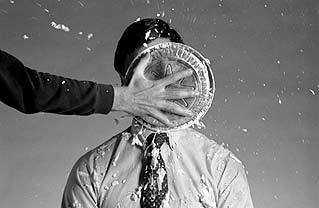
The dreaded ensuing of wackiness

pie-in-face
Done right, this is comedy gold

As part of my work on the low-budget comedy spec, I’ve made an effort to read other comedies to help get a better understanding of how it could be done and hopefully some guidance I could apply to mine.

It’s always been tough for me to read comedy because my sense of humor doesn’t always align with others. Many’s the time I’ve read a script that garners universal praise for being gut-bustingly hilarious, but doesn’t do anything for me.

There is, however, one detail I’ve noticed that keeps popping up:

Unrealistic situations.

Things that seem to happen only for the sake of a joke, and not much else. These often feel forced and inorganic to the plot. Almost as if the writer thought “Hey, wouldn’t it be crazy if ____?”

In theory, potentially a good idea, but in execution – not really.

Some might argue that since it’s comedy, things don’t have to be realistic as long as they’re funny.

I beg to differ. If I don’t think something could actually happen, I will most likely not find it funny.

**side note – this doesn’t necessarily apply to slapstick or absurdist fare, which are two entirely different discussions**

Sure, there are comedies where the entire premise isn’t all that realistic to begin with, but even the humor in those should stem from the situation, rather than being a crazy assortment of wacky gags.

Going for the easy laugh or cheap joke doesn’t take much skill and shows a lack of sincere effort. If a writer does it once, chances are they’ll do it a lot. It also doesn’t offer anything new. Who wants a joke they’ve probably seen or heard a thousand times before?

Looking at comedies that would be considered strong, there are a lot of instances where the joke is an integral part of the scene, rather than feeling like something tacked on.

You’ll hear that the best comedy is the kind that makes you think. I prefer comedy that shows the writer did a lot of the thinking.