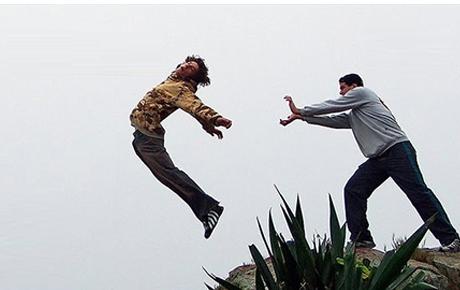
This was originally a clip of “Igor, would you give me a hand with the bags?”, but the greedy jackals at Fox have removed it. This photo proudly takes its place. RIP Mr Wilder
More feedback coming in on the comedy spec, so some tweaking and revamping is underway. Hope to be done with it soon.
In the meantime, I think these previous posts do a more-than-adequate job of summing up what a lot of writers, along with yours truly, probably experience and encounter during this process.
Notes are coming in for the comedy spec, and reactions are pleasantly positive. My always-reliable readers have provided some extremely helpful notes, including an across-the-board opinion about a key plot point.
A lot of what they had to say made some good sense and are really helping solidify the script into something more-than-decent.
While they had nice things to say about the script, each reader threw in an extra little tidbit in the form of comments directed at the script’s writer.
AKA me.
“These two lines of dialogue are an anomaly compared to the rest of it. I know you can do better.”
“Great story, but I’d like to see you dig deeper.”
And these are comments from experienced writers who’ve read some of my other scripts, so they know what I’m capable of. They’re not just saying these things in a casual, generic feedback kind of way, or because they’re trying to be nice. They really mean it, and I take what they say to heart.
I thought the script was okay to begin with, but after getting comments like these, it makes me want to try even harder.
When you’re in the process of putting a script together, you really dedicate yourself to doing a good job, and then try to do better with each subsequent rewrite. It’s how we improve.
But it’s also kind of tough to be able to get yourself past a certain point. You think you’ve done everything you can, but then you get a bit of a supportive nudge and your journey resumes.
It’s quite the confidence booster to know there’s somebody out there rooting for you (especially somebody without a vested interest in you). They want to see you succeed just as much as you do. So you buckle down and throw yourself into making that next draft even better.
End result – you have a stronger script and their belief in you and your abilities is confirmed. Wins all around.
And when the time comes and they ask me for notes on their script, I have a strong suspicion I’ll be able to do the same for them.
Intimidating at first, but eventually, just a big ol’ pussycat
When I was part of a writing group last year, each week we would read and critique a few members’ sets of pages. Some were just starting out, some had a few scripts under their belt, and some had been doing this a while. You can probably figure out which category I fell into.
Simply put, some of the writing just sucked. Really sucked. Like painful-to-listen-to sucked. To my credit, tempted as I was, I never actually expressed my thoughts that way.
I fully understood that not everybody had a firm grasp on the basics, and I, along with a few others, made a sincere effort to explain what would help improve their work. While a majority were appreciative of our comments, a select handful got defensive, some even to the point of flat-out dismissive, of any kind of comment that didn’t reinforce their belief that their writing was fine just the way it was.
This was one of the things that helped me decide to leave the group.
One of the universal truths about being a writer is that not everybody’s going to like what you’ve written, and just about everybody will have a suggestion as to how it could be better.
While there’s nothing you can do about the first part, the great thing about the second is that it gives you options. A lot of them. You like what this person said? Use it. Don’t like what that other person said? Ignore it.
Some people will make suggestions based on how they would do it, which is all well and good, but what’s more important is how you would do it. Do you agree or disagree with what they’re saying?
You’ll be bombarded with a wide variety of opinions, but don’t feel like you have to incorporate every single one. And while you may be the final word on what works and what doesn’t for your story, you shouldn’t dismiss every suggestion either. Some of them may be more helpful than you realize. There are a lot of writers out there with more experience than you, so their opinions should be at least taken into consideration. But it’s okay to disagree with them, too.
Speaking from experience, it takes time to learn not to take criticism of your material personally. The comments you receive may sting at first, but you have to remember they’re about the material, not you. Read them with a “How can I use these to get better?” frame of mind. That’s the only way you’re going to improve.
One last thing – make sure to thank the person for giving you notes, even if you totally disagree with everything they’ve said. Doesn’t matter if you asked them to do it or they offered. They took the time to help you out, and the least you can do is acknowledge that and express your appreciation for it. And it’s the polite thing to do. Manners still count.
Throughout the online writing community, among the many forums and networking groups, there will always be someone, most likely just starting out, who asks a question along the lines of:
“How do I go about accomplishing THIS?”
The variations on this are endless (as are the number of possible answers, but that’s another subject for another time).
A lot of the time, the question stems from a simple lack of knowledge; they just don’t know. Most likely, it’s about a subject which the more seasoned of us have an answer, probably having lived through it ourselves. Hoping to pass on the benefit of your experience, you provide an answer.
Is it what they were expecting to hear? Maybe. Maybe not. But you are giving them THE TRUTH.
With any luck, the question-asker is grateful and appreciative. A win for both sides. They learn something, and you fulfill the mentor role. Even if you just told them “For God’s sake, DON’T DO THAT!!”
And sometimes they don’t like the answer, possibly even getting angry and resenting you for telling them what is, in essence, THE WAY THINGS ARE. How dare you shatter their illusion in which they can do no wrong? They probably don’t realize how petty and thin-skinned they’re acting; two traits which will doom their potential writing career before it even gets started. Hey, at least you tried to help.
(Side note – this process is a two-way street. If somebody asks you a question straight out of the first day of Screenwriting 101, don’t insult or belittle them for asking it. You were in that exact same situation once too. Plus, it makes you come across as a total dick.)
If you’re among those just starting out, remember that nobody’s first script is at 100 percent. Mistakes will be made. Don’t be afraid of making them. It’s the only way you’re going to learn.
If you’re among those who’ve been down this road many times, be willing to take on the role of patient educator and help when you can.
Even though writing is for the most part a solitary activity, we’re still part of this community, and all in this together.
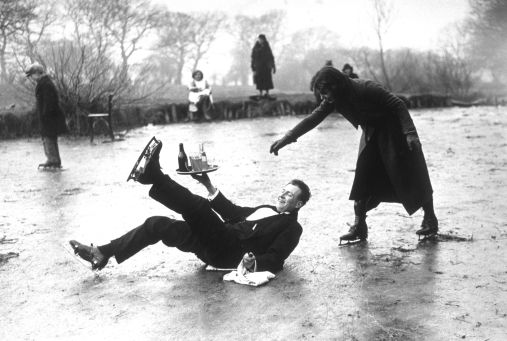
Just give me a sec to get back on my feet. Bonus – drink remains unspilled
The Chinese restaurant script got the standard “Just isn’t what I’m looking for” response from a producer.
Years of experience has taught me how to properly respond to this kind of situation.
“Well, that sucks. Okay. Moving on.”
Thus the struggle continues to gain a new foothold on this constant uphill climb. But I’m in it for the long haul.
Sure, it’s frustrating to get yet another “no” about a script, but getting upset about it won’t do me any good.
And what better way to get over it than by working on something else with the intent of making this one that much better? And there are plenty of something elses to keep me occupied.
A revamping of the outline of an older script continues, with pleasantly productive results (along with some phenomenal feedback on the logline). More insightful notes have come in for the comedy spec. Setting up a few more get-to-know-you meetings with other local writers*.
(*A meeting last week with one writer about her current project resulted in me being able to offer up some suggestions to another writer feeling frustrated about his. He, in turn, felt very encouraged with a renewed sense of hope, and was excited about some possible new avenues to try. I’m just happy to help.)
Hearing “thanks, but no thanks” still stings, but only for the briefest of moments. It’s taken a very long time for me to get to this point.
A few months ago, all that pressure I’d been putting on myself just went away. And I’m a lot better for it now.
And patient.
Success will happen when it happens.
But having it happen sooner rather than later would still be much appreciated.



 Maximum Z