Best seat in the house

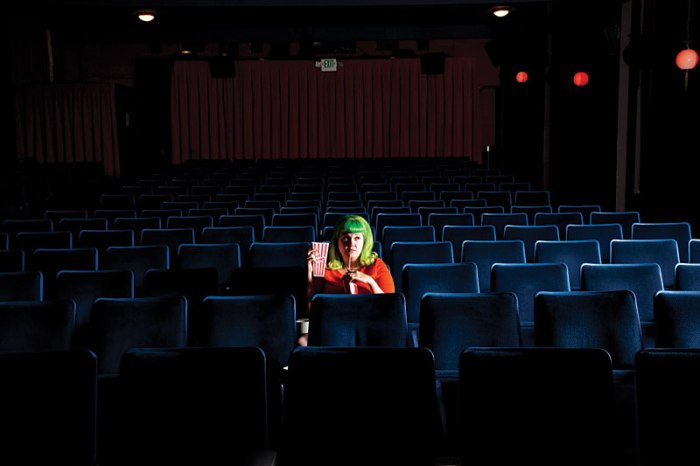
alone in theatre
The next person who comes in will sit directly in front of me. Guaranteed.

I recently had the opportunity to revisit the outline for my pulpy adventure story after having not looked at it in several months, and wanted to see what was needed in order to get me a little closer to being able to start on pages.

Time was limited, so I was only able to get through the first half. It was a pleasant surprise to discover that a lot of it still held up, plus an added bonus of some small inspirations resulting in tweaks that strengthened a few of the subplots and tied a few them together in a better way.

And of course, some of these new developments were a total change from how I’d always imagined them. This happens a lot for me.

But what was really the most positive experience out of this was how easy it was to “see” the story play out. It was as if I was in a private theatre, watching my imagination come to life on the big screen, complete with surround-sound. It definitely reinforced the kind of story I’m trying to tell.

When you’re putting your story together, or writing it, or even just reading it, how easy is it for you to visualize it? Do you “see” it as if you’re watching it in movie form? Is it a smooth transition from coming up with the idea to putting it on the page so it reads how you originally imagined it?

And therein lies part of the challenge. It’s just not an easy task, or at least isn’t for a lot of writers. It takes time to find the right words.

You might know what you want to say, but can’t find the exact way to say it, so you tinker around with it, trying and trying until something takes hold. Or maybe after writing it down, actually seeing it on the page makes you realize “this might not have been the best way to do it,” so you jump back in to come up with something new.

Sometimes I even go so far as to narrate aloud while acting out what’s happening for that particular part of the story (or as much as I can while sitting at my desk), which really helps, despite how silly it might look to somebody else.

As writers, the gears of our imaginations are always turning. Always. You could be doing something totally ordinary or mundane, and then, like a bolt from the blue, come up with a solution so perfect and now-obvious that you can’t understand why you didn’t realize it before.

So you work and work, making your writing better to the point that anybody reading your story will eventually be able to “see” it the way you want them to.

 

A workload on steroids

Man drowning in stacks of paperwork
All I need to do is cut out the non-essentials. Who needs food, sleep or oxygen anyway?

I’m in the home stretch for the November writing project. I got into Act 3 over the weekend, and think there about 10-12 pages left before I can call it a day. No reason I can’t wrap things up in the next couple of days. Estimated final page count should be somewhere in the mid-90s, so pretty much where I was hoping it would be.

My original intent was to put that on the back burner once it was done and shift my focus to another script, but something else has developed that definitely requires my attention: other people’s work.

Over the past couple of months, I’ve been very fortunate to have gotten some fantastic feedback from friends and trusted colleagues. Now it’s my turn to return the favor.

Actually, make that favors. Plural.

Every time I’ve asked someone if they’d be willing to read and give me notes, I always offer to do the same for them. And several have taken me up on the offer.

Which is totally fine. I just didn’t expect all of them to happen within such a short timeframe.  But it’s cool. Just requires a little planning.

Some script-related items, two scripts requiring special attention (with a bit of a time limitation), and at least 4-5 others getting straight-up notes. Yeah, that’s a lot, but I’d feel pretty shitty if I didn’t reciprocate the kindness all of these folks extended to me.

While I’d love to keep the 2-pages-a-day momentum going clear through to the end of December and have at least part of a draft of another script, taking care of these is now top priority.

It may take me a little longer than I expect, but I always strive to honor my commitments. I said I’d do something for you, and by gosh, I’ll do it.

It’s the least I can do.

Just a moment of your time, please

It’ll only take this long, right?

Even though I don’t actively participate on a lot of online forums, I still enjoy reading them, occasionally throwing in my two cents when I think I have something worth saying.

On one such forum, an experienced writer offered to provide detailed notes on the script with the logline he liked the most. He was very detailed and meticulous in laying out the guidelines and rules, including that the script “MUST be ready to read NOW. No exceptions.”

Up until that caveat, I’d thought about submitting the logline for my mystery-comedy, but knew the script still needed work, so instead opted to hold off and wait until I thought the script was ready. And I said words to that effect in the comments.

Much to my surprise, he responded almost immediately.

“Now that’s what I love to see. Writers respecting the investment of time and energy of others. I’m taking about five hours out of my life to do this and I want to feel the script I’m about to read will be worth it. Good on you, Paul, for being so conscientious. It’s one of the responsibilities of a writer no one tells you about, but it’s absolutely vital for building and sustaining a career.”

I never thought of it that way because I was looking at it from my perspective: I didn’t want offer up a script I didn’t consider ready yet. But he makes a very good point – the other person has their own schedule, and you need to be respectful of that.

It’s easy to forget that even though you’ve put a lot of time and effort into your script, now you’re imposing on somebody else to devote a sizable chunk of their time to giving it a solid read-through. That’s a lot to ask, especially when they’ve offered to do it for free.

When somebody asks me if I can take a look at their script, I always let them know it’ll probably take me longer than I think to get those notes to them – and it usually does. Nobody’s complained about it (to my face, anyway). And when the situation is reversed and someone’s giving me notes, I’ll send the script with a note of thanks and that there’s no rush. I’ll distract myself from the waiting game by working on another project or two.

We all only have so much time to spare to devote to work on our own material, let alone someone else’s. Just be grateful and appreciative that someone’s willing to sacrifice some of their time to help you out, and definitely be just as willing to return the favor.

In a timely manner, of course.

Making the most of a limited timeframe

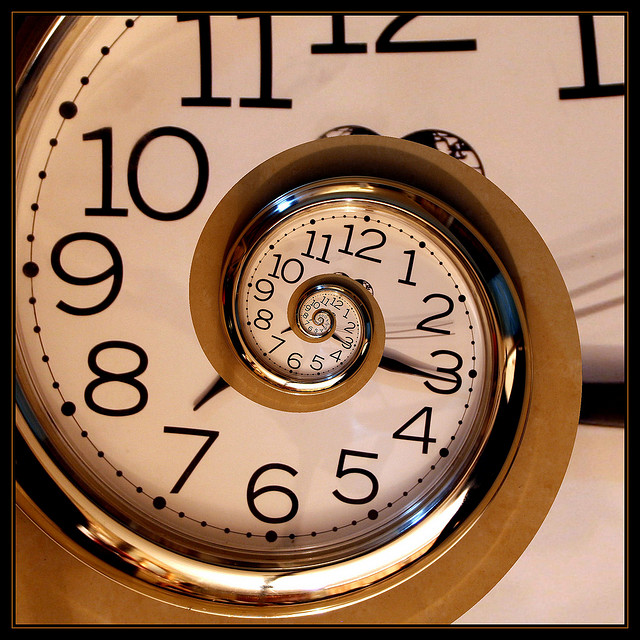
Fortunately, I'm not doomed when the sand runs out
Fortunately, I’m not doomed when the sand runs out

My schedule is probably a bit different than yours.

A job in broadcasting, getting around a large metropolitan city via bicycle or public transit, and escorting V to her numerous afterschool activities means not a lot of time to sit and write. Maybe a little over an hour a day. Maybe one and a half to two, if I’m lucky.

Since it’s all about getting stuff done, I’ve learned how to jam as much productivity as possible into that short window. Sometimes it’ll be “write until the end of this particular scene” or “crank out X number of pages.” Other times it might be “write until this point in time” or “write until you just can’t do it anymore”.

An hour may not seem like a lot of time to work with, but you work with what’s available.

Plus, setting up this kind of work habit is extremely beneficial on several levels:
-compels you to concentrate
-regular work pattern can improve skills and boost creativity
-problem-solving becomes easier and less necessary
-productivity may be slow, but remains steady
-that sense of accomplishment from having actually written something (very important)

These extremely unscientific results are how it’s worked out for me. I can’t speak for others, but I would imagine the results have been similar.

Find a system that works best for you, and keep at it. Make the commitment and stick with it. A few pages a day, and before you know it, you’ll be done.

Then you reset the clock and start all over again.

A leaky faucet can be just as good as opened floodgates

faucet
All those drips can really add up

We’ve all got busy schedules, so finding time to write can be quite the challenge.

One writer I know says he waits until his kids go to sleep. Another one gets up early and writes until he has to start getting ready for his day job.

Since I work unusual hours, my prime writing time is mid-afternoon before I head out to take care of Dad stuff.

For the past couple of weeks, circumstances have limited me to about an hour, which has been very productive. My goal on days like this is to write at least one page; two if I’m on a roll, and this is what usually happens.

But working within a set time limit has also been surprisingly liberating. Knowing you’re only producing one or two scenes really takes the pressure off, and removing that part of the equation can definitely yield positive results.

Just as an example, I had to come up with a new way to have a scene play out because it was way too similar to one earlier in the story. Since it was the last of a handful of small scenes I was doing that day, I knew I’d be done when the scene was done.

A few minutes later, that’s what happened.

Not worrying about the time allowed me to really focus on what I had to do, and since I already knew what the point of the scene was, it wasn’t too hard to come up with a solution.

The more you work at it, the easier it’ll get to be productive, even if it’s only a page or two at a time.