Class is in session

All I need now is the magnifying glass

When I start on a new project, I make a point of reading scripts and watching films that are similar to the kind of story I’m trying to tell.

This time around, it’s a rewrite of my mystery-comedy, so among the works being studied are CHINATOWN, L.A. CONFIDENTIAL and WHO FRAMED ROGER RABBIT (comedy, remember?). There are a lot more to consider (suggestions are always welcome), but I don’t want to overdo it. As much as I love submersing myself into these stories, I would like to eventually get around to actually working on the script.

Putting myself through this has a double benefit: I get to see solid examples of elements of the story and genre, which forces me to come up with different ways of how to tell a similar story but with my my own stamp on it. I’ll also be the first to admit that my skills at putting a mystery together aren’t exactly the best, so studying these will hopefully help me get a better sense of how to develop that part of the story.

Since this also happens to be a story I’ve worked on before, a lot of it is already in place, but there’s still a ton of work to do, with lots of ideas and changes being considered. Luckily, I have a few previous drafts to mine for material. Almost like starting anew, but with something very familiar.

My hope is that studying these scripts and films will help me get a better understanding of how all the puzzle pieces fit together in those stories, which will in turn will help me figure out how to do the same with mine.

This is the kind of homework I actually look forward to having.

I want instant gratification, and I want it now!

Don't be a Veruca
Don’t be a Veruca.

“Hurry up and wait.”

“It’s a marathon, not a sprint.”

“It takes years to become an overnight success.”

“What do you mean you haven’t read it yet? I sent it yesterday!”

You’ve no doubt heard things like these and many others like them before. For a screenwriter, nothing happens as fast as you want it to.

As the contractors and engineers say, “You can have it done right or fast. Which one do you want?”

You might feel like something has to get done or be sent out immediately, but that just ends up being counterproductive. Or worse – has a negative impact. Who among us hasn’t sent out a draft to a potential rep or a contest, only to discover something wrong with it after the fact?

Maybe it’s thinking that the faster you get it out there, the faster the results will come. Those of us who’ve have been doing this for a while know that ain’t how it works. It takes as long as it takes. You can’t force it.

It constantly amazes me to hear writers who claim to have cranked out a first draft of a “surefire hit” in practically no time, don’t do any rewrites, then are dumbfounded when it doesn’t get any responses from the industry or fails to place in a contest. What else would you expect?

You have to learn to control that impulsiveness, and it is not easy. I’ll get an email about a special early bird rate for a contest, and I’ll immediately think “Great!” Then I remind myself that the script’s really not ready yet, and I’d much rather spend the time to work on it until it is. If that means totally missing the contest and entering it next year instead, then that’s fine.

Writing a screenplay is not something you want to rush through. There are so many elements to it, and learning how to do it properly and effectively takes a lot of time.

The only way you can make progress as a writer is to put in the time and effort to be a better writer. It might seem like it’s taking forever, but keep working at it and the results will present themselves before you know it.

Oh, the possibilities! – OR – It’s nice to have choices

Either way, I win
Either way, I win

With the books officially closed on my western spec (unless someone of influence wants to develop it further? Operators are standing by!), a certain question has been popping up on a regular basis:

“So what are you working on next?”

(This is a close relation of that other inevitable question: “What else have you got?”)

Any writer should have an answer ready. Doesn’t matter if it’s one script or three or ten. I’ve said it before, but it can’t be emphasized enough. The more you can build up your arsenal of material, the better.

Not only does this give you more scripts, but it also means you’ve been doing a lot of writing (and rewriting), which can only help improve your skills and the quality of your material. One of the things I’ve noticed from doing rewrite after rewrite is that each subsequent draft is a little better than its predecessor.

I try to always be working on something. Whenever I’d take a break from the western, my focus would shift to another script. Results always varied; sometimes I’d get farther along than expected, or not as far as I’d wanted, or just kept going until I got to a point I considered enough. It was all prep work for each individual project, with the underlying message of “it’s all part of the process”.

So where am I now?

I’m feeling fortunate in that I’ve got several scripts to choose from, some of which have multiple drafts, whereas others are still just an outline-in-progress. No matter where they are in the development stage, the heavy lifting is already out of the way in that they exist.

All of my options are viable (to me), each for its own reasons. Do I want to go high-concept or low budget? Comedy or popcorn adventure? There is no wrong answer.

I haven’t made a final decision as to which script I’ll work on next, but whichever one it does end up being, it’ll be the right choice for me, and I’m pretty psyched about getting started on it.

Again.

The end is nigh. Near. Comin’ up fast.

An apt metaphor if ever there was one (unless you're a manager, agent or producer, in which case we can talk about it)
An apt metaphor if ever there was one (unless you’re a manager, agent or producer, in which case we can talk about it)

A self-imposed deadline is fast approaching.

At the end of this week, all operations on my western will stop. The time between now and then involves one last edit/read-through to really tighten it up, but when I close the file in a couple of days, that’s it.

Mostly because I’ve been working on it for so long, and toiled through several major rewrites, that I’m simply feeling burned out on it. Plus at this point, it really feels like doing any more extensive work on it would probably have the opposite, negative effect and do more harm than good. And I like this script too much to have that happen.

As it reads now, it’s a pretty solid example of my writing style. Even if it only ends up being a calling card that results in some assignment work, that’s perfectly fine with me.

Is it perfect? Of course not. Is it above average? So I’ve been told; excessively so, according to more than a few people not related to me. Is it a rousing tale of thrills and adventure that puts a new spin on an old genre? You’re darn tootin’.

I couldn’t have gotten to this point without all the helpful comments and support of some very talented writers and consultants. All of it has helped me make the script as good as I think it can be. For now. I also like the idea of coming back to it in a few months to get it ready for next year’s Nicholl or PAGE.

But the time has come to bring down the curtain once and for all. It has been an amazing experience that I honestly believe has made me a better writer and definitely upped the quality of what I write. As one of my reliable note-givers said to me, “As good as your writing is on this one, your next one is going to be even better.”

I sure hope so.

Turning your characters into people

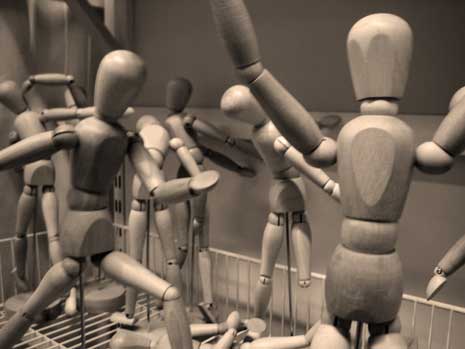
Make each one of these a distinct individual. And...go.
Make each one of these a distinct individual. Ready? Go.

One of the notes I occasionally get (as many others have as well) is that my characters are good, but could use some more depth.

No matter how big or small a part a character plays in my stories, I try to make them seem like real people. Sometimes it works, and most of the time it needs more work.

I don’t go through the whole “create a detailed character history” thing, but as I work progresses on each story, I get more of a feel for what kind of person that character is and hope I can transfer that to the page.

So today’s post is going to be a little different, and involves audience participation.

How do you develop depth in your characters?

There’s no one right answer, and everybody has their own way of how they develop a story and its characters, so it would be great to hear what works for you.