More like chiseled in frosting

Didn't work out right the first time? Go back and do it again.
Sometimes you just have to go back and do it again

Y’know one of the best things about putting together a story?

If something doesn’t work, you can change it (and most of the time, the change is for the better).

Most of the details in my western outline seemed pretty solid, and they were transferring nicely to the steady output of pages.

Then I got to the culmination of a big sequence – it involved a shootout. Something seemed out of place. I read the thumbnail sketch of the scene in the outline again.

Wait a minute.  Where did the one character get a gun?

A quick check of some previous scenes. There was no opportunity for that happen.

So now I’ve got a choice to make: keep it as written in the outline, or try something different.  Keeping it would mean going back and changing several scenes, which could also potentially slow the pace of the story. I opted for something different.

The end result was a shortened scene that retained crucial story and plot points, which gave them more of an impact. I also went with ending the scene ‘bigger’, keeping with the overall tone of the story.

There’s a good chance this will also result in having to rework parts of the big finale, but for now I like the way it plays out.  Besides, there’s another chance for a rewrite for the better.

So even though you think your story’s ready to go, chances are more than likely you’re going to reach a point where something has to be changed, fixed, altered or just plain rewritten.  Don’t see this as a negative – welcome the opportunity with open arms.

You want each scene to advance the story in the most effective way possible, and now you’ve given yourself the chance to do that.

Ask yourself if this is the best way a scene can be done. If not, what can be changed so it not only does what it’s supposed to, but does it better than your original version?

Then do the same for the next one, then the one after that, until you reach the end.

Simple, no?
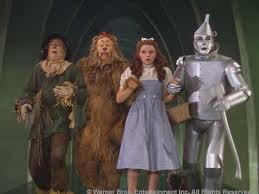
Can’t forget B, C and possibly even D

It’s not all about Dorothy, right?

It’s been a productive couple of days.  I worked a ton of hours on the air, made two well-received pies for Thanksgiving, and even got some writing in.

I’ve reached the part of the outline that says “The End,” but it’s not time to celebrate just yet.  Far from it.  There’s still a lot that has to be done before those words can really be applied.

While the main storyline has wrapped up, it became glaringly obvious that I’d completely ignored my supporting characters. I was so focused on the main character, I forgot to give the others something to do during the climax/showdown portion of the story.  And that’s just wrong.

This has the potential to become a somewhat sticky problem. It’s important that the individual arcs and storylines/subplots each come to a satisfying conclusion, but just as important not to overdo it and drag things out too long (e.g. LOTR: THE RETURN OF THE KING).  There’s always a way to wrap things up. The challenge is finding the right one AND making sure it works.

As always, this is going to take some carefully-orchestrated and organized planning.

Still, any progress is good progress.

-Movie of the Moment. This weekend was also good for making a dent in our Netflix queue.

-BLACK DYNAMITE (2009) A hilarious satire on blaxploitation films that really feels like it came out of the 70s. Star Michael Jai White was also one of the writers.

-DETECTIVE DEE AND THE MYSTERY OF THE PHANTOM FLAME (2010) A great combo of martial arts and supernatural mystery set in 7th century China. V was really excited to watch this at first, but in the end was too freaked out. End result – more kids movies for now, leading into…

-PUSS IN BOOTS (2011) or IF ZORRO WAS A CAT. Since there’s a western element, I enjoyed it, and probably would have loved it if I was a cat person.  A sequel to this would be more preferable than yet another SHREK film.

Color me pleasantly surprised

Totally wasn’t expecting that

Since figuring my way through the climactic portion of Act Three is still stressing out my creativeness, I did what any good writer would do in this situation: go back to the beginning and edit like a madman.  This will give my creative muscles a good workout while subconsciously working out the end.

Overall: the opening definitely needs some reworking, and there are a few places here and there that could stand a little adjustment, but for the most part – a lot more fun than I remember. Trying really hard not to sound egotistical, but I had to occasionally remind myself this was something I wrote.

Me.

Gosh.

Not working on this for so long enabled me to take a really good look at what I have so far. Interestingly, even though I knew what was coming, there was still a lot in there to make me want to keep going and see what happened next.

In all honesty, I’d also forgotten how much I wanted to utilize a lot of elements that make up the thrill-generating, pure adventurousness of the Western genre.  Those are definitely in there, with a lot of potential to be built up even more, but for now it’s all about the story. If that’s not rock-solid, then everything else is irrelevant.

The whole time I was looking this over, I found myself focusing less on ‘would it look cool on the big screen?’ factor, and more on making sure the characters were being proactive and realistically moving the story forward (especially the title character), and that each plotline was being established.  Maybe this is my brain quietly telling me my storytelling and writing skills are improving.

Something also very important to work on as this whole project moves forward – that the story grabs you from the start and doesn’t let go. But I suppose that should go without saying…

Making the most of reverse engineering

They started with “How can we make a phone look like this?”

The past few days have been spent figuring my way through a handful of scenes, maybe 3 to 4 at the most. But these all lead up to the end of Act Two, which is supposed to be when “all seems lost” for our hero. He/she is so far away from achieving their goal, it’s scary. You can’t help but wonder “how in the world are they gonna get out of this?”

Way back when I was setting up the important plot points, I knew what the end of Act Two was going to be. As always, getting there is the biggest obstacle.  I tried different scenarios, but none of them seemed to fit.

Then it hit me. Go backwards. Since I know the end result, what would make the most sense to happen right before it?  And what happens before that? Repeat as necessary. All the while keeping in mind that each scene should also be advancing not only the story, but the theme and character’s development as well.  This can be more productive than you realize. It’s a good exercise in writing, but also helps develop your creativity.

End result – that much closer to finishing, and hoping to have a pretty solid outline by the end of the month.

Inner movie geek to the rescue!

What can we expect when we see YOUR movie?

No doubt you’ve heard “write what you know”. But how often do you hear “write what you love,” or “write something you would want to see”?

If you have a favorite genre, try writing something in that style. Put your own spin on whatever it is you have a strong appreciation for.  I’m not at the same level as STAR WARS, RAIDERS OF THE LOST ARK or THE LORD OF THE RINGS, but that didn’t stop me from devising my own thrilling rollercoaster ride of an adventure. Hence DREAMSHIP.

“Familiar, yet different” is another mantra. Use well-known examples as a model or guideline for your story, but figure out how to make it different. You don’t want somebody to read your script and think “blatant ripoff”. What would make  it completely your own?

The more appreciation you have for a style or genre, the more it will show on the page. You want your work to capture the mood or essence of what it is you liked about it in the first place. Reach inside and use it to enhance your story.

Chances are you could easily fall into that trap of writing something very cliched, so while you’re still in the planning stage, take a step back and think “What would be a more interesting way to do this? What would I as a moviegoer NOT be expecting? What have I NOT seen before?”

The great thing about writing something like this is that you already know what works and what doesn’t. And even better, you have can fun with it. Because if it’s not fun, then why are you doing it in the first place?