Q & A with Babz Bitela

Babz Bitela

Barbara “Babz” Bitela is a literary manager operating out of northern California, a “hired gun” editor for fiction writers, and hosts the Babzbuzz internet radio show “because folks were nice to me and helped me, so I’m trying to pay it forward, and believe me, I’m keeping it real.”

“We want voice on the page. We KNOW it when we ‘hear’ it.”

Her book Story of a Rock Singer is currently being adapted as a Broadway musical.

What’s the last thing you watched/read that you thought was incredibly well-written?

Justified and Bates Motel are my top two. Joss Whedon is by far one of my favorite writers. Buffy the TV series –  WOW!  You can youtube his interviews: it’s like an AA degree in writing and it’s free to anyone.

How’d you get your start doing representation?

I pitched a semi-retired agent named Ed Silver on a book I wrote. He was Lee Marvin’s manager and finance guy, also for James Coburn and many others. The guy’s ‘seen’ stuff, man – Hitchcock napping, for one. He loved my style and offered me a gig to take over and he’d mentor. We clicked big time. He’s Jewish, I’m Italian. As Sebastian Maniscalco says, “Same corporation, different division.” That’s us.

Is recognizing good writing something you believe can be taught or learned?

You for sure can learn it IF you want to. Here’s why – bad writing obviously sucks. It just does. How do you know that? By reading GREAT (not just good) scripts. I read so much so often I can now tell what’s going to go and what MAY go but here’s the rub: in the absence of money behind it, it may not matter. And I may love it and another may say “meh”. So pov does matter.  So you can learn and pitch but Lady Luck is no lady: she’s a tramp in cheap shoes and she’s fickle. We press on because we believe in the story/writer we hawk. If it goes, it goes, if it doesn’t, well, I’ve had the benefit of “seeing” incredible “movies” and the only down side is, so few others will see that. THE WRITER however, benefits. Why? Job well done. And if you don’t write for the JOY of the craft, there’s no point. Write for the sale? That’s an industry sucker punch. I’ve learned to find great scripts and I’ve learned it can be like screaming in space once you do.

What are the components of a good script?

VOICE, RISING ACTION and TWISTS.  What is voice: it’s a lot like porn – I know it when I see it but it’s hard to describe. Think of it this way: you open a novel, settle in and by page two you’re thinking “Ugh, this just sucks”, but you press on and by page ten you know it’s not the book for you so you donate it to Goodwill. It’s the same with a script. I once read a tv pilot by my client that I couldn’t read it fast enough. Why? I WAS DYING TO SEE WHERE IT WOULD LEAD. The action and characters were alive on the page. That is what makes a good script: I call it NARRATIVE TUG.

What are some of the most common mistakes you see?

Where to start? Typos, for sure. It’s a speed bump.

Wrylies. Just don’t. UGH! Makes me crazy. There’s only one time I’ve seen it used where it worked. ONCE. And that writer is a five-figure-income writer.

Novels posing as scripts. The writer MUST understand the economy of words and do VISUAL storytelling. Telling a story with pictures is a movie. Telling a story with talking is a soap opera.

Avoid using “ing” words – slows narrative, slows the readers eyes.

Avoid “very”. Just find what IT IS. Don’t say “very smart”, say “bright”  – just pick! Not kidding. You’ll thank me. Rodale’s The Synonym Finder is invaluable for writers.

And never fall in love with your stuff. It’s gonna get cut.

What story tropes are you tired of seeing?

Well, many work. Some don’t. My favorite recently was probably in draft form: “Fire all phasers!” But instead he said “Fire everything!” Love it!

But I say write bad and cliché in the draft, leave it there, then go back and rewrite it.

Lots of folks say “Not my first rodeo.” I say “Not my first rocket launch.” Anything to WAKE UP the reader.

What are the three most important rules every writer should know?

I’ve got more than three.

-Don’t enter a script contest pitching a word doc.

-Don’t send a script unless invited.

-Don’t ask me what I think if you don’t want to know.

-Don’t go past 120 pages. I mean it. Try to stay around 100 if you can.

More rules? I think it’s just wise to do 12pt Courier font as it’s tradition. The Coen Brothers don’t use Courier. But they’re already famous, so when you’re famous do what you want. In the meantime, stick to tradition.

What do you look for when it comes to potential clients, both personally and professionally?

No dope. No booze. No drama.

Feet on the ground, and committed to spending tons of time doing what you love, regardless of the outcome.

My clients pitch themselves. They must. If that’s not for you, then I’m not the agent for you, and also, you’re in the wrong business.

Yes, the agent makes inroads, but you must pitch you and build relationships. When you do; AVOID using “I” and ask the person “What do you do, and how do you do it?” Ask about them. We’re people FIRST. That’s why I do Babzbuzz. People like me. They helped me. So I take what they tell me and mush it up with what I’ve learned, and talk about it on my show to try to help.

I’m a small company: I’m WGA.

Meh. Folks hang up on me all the time.

Why?

“Babz, love the script! Who’s funding?”

Crickets.

“Babz, baby. Call us back when you have the dough and I’ll show my client. He may want to star in it.”

EEEK!

What happened to love of story?

Hell, that left the building and moved to an island the actor/director owns. He’s got to feed his family too, ya know. So bring the bricks.

EEEK!

Lightning can and does strike. That’s what I do. I’m really a stormchaser who looks for folks with money who want to buy.

Readers of this blog are more than familiar with my love and appreciation of pie. What’s your favorite kind?

Oh man, you had me at the fridge door. Dutch apple. Key lime. Rhubarb when you can find it. And pretty much any clever use of chocolate.

An education most painful

scared
Please don’t make me watch that again!

Once again, your stalwart author makes the necessary sacrifices so you don’t have to.

This time around, I had the misfortune of watching an extremely bad large-budget movie from the semi-recent past. It was painfully obvious that a larger percentage of the budget should have been diverted to hiring quality writers, rather than on everything else. A pipe dream, I know.

But trust me. It was bad.

What made it so bad, you may ask?

Oh, where to begin.

My biggest problem was that too much of the story felt glossed over, with vital elements explained in a very lazy and haphazard way, if they were even explained at all. It felt like they were trying to force events to match how they wanted the story to play out, rather than deftly setting things up.

Reasons why something would happen, or were supposed to have happened, seemed to have simply been thrown against the wall, and whatever stuck, that’s what they went with. Did it matter if it fit within the context of the story?

Nosireebob.

Once again, there were too many questions raised that were never sufficiently answered. When this happens, it simply takes away from the movie-watching experience. The only reason I knew the film had to have been around the midpoint area was because of its running time, and NOT because of what had transpired over the course of the story.

I could say I had a vague inkling of what was supposedly going on, but was just never sure, since the story was being told in a very sloppy and unorganized way. It irked me to no end to be see such terrible writing so prominently displayed. And apparently I wasn’t alone in my opinions. The film was a major flop at the box office.

So what silver linings can we extract from this pitch-black cumulonimbus that stole away just under two hours of my life?

-Write a story that’s easy to understand. Keep it simple. This doesn’t mean dumb it down. Keep us informed, unless withholding that information is absolutely necessary.

-Let the story play out organically. Don’t try to force it because that’s what you want to happen. It’s easy to tell when that happens, and it ain’t pretty. If you didn’t put in the effort to figure it out, why should we?

-Have things happen for a reason. “Because it looks cool” is not one of them. Would it drastically change things if it didn’t?

-Set up, pay off. If something happens, we want to see what happens as a result. Don’t leave us hanging. And counter to that, don’t suddenly spring something on us out of thin air. It reeks of desperation. Audiences don’t like that, either.

One of the things I always strive for in my scripts, be they big or small budget, is to respect the intelligence of the intended audience. That is one lesson I believe the writers of this abomination should have kept in mind.

Q & A with Rick Ramage of The Screenplay Show

Rick Ramage

Rick Ramage is a writer, director and producer with numerous credits on major motion pictures and television shows. During his 25-year career as a screenwriter, he has set up or sold over 40 scripts in Hollywood.

Rick’s latest project is The Screenplay Show, a new 10-part online series to educate about the art, craft and business of screenwriting and storytelling.

What is The Screenplay Show, and what inspired you to do it?

The Screenplay Show is an actual show about writing, presented in a fun, narrative style. It’s a ten-part webseries that will focus on the trade secrets I’ve developed (and learned) from Hollywood’s most talented writers, directors and producers during my 25-year career.

As to what inspired it, a few years ago, a buddy of mine started a writer/actor group called, “Write to Act” and he asked me to put on a seminar for his people in Denver. I was reluctant to say the least. For the last 25 years, my only job has been writing and producing film and television. Speaking in public? Not so much. He kept twisting my arm and after about a year of hounding me, I finally gave in and promised him I would do a one-day seminar. Then reality hit me: What could I possibly say for six hours that would interest other writers and actors? In an effort to alleviate the poor souls who would be stuck looking at my ugly mug all day, I pulled in my editor and we put together a long list of writing samples and clips covering every element of screenwriting so they could actually SEE what I was talking about – instead of listening to me pontificate as I clumsily tried to explain it.

For instance, using stills from The Shining, I put every moment of Jack’s character arc into a still photo sequence. You can actually visually track his descent into madness. I then put the page number from the script beside each expression. The audience literally gasped, because it was the first time they had actually seen a character arc moment by moment. I did the same thing for all the other elements of storytelling. As screenwriters, we have to write visually – so I figured it would work for seminars, too. But one thing really surprised me: the audience had as many questions about the writing experience as they did about the nuts and bolts. Personally, I’ve always been fascinated by the methods of actors, athletes, and other writers, so I guess it’s fair that they wanted to know about my method – and how a life and career in the film business actually works.

What sets The Screenplay Show apart from other online seminars?

One look at the teasers we’re putting out there will let people know this isn’t your father’s seminar. I can’t honestly say I had an epiphany and The Screenplay Show was suddenly born. But doing the seminars over the next year or two, it definitely evolved into a rolling narrative; my personal Hollywood experience merged into describing actual methods that have worked for me and many of my colleagues. So far, I’ve set up or sold over 40 scripts. But I have to give credit where credit is due: I didn’t learn how to survive the biz, or sell scripts from books. I learned from working closely with tremendously gracious agents, managers, producers, directors, executives and actors who were generous enough to share their knowledge with me for one purpose – to get the story right.

My goal with The Screenplay Show is to share what they’ve taught me with other writers and storytellers. And when I say storytellers, I mean anybody involved in the film and television business. Directors, actors, producers, cinematographers, and even executives. They are storytellers because they impact the script and help bring it to life.

Tell us a little about your writing background. How did you get started?

I didn’t finish my degree. Instead I went into business with my dad, selling tractors. But I wanted to be well-read and well-spoken, so I sat down with 100 of the great novels and voraciously read them back-to-back. In the process, I began to see how the authors worked the elements. The storytelling process fascinated me. So when I was out covering my sales territory, I began to daydream about becoming a writer. Eventually, I tried to write a novel. Long story short – it sucked. But the person who told me it wasn’t very good also told me I was a good writer. That seemed like a contradiction, but it wasn’t. He told me I had a very visual style, and suggested I write a screenplay. So I turned my bad novel into a bad screenplay! (But that process lit a fuse in me, and I’ve never looked back.)

What have you recently read or watched that you thought was incredibly well-written?

When I’m deep into writing one of my own scripts, I don’t usually watch or read much. By the end of the day, more words and plot lines are the last thing I need to relax. But two shows I try not to miss are Game of Thrones and House of Cards. From their production values, to the great characters, to the tight, well structured scripts, I admire them both a great deal. In fact that’s how I can tell when I’m in the hands of great storytellers – they make me forget I’m a writer. I become a fan.

Is recognizing good writing something you think can be taught or learned?

Definitely. Recognizing good writing can and certainly should be taught and learned. I’ve known some executives who were by no means writers, yet they learned to identify good writing and write smart notes. Their jobs depend on it. I’ve learned to recognize good writing by the way it makes me disappear into it.

What do you consider the components of a good script?

For me, the single most important component of a good script is simply this: It must have soul. I need to feel what the writer is trying to say through his or her characters. If that happens, I know the other elements are working.

What are the three most important rules a writer should know?

-Dialogue:  When to shut up and let the subtext play.

-Action:  When not to overwrite. (more often than not, you’ll lose your reader.)

-Characters:  We write in search of ourselves. (makes them real.)

How can people find out more about The Screenplay Show?

We’re really encouraging people to go to their most comfortable social media site and follow us. Also, we’re really hoping they go to www.thescreenplayshow.com and sign our landing page. We won’t bombard you with trivial junk, but we do want to build a steady audience so we can let people know about events and new material.

Readers of this blog are more than familiar with my love/appreciation of pie. What’s your favorite kind?

My grandmother made the best pie I’ve ever had. Golden, flaky crust made from scratch, crisp green apples sliced thin, and lots of cinnamon! I do miss that woman.

The silver lining of a bad movie

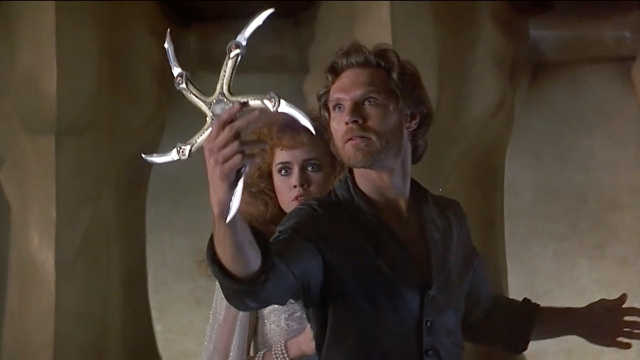
Krull
A definitive shining example (AND a prime candidate for a remake)

Since the screenwriter’s education is ongoing, there’s always something for you to work with or study to get a better grasp and understanding of what constitutes good writing, which can then be applied to your own.

Read scripts. Attend or take part in a table read. Watch movies.

While there are countless examples of exemplary writing and filmmaking to see it done properly and effectively, there are even more examples of crappy writing and lousy filmmaking to see it done poorly and ineffectively.

Nobody starts out with the intention of making a bad movie. What starts out as a great script can easily be messed up along the way to the point that there’s no salvaging it. It happens.

Is watching one waste of time? Not necessarily.

As enjoyable, informative and educational as the good stuff is, the bad stuff is actually just as good, possibly even more so. Because from these cinematic travesties you can learn what not to do with your own scripts. Lessons abound with all the glorious misfires regarding story, characters, and dialogue.

Regrettably, bad acting is a category all by itself and there’s nothing that can be done about it. Do what you can to ignore it (which can border on the impossible, depending on the quality of badness) and focus on the non-tangibles.

It’s especially helpful to work with something from the same genre as your script. See how they did it, then compare it to your own. Can you see why theirs didn’t work? Is it riddled with plotholes you could drive a truck through? Is the dialogue pure on-the-nose? Do the characters come across as unrealistic caricatures?

Look at it as a whole. Does it respect the reader/audience’s intelligence? Is the structure solid? Do you care about what happens to these characters over the course of the story?

Now bring your script into the equation – and be objective! How much of a similarity or difference is there between that story and yours? Did that other material open your eyes to some previously unforeseen flaws and potential problems within your script, so much that it made you realize “this needs work”?

Once you identify these problems, your writer’s mind goes to work, figuring out how to make sure your script doesn’t repeat the mistakes you just read or watched.

It may not be easy to endure having to watch a bad movie just for the educational experience, so just keep reminding yourself “It’s to help me become a better writer”.

Good luck!

Question time! What’s your favorite bad movie? Feel free to list it in the comments.

Ask an Astonishingly Productive Script Consultant!

Bill Boyle

The latest in a series of interviews with script readers and consultants who would be worth your while to work with if you want to get your script in shape. Today’s spotlight is on writer-educator-consultant Bill Boyle of www.billboyle.net.

*editor’s note – Bill passed away in July 2018

Veteran screenwriter Bill Boyle has been involved in the film industry in both Canada and the U.S. for over 25 years as a writer, director, agent, producer, story editor, and mentor. Mr. Boyle has the rare honor that every screenplay and television series he has written has been produced or optioned. He currently has four screenplays produced and a fifth scheduled for production. Two others are presently under option. Additional information on the films can be found at www.billboyle.net or at www.imdb.com

In addition to screenwriting, Mr. Boyle devotes a significant amount of his time sharing his experience mentoring younger screenwriters. He teaches screenwriting at UCLA and has lectured throughout Canada and the United States.

Mr. Boyle is one of the most popular script consultants in the industry. He has consulted on over 1,000 screenplays worldwide. Creative Screenwriting Magazine rated him among the top 10% of screenwriting consultants. He is the lead proponent of a visual style of screenwriting called “The Visual Mindscape of Screenplay” that focuses on the visual and visceral aspects of screenwriting. His book of the same name was released in 2012.

1. What’s the last thing you read/watched that you thought was incredibly well written?

I am a huge fan of Jo Nesbo’s novels. His visual exploration of the environments he creates are so visceral that once read it is impossible to ever forget them. As for screenplays, I recently read Nightcrawler and found it exceptionally well-written.

2. How’d you get your start reading scripts?

If you mean reading scripts as a job, I was never actually a script reader. I was a manager in Canada and read many scripts that my actors were up for, as well as reading the work of my own screenwriters and playwright clients.

3. Is recognizing good writing something you think can be taught or learned?

It needs to be taught, but not taught as in learned; taught as in establishing the ability to connect fully with the writing and to remain focused. That ability and willingness to be fully immersed in the screenplay allows the reader the conduit into the rhythm, pacing and flow of the narrative. Sounds obvious, but it is my experience that the vast majority of writers ‘skim write’, which is to say they focus all of their attention on what they want the scene to say and little on the atmosphere and pacing of their scenes.

4. What are the components of a good script?

A good script is one that captures the visual and visceral imaginations of the reader. Actually, it’s a misnomer to say we’re writing for the reader, when actually we’re writing for the viewer within the writer. Besides being a visual expression of the story, a good script also expresses the proper pacing and atmosphere within each scene. These are the two elements most often missing in a screenplay.

5. What are some of the most common mistakes you see?

-Detailed Action

-Skim writing

-Blueprint Narrative lacking pace, atmosphere and visual expression

-Overwritten dialogue that lacks a pulse.

6. What story tropes are you just tired of seeing?

The two things that disturb me the most are how fundamentalist screenplay instructors and gurus have poisoned the creative minds of so many young writers.  This attitude of “my way or the highway”, or the ever-growing list of things a screenwriter must not do (Voiceovers, Camera Angles and Directions, Character Descriptives, Flashbacks, etc) is absurd.

For me the big one is the white on the page dictum. Of course, part of the art of screenwriting is the ability to tell the story in a succinct, near-haiku style. This form of brevity allows the story to flow and remain in the Absolute Present Tense. But this should never go beyond the point where it strips the narrative of its creative purpose.

I actually believe that white on the page is a way of devaluing the writer’s role in the filmmaking process. I seriously question when and why white on the page become more important that what is on the page.

7. What are the 3 most important rules every writer should know?

-Screenwriting is first and foremost a visual expression. Whether you choose to ignore it or not there is always and image on the screen.

-Establish pacing and atmosphere in your scenes so as to create a visceral experience within the reader/viewer

-Every action, element and scene of a screenplay exists in the Absolute Present Tense

8. Have you ever read a script that was an absolute, without-a-doubt “recommend”? If so, could you give the logline?

A script by Canadian screenwriter Laura Beard called ‘A Quiet and Distinguished Gentleman’. It was about a French Catholic detective who must overcome the bigotry of an English Protestant city and police force to solve a brutal axe murder in 1930. There are things she does with that script that to this day I still use in my lectures. A brilliant and very clever piece of work.

9. How do you feel about screenwriting contests? Worth it or not?

I am not a fan of screenwriting contests. Before I explain why, let me make the distinction between contests and fellowships. I think the fellowships (Nicholl, Praxis, Disney, etc.) are excellent programs.

I swear to god I have never heard a ‘true’ story of someone having a script produced based on a contest, which, considering how many there are out there, is rather shocking.

This idea of letting the writers know that they have moved to the next tier and then the quarterfinals, semifinals, etc., is their rendition of Three Card Monte. They let you think you win for a while so that you come back for more. What other reason is there?

10. How can people get in touch with you to find out more about the services you provide?

Check out my web site www.billboyle.net. You can also sign up for my newsletter, blog notices, online course dates and when spaces open up for my Unlimited Script Mentoring Program.

11. Readers of this blog are more than familiar with my love/appreciation of pie. What’s your favorite kind?

I will go for pretty much anything except the pie in The Help.