It’s September 1st! New month, new season (kinda-sorta), school’s back in session, all that rot.
It also means there are 4 months, or 122 days if you want to be super-specific about it, left in 2023 for you to GET SOMETHING WRITTEN.
Totally not impossible.
Even if you average a page a day, that’s a completed draft of a feature (or a pilot), plus some extra time for notes, editing, and polishing.
Dive back into that script you finished earlier this year, last year, or whenever, and attack it with your red pen to edit the bejeezus out of it.
It doesn’t matter what you write, just as long as you plant that ass in a chair and DO. THE. WORK.
That script ain’t gonna write itself, y’know.
Why all the encouragement?
I find a certain appeal to closing out the calendar year having accomplished something writing-wise. You can simultaneously proclaim “Look at what I did!” while also be ready to work on it from the get-go on January 1st.
You’ve got 122 days and counting, so quit your procrastinating, hemming and hawing, and get to it.
Savvy and experienced consumer of literature I’m sure you are, no doubt you’re more than somewhat familiar with the classic piece For Want Of A Nail:
For want of a nail the shoe was lost. For want of a shoe the horse was lost. For want of a horse the rider was lost. For want of a rider the message was lost. For want of a message the battle was lost. For want of a battle the kingdom was lost. And all for the want of a horseshoe nail.
Sometimes we don’t realize how important something is that at first glance might seem completely insignificant.
The same concept could apply to screenwriting and the details of your story. A reader could see something and wonder “I don’t get it. Why is this in here?”
If you do the work and plan accordingly, the answer/reason will soon be obvious. That little detail is there for a reason, probably an important one, and without it, the rest of the story won’t work.
This is important on several levels.
It shows you put a lot of thought into putting the story together.
It shows you understand the concept of effective setups and payoffs.
It shows you respect the intelligence of your reader/audience and don’t feel the need to deliberately draw our attention to this sort of thing.
It always bothers me when a story sets something up and doesn’t pay it off, or has something later on in the story that comes out of nowhere.
Some writers go into it with a solid idea of how everything is set up and know how it’s going to play out, some come up with the bare bones of a foundation and fill in the blanks, and there are even those who sit down with a blank page, start writing, and see how it goes.
I tend to waver between the first two.
Sometimes you might even go back over what you’ve already written and discover an opportune moment to put in a small detail that can further enhance something later on in the story. It’s as if your subconscious was working in conjunction with your creativity and giving you an unexpected helping hand.
Are parts of your story set up that they start with a “nail” and escalate from there? Or does something happen later that could use a stronger setup?
You’d be surprised at seeing the ripple effect one little change can have on the rest of your script. Hopefully for the better.
Saw a great quote the other day that was along the lines of “Being a writer is like having homework for the rest of your life.”
From a certain perspective, that definitely has a negative connotation. Emphasizing the ‘work’ part of the word indicates drudgery and toil. Like, strictly dullsville, man.
The obvious solution is to make it a positive experience.
I know. Easier said than done, but bear with me.
(Writing should never seem like work anyway, but that’s another post.)
To be a better screenwriter, you need to read scripts and watch movies. You can see how the pros did it and figure out how that could potentially influence your work.
While watching your favorites and the classics can definitely help, I also suggest watching really shitty movies as well.
Hard as this might be to accept, there’s something be gained from it.
What was it that made them bad?
The possibilities are numerous, but a good percentage of the time – it’s the script.
As a writer, you can use that to your advantage.
Painful an experience as it might be, watch that bad movie from a writer’s perspective. Is it the writing that sucks? The story? The characters (and not the actors)? Is there a coherent sense of structure? Is there any structure at all? Does the story flow naturally, or do things happen because it seems like the story needs them to?
Maybe it feels like the writer didn’t take any chances, or worse, went for the very easy and cliched (i.e. expected) solution. Does anything in your script feel that way? If so, think about what changes you could make that would produce the same results, but get you there in a totally different way.
It may be 90-110 minutes of your life you’ll never get back, but at the very least you’ll get a better idea of what NOT to do when it comes to developing your script.
And that is a worthwhile lesson for any screenwriter.
A few weeks ago, I printed a copy of the animated fantasy-comedy, and then posted on social media about holding the actual document in my hands and the sensations that resulted from doing that.
(Quick note – said sensations were of a very positive nature. There’s definitely something to be said about holding a physical manifestation of all the time and effort you put into this draft. It’s exhilarating. Uplifting, even. A true sense of accomplishment. And then eagerly accepting the next step of figuring out what’s wrong with it and how to fix it/make it better.)
The post yielded quite a wide spectrum of responses. From “Totally agree. It’s fantastic!” to “I can’t imagine NOT printing it” to “You still print out scripts?”
As I matter of fact, I do. I find it to be incredibly helpful when it comes to editing, proofreading, and overall polishing.
As more than a few people put it, “Printing out a script is a necessary part of my process. I can see things on a page I’m holding that I might not see on a screen.”
That can definitely apply to me. After I finish a draft, I’ll step away from it for a few weeks, then print it out (double-sided) and have at it with red pen in hand. I go through the whole thing page by page, line by line, marking it up as much as necessary.
Could there be some kind of subconscious connection between holding an honest-to-goodness physical printout in your hands and what it does to your creative process? Beats me, but it seems to really make a difference.
I’m much more likely to spot something that needs to be changed when it’s on a piece of paper rather than on a screen. A line of dialogue that doesn’t work or needs retooling. A scene that doesn’t flow the way I need it to, so I try rearranging it. Or those most common of miscreants – a typo, a misspelled word, or a rogue punctuation mark. It happens.
Sometimes I’ll have a page that’s totally mark-free, or maybe one or two little fixes. Sometimes the page has got more red ink and edit marks than actual text, or my notes and comments occupy a lot of that white space.
All of it – not uncommon.
One interesting side note – many’s the time I’d have to decide about cutting something I was hesitant to cut. I would then figure out what was best for the script and story, and not what I wanted. If cutting this or rearranging that resulted in the scene, and subsequently the script, being better, then so be it. The usual follow-up to that was I’d make the change, then immediately forget about what was cut because the new version was better.
Once all the changes and fixes have been taken care of this draft, I’ll go back to the beginning and start implementing those changes and fixes on the digital copy.
Also not uncommon – trying to read my own handwriting, which can occasionally border on appearing microscopic in size from me trying to cram too many notes on the page. It might take a few passes to read it, but I eventually get there.
Before I know it – voila! A new draft.
Printing out my scripts to do some more work on them in order to make the next draft better is a process that’s served me quite well over the years, and I don’t see any reason to stop doing it.
Even despite a temporary lapse, output on the sci-fi adventure rewrite was progressing at a decent pace.
I already knew there’d be more work to do once it was done, but something still felt off. A piece of the puzzle was missing, and it felt weird to keep pushing forward. Like building a house with incomplete blueprints.
Although my original intent was to finish the rewrite, I wanted to take care of the missing puzzle piece. This in itself was quite challenging.
Once again, my network of savvy writing colleagues comes to the rescue.
I’ve been doing more one-on-one Zoom calls with writers I’ve only known through social media. It’s a great opportunity to get to know them as people, as well as talk a lot of shop about screenwriting.
Such was the case earlier this week. Another writer and myself were discussing some of our current projects, and the sci-fi adventure came up. Despite my stumbling through the “pitch”, my friend got really into the concept, prompting them to ask a lot of thought-provoking questions about the story and the characters. Some I had an answer for, some I didn’t.
(side note – I used to be embarassed about not having all the answers when it came to my stories, but have since embraced it and am now willing to say “I don’t know” or “no idea” because this usually leads to a discussion where everybody involved helps me come up with an answer.)
This led me to realize that some aspects of the story weren’t as defined as I thought. That, in turn, had a ripple effect on the rest of the story. The same story of which I had just passed the halfway mark with rewriting.
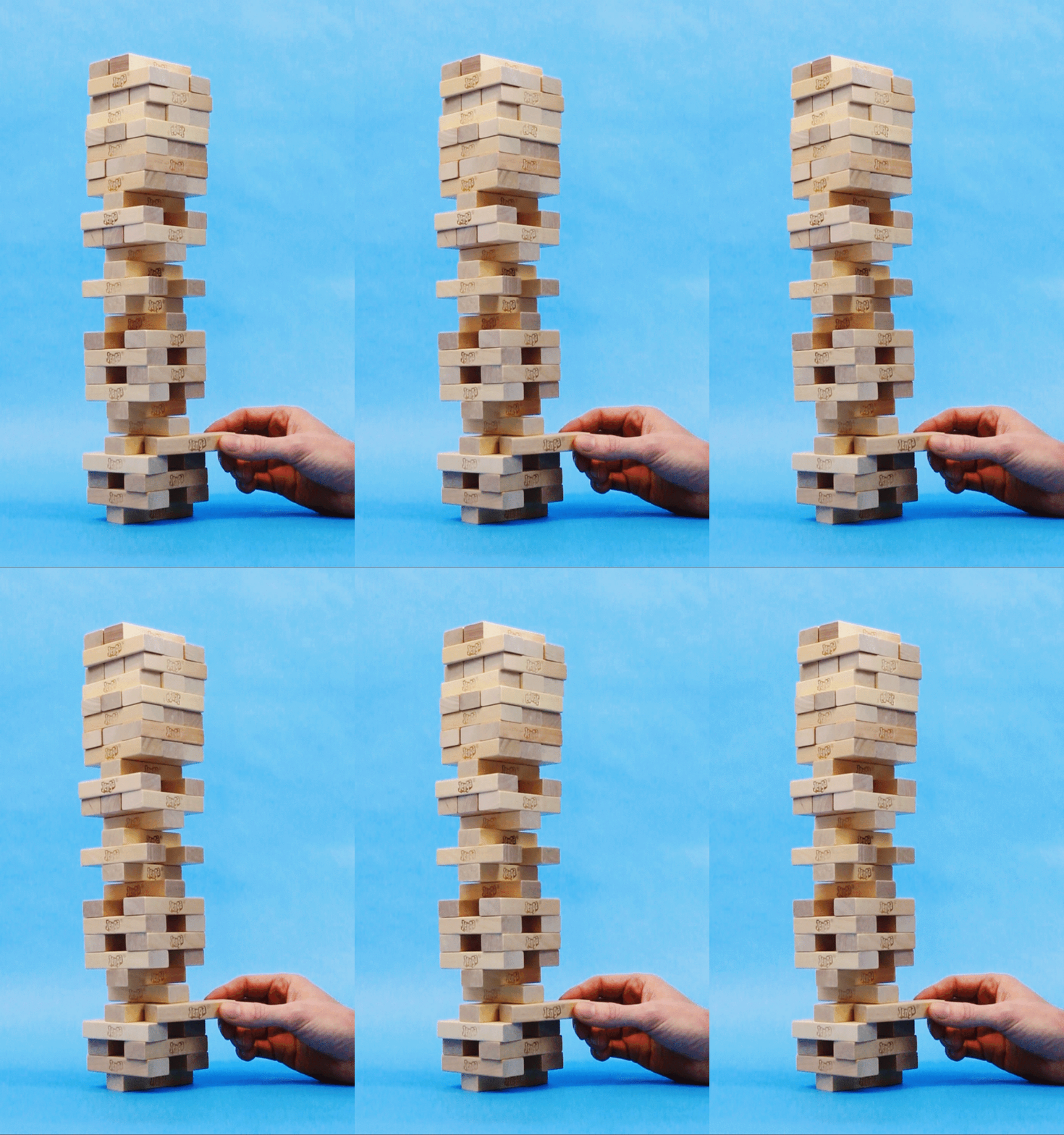
It was like taking a piece out near the bottom of the tower in a game of Jenga. Not that everything came crashing down; more like things got a whole lot more wobbly.
We talked things through some more, and did some impromptu brainstorming, all of which which helped point me in the right direction.
Long story short: the rewrite’s on hold and the reset button’s been pushed. But like I mentioned during the discussion, once those fixes are worked out and implemented, it shouldn’t be too difficult to get back on track.
While I originally hoped to be done with the rewrite around now, or at least mighty close to it, I don’t mind making another trip to the drawing board to take care of this. I’m already looking forward to taking this on and seeing how it goes.
Bonus – the chance to make any other fixes in the 50+ pages I’ve already written.
Yet another reason to be active and interactive within your personal writing community.
–The final chapter in the Indiana Jones series opens today. The characters and storytelling have been a huge influence for me and my writing, and I can only hope that my scripts can someday be compared to them.



 Maximum Z