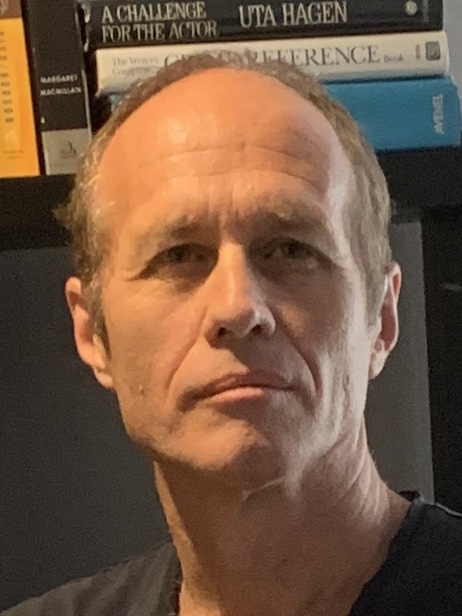

Jeff Kitchen was classically trained in playwriting technique, specializing in the work of the groundbreaking Broadway script doctor William Thompson Price.
Jeff worked as a dramaturg in the New York theater, Playwrights Preview Productions (now Urban Stages) and taught playwriting on Broadway at the Negro Ensemble Company. He then started teaching screenwriting and has taught for over twenty years in small high-intensity hands-on groups.
He teaches the craft of the dramatist, advanced structural technique, the core of dramatic action, script analysis, and plot construction. Jeff is a sought-after script doctor, plot construction specialist, and rewrite consultant.
He has taught his techniques to development execs from all the major Hollywood studios and they consistently say that he teaches the most advanced development tools in the industry.
One of his students, Ted Melfi, was recently nominated for Best Picture and Best Adapted Screenplay Academy Awards for his film about the black women mathematicians at NASA, Hidden Figures.
Jeff is the author of the book, Writing a Great Movie: Key Tools for Successful Screenwriting. Jeff is now doing high-intensity training programs for professional scriptwriters as well as script consulting.
What’s the last thing you read or watched that you thought was incredibly well-written?
Narcos: Mexico on Netflix. It was so gripping, so watchable. Hard to believe it was true. I kept telling my wife how great it is, and said to her several times I thought it was better than The Godfather. They move through so much story in just two seasons, with so much intensity and depth, great casting and acting, great writing, and so much material to weave together. The corruption makes your blood boil; the loss, the genius, the brutality, the nobility, the adventure, the chess game, the betrayal, the power and murder and love and ambition, and the pure history—there’s so much going on and it’s so compelling.
How’d you get your start in the industry?
I was mostly self-taught. A friend who was a playwright taught me the basics of Aristotle and gave me two old obscure books on playwriting to read. They were quite fascinating and very difficult, but I spent three years studying them intensely. The guy who wrote one of them, William Thompson Price, was a pioneering Broadway script doctor for top producers pre-1920 and he founded the first school of playwriting ever in the history of the world. Twenty-four of his twenty-eight students had hits on Broadway.
Price created several seriously groundbreaking tools for the dramatist and I emerged with a mastery of what he created, then improved on them and taught these tools nonstop for twenty years. People kept saying they’d never seen anything like what I taught and said they worked better than anything they’d seen. I trained development execs at all the major Hollywood studios and they consistently said I taught the most advanced development tools in the industry. So I found these old tools and ideas for tools, and studied them like crazy, then synthesized them into their current form. I taught and consulted with them for years, and got deeply experienced with them from working hands-on with them on thousands of students’ works in progress.
What do you consider the components of a good script?
The short answer to that question is my 352-page book, Writing a Great Movie. Of course I can say something in a paragraph or two, but a proper answer can go deep and wide and long. A great premise, first of all, because if your raw idea sucks, then no amount of structure or character or storytelling elbow grease will get that clunker up in the air as a commercially viable project. In the industry, it’s called Polishing a Turd. I always say well-structured crap is still crap. So start with a great idea.
Also crucial is a good strong Dilemma of Magnitude for the protagonist, but it’s not easy in such a brief format to properly communicate how to make that one dilemma occupy the full proportion of the script, build to a Crisis, force Decision and Action in the face of crisis, and then conclude with the protagonist’s active Resolution of the dilemma. The way in which the protagonist resolves the dilemma expresses the Theme, and it’s crucial to have a solid sense of theme as you build your story. You need distinct characters who are deep and complex and colorful in various ways, and who are deeply flawed, contradictory and universal.
You need attack as a storyteller, so you’re not making safe, cliché, or stock choices. Your script must be actable and it has to be stageworthy. The action of the story must move ahead aggressively, with nothing unnecessary bogging it down. It needs good cause and effect, escalating conflict, structural unity, dramatic action, and so much more. But mostly, it has to hit the audience where they live. If it doesn’t connect to the audience, then it’s not compelling.
What are some of the most common screenwriting mistakes you see?
Weak ideas, lack of imagination, lack of attack, poor execution, poor structure, lazy storytelling, stale characters, lack of depth, lack of color, overwriting, over-describing, overbearing, too much exposition, attempting to dictate an emotional response rather than earning it, lack of empathy for the main characters, underpowered ending, doesn’t pass the So What? test, crappy dialog, boring, derivative, packs no punch, uneven tone, peters out, holes in the story’s logic, lack of conflict, no clear goal for the protagonist, stupid, a simple plot vs a complex plot, episodic, formulaic, wooden characters, preachy, predictable, miserable writing skills, lack of follow-through, writing not cinematic, story not commercially viable, no sense of vision, no entertainment value, flat dramatically, lack of magnitude.
Just to name a few.
What story tropes are you just tired of seeing?
I’m not sure how many more serial killers I want to read about, or how many more procedurals, or special forces dudes, or nuclear annihilation. They can all get tiresome, but it obviously has to do with the execution, because each of them can kick serious ass when done well. But I think that things like a serial killer can be just a cardboard prop or a vastly overused excuse to write something brutal and adventurous for people who can’t or won’t do the work to go deeper and find a freakier way to mess with people’s heads.
Watch a movie like Bad Boy Bubby or Bad Lieutenant with Harvey Keitel to see something fresh and wacko. People sleepwalk through the writing process sometimes, and it’s tedious because so many people are out there writing the same warmed-over tales. There’s probably room for a story about a serial killer who kills writers who are writing about serial killers.
What are some key rules/guidelines every writer should know?
Shake things up. You’re a writer. Do something to me, mess with my head, defy my expectations, violate my sense of how a story should go. Tell a story that really tweaks me, that seriously makes me care, that grabs me by the throat and makes me notice. Make me fall in love, or go through something unimaginable, or face death, or embrace life—but do it full tilt and do it well. I don’t need the same old tired stories coming at me all day long. I’m looking for adventure, depth, love, heartbreak, power, in any genre.
Make the overall structure for your story work first. If it does not, then the details do not matter. A beautifully written scene in a script that doesn’t work is meaningless. It’s like having an ornately finished room in a house that’s falling down. Learn to work from the general to the particular. Make the overall story work, then make each act work, then each sequence, and then each scene. You gradually develop and dramatize your work as you build it.
Learn to separate the Necessary from the Unnecessary. The work of the amateur is characterized by the Unnecessary. Dialogue and description are overwritten, scenes may not be needed, whole sequences may only be dead weight, sometimes an entire act can end up being unnecessary, and in fact your entire script may be unnecessary. Which may sound funny, but it’s not. The Unnecessary kills scripts. Most scripts are unreadable—and that means 98% of them—UN-READ-ABLE. Atrocious. And in many instances, the Unnecessary plays a major part in how unreadable it is. Clean, crisp cause and effect separates the Necessary from the Unnecessary, and moves the action of the story ahead crisply and cleanly.
Master the craft of the dramatist. Dramatic writing is generally considered the most elusive of all the literary disciplines. It’s tricky, it’s slippery, it’s hard to pin down, hard to predict, and hard to diagnose or cure. But the more craft you’ve got, the more mastery you have in addressing every type of problem. People forget that scriptwriting is a performance medium—intended to be acted out in front of an audience in such a way that it’s gripping. So take the time to really learn your craft, to master it. Because almost doesn’t count, and people don’t want to read scripts that could have been good but the writer didn’t have the chops to make it work.
Take the time to build or discover deep, complex, dynamic, unpredictable, flawed, dimensional characters. Explore the Enneagram (EnneagramInstitute.com is a great resource) for each of your main characters because it’s such a remarkably powerful resource. A mixture of ancient wisdom about human nature and cutting-edge psychology, it purports that there are nine basic personality types, and each of these types has a healthy aspect, an average aspect, and unhealthy aspects. This helps you go deep and complex, to develop substantial flaws, hidden strengths, the mechanics of failure, a path to greatness, and complex, sophisticated human emotional reality.
What was the inspiration/motivation for your book Writing A Great Movie?
I wanted to get down on paper the know-how I’d accrued from teaching non-stop for eighteen years while it was still white hot. I had always taught small hands-on classes, maximum six people, and each person had to bring a script idea with them to develop so I could really get them using the tools. This helped them not only learn how to use the tools, but their scripts improved so much in the process that word of mouth on my classes was through the roof. I never taught large groups because the material was too complex. I knew that if I just talked at people about sophisticated techniques without showing them how to really use the tools that it would be mostly useless, because they couldn’t go home and use it to build their own script.
But when they started doing a big Screenwriter’s Expo in LA, they dragged me into teaching 150 people at a time. And there were riots outside my classroom of people trying to get in, so I realized that with this many people having heard about my training, it was time to write my book. So I cranked one out and self-published it by the next year’s Expo and sold a lot of them. I shopped that version and it got me a lit agent in New York who got me a publishing deal at Watson Guptill where two phenomenal editors helped bring out the best in my writing.
There are a lot of screenwriting books out there. What about this one makes it unique?
Not only are the tools unique, unusual and powerful, but I worked hard to emulate the hands-on aspect of my small classes in which I worked with each participant on their script as I explained the tools. So I explain, illustrate, and demonstrate each of seven tools in the first half of the book, and then I build a real script from scratch in the second half of the book, using all the tools. I start with a one-line idea and build the whole script, demonstrating the full use of the tools as I utilize them to create, develop, structure and write it.
Because I was rewriting the self-published edition, my editor wanted to clean up the second half of the book. I argued, saying that it had to remain unvarnished because the process of using these tools to create from scratch is necessarily messy. I needed it to remain fumbling and exploratory and rough, because cobbling a story together and dramatizing it is like feeling your way along in the dark. And I wanted to show them the raw reality, not the cleaned-up varnished version.
In the introduction to part two, I say that the first half of the book is as different from the second half as training in medical school is from working in an Emergency Room, or as studying a bear in the zoo is from wrestling one in the wilderness. I jump from tool to tool bootstrapping the story into existence, using Dilemma, the Enneagram, the 36 Dramatic Situations, Crisis, Theme, Research and Brainstorming all at the same time. And then I put the story through two structural tools, the Central Proposition and Sequence, Proposition, Plot, which help dramatize the narrative, strip out everything that’s unnecessary to the forward action of the story, and create consistent, coherent, compelling Dramatic Action.
I build the whole script with my readers looking over my shoulder, and I think it did a good job of showing the tools in action in order to give the reader genuine know-how and experience in utilizing the tools.
How do you feel about screenwriting contests? Worth it or not?
The top five or ten are definitely worth it and have launched many careers. I myself wouldn’t bother with many others, but it totally depends on what you’re up to as a writer. If you just want to put your stuff out there to see what people think of it, then you can use it as a learning opportunity. But you can also just hire somebody to give you notes on your script and that might give you more specific feedback. But there are books and websites that can help you sort the contests for value, and people who know everything about them, and they’re definitely worth taking a look at as part of a career strategy.
How can people find out more about you and the services you provide?
My website is BuildYourScript.com and I can be contacted through there or directly at jeffkitchen88@gmail.com. I offer a free class on Reverse Cause and Effect at my site. This is a powerful class that shows how to take a story you’ve roughed out and work backward from the ending, chaining backward from each effect to its cause. This enables you to stitch together the main building blocks of your story, and then to gradually flesh out the details as they become necessary. I demonstrate the process in action by working on a real script.
There’s also a paid class on a remarkably powerful plot construction tool called Sequence, Proposition, Plot which is a groundbreaking way to structure and develop your script, working from the big picture down to the details. I do consults on scripts as well as private classes on technique. One of the coolest things I do is to help people build their script from scratch, or to work with them rebuilding it once they’ve gotten a script up and running.
I’m about to roll out a high-intensity training program for scriptwriters that I’m really excited about. It’s an online immersion program in which I train apprentices for a year as we work together building multiple scripts. We’ll work two hours a day, plus one hour of homework, five days a week. In what’s called a Community of Practice, I communicate know-how through using the tools to build real scripts on the spot, and I also have students do extensive drills and rigorous exercises, handling the tools, practicing them over and over, and learning to think in that language until it all becomes second nature.
This type of learning process is called Cognitive Apprenticeship, in which writers work hand-in-glove with me to learn how to think like me. I communicate both explicit knowledge and the more ambiguous but crucial tacit knowledge, that feel for things which is indispensable for full expertise. This will be a high-intensity program, similar to a trade school, followed by a year in which I work with these highly-trained writers on building their own scripts. They will emerge as trained dramatists with key skills and experience, who can forge a career as working writers.
Readers of this blog are more than familiar with my love/appreciation of pie. What’s your favorite kind?
It’s hard to pick, but right now I’d have to go with cherry.





 Maximum Z