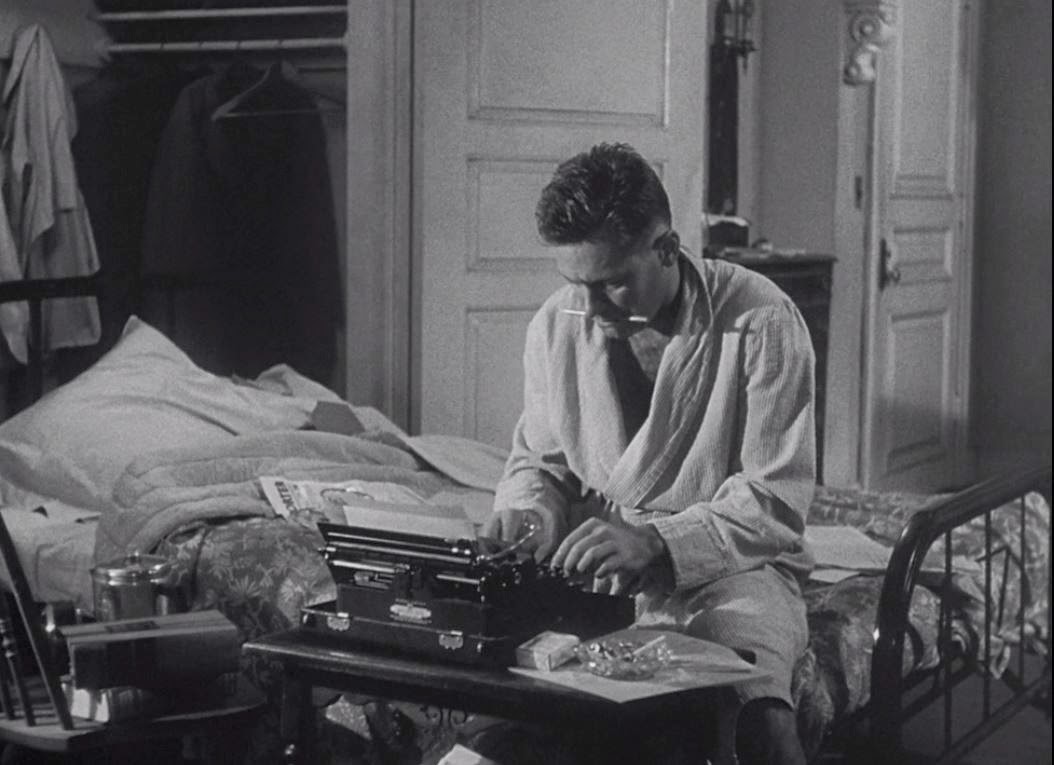
Have you no imagination?

"You'd have turned down Gone With The Wind." "No, that was me. I said, "Who wants to see a Civil War picture?""
“You’d have turned down Gone With The Wind.” “No, that was me. I said, “Who wants to see a Civil War picture?””

It’s still an uphill climb with a few gaps here and there, but the overall story for the low-budget comedy is coming together.

I’m making a point of not rushing through it and being extra careful – almost to the point of meticulous – about how all the pieces interconnect.  The more I work on it, the more the phrase “French farce” comes to mind, so lots of interweaving storylines, the intersecting of character paths, and the ramifications of each character’s actions on the others. At least that’s my interpretation.

A challenge, to say the least, but it’s been a fun ride so far.

A last-minute surprise factor was this response to the logline on an online forum:  “It’s so straightforward now it’s hard to believe you could sustain interest through 100 pages.”

I’d like to thank that person for throwing down the gauntlet in making me work even harder than I already was. Never underestimate the motivational power of “Oh yeah? Just you wait and see what I can do.”

But back to the bigger issue. Statements like these always make me wonder about the person who says/writes them.

I never cared for the “I don’t see how this could be a story” line of reasoning.  That tells me you lack vision and creativity. Just because you think it won’t work doesn’t mean it won’t. Nobody thought GUARDIANS OF THE GALAXY would do well and look what happened.

Side note – My western received a handful of reader responses along the lines of “This isn’t factually or historically accurate, so I just couldn’t get into it.” They’re entitled to their opinions, but I feel bad about their inability to just sit back and enjoy an old-fashioned ripping yarn. Although one person was gracious enough to admit at the end of their comments “It would be better if you just ignore everything I’ve just said.” Consider it done.

Always remember the sage advice of William Goldman: Nobody knows anything.

I’m all for encouraging other writers. If your idea interests or excites me, I’ll tell you. If it doesn’t, I’ll explain why not and make suggestions of potential fixes. The last thing I want to do is discourage you or give you a lecture, and you sure as hell don’t want to hear one.

My criteria is pretty simple: If I read somebody’s logline or hear their story pitch and can instantly imagine the potential within that story, and more importantly, if it sounds like something I would want to see, then they’ve succeeded and gotten over the first hurdle.

Of course, having the actual script live up to or possibly even surpass expectations is another thing.

 

Constructive criticism – a force for good

If I can't hear you, then it's not true
If I can’t hear you, then it must not be true

If you met someone who does the same thing you do, but has been doing it longer and with more success, wouldn’t you ask them for advice on how you could get to their level, and more importantly, heed that advice?

While I’m not a professional writer (yet), others, mostly on the newer side, will ask me for feedback on their script.  If I have the time, I’ll do it, and offer up what guidance and suggestions I can.

My notes are sent with the reminder that these are just my opinions to do with as they see fit. Fortunately, most of the responses have been positive and appreciative.

But once in a while, somebody will disagree with what I’ve said or totally ignore it. That’s their choice. They came to me seeking help, and I guess didn’t like what I had to say.

I once asked somebody what kind of material it was, and the answer was long-winded and very academic. While they were droning on, I couldn’t help but think “If they tried to pitch this to a producer, that meeting would probably be over right about now.”

Asking another writer for their logline, I got what sounded more like the short paragraph you’d see on the back of a novel. I tried a few different approaches, each time hoping to point them in the right direction as well as coax out some of the creativity they claimed to have. No such luck. After offering up what you do and don’t want to have in a logline, the response was a curt “Got it. Thanks.”  Can’t say I didn’t try.

Part of me wonders if my advice would be taken more seriously if I charged for it.

You came to me for help, remember? Just because you don’t like the answer doesn’t mean it’s not true.

I’m not trying to be mean. Quite the opposite. There are hard truths about this business that some people just refuse to acknowledge. All of us who came before you learned them the hard way, and if you want to make it, then you’re going to have to do the same.

The fastest route out of Sore Loserville

Get out and get out fast

There’s been a disturbing trend on some online forums regarding the results of some recent high-profile screenwriting competitions. While the writers who advance receive and exchange congratulatory messages, some of the ones who don’t seem to be looking for some kind of explanation as to why their script didn’t do better.

“They don’t like this genre.” “They’re only looking for stuff they can market.” “They just didn’t get it.”

Hate to break it to you, but that’s not it.

This is: you and a few thousand other people entered the same competition, so the odds were already against you. Chances are pretty good that some of those scripts are better than yours. It happens. Accept it.

And this may come as a shock, but maybe your script just isn’t as good, let alone as perfect, as you think.

So rather than gripe, complain and avow “Those rotten bastards are never getting my money again!”, use this as motivation to make your script better. Rewrite it. Get feedback from your inner circle of trusted colleagues. Pay for one or two sets of professional notes. Some contests offer feedback for an additional fee, so maybe that’s something you might want to consider.

I was disappointed my western didn’t do better in some of these competitions. Frustration and depression were the dominant moods for a couple of days. That’s when reality smacked me in the face and said “You want to do better? Then get to work.”

So that’s what I’m doing. I’ve completed the initial edit, so the script is now 6 pages shorter. There’s still some work to do, but it already feels better and tighter than it was before. I’ll be following my own advice (more rewrites, feedback from friends and pros, etc.), all while planning ahead for next year.

What about you?

Deliberately avoiding referencing that song

A great mantra, but a little tired of hearing it over and over
A great concept in terms of editing, but a little tired of hearing it over and over

As I work my way through the hack-n-slash editing phase of the western, it’s getting easier and easier to cut something and not worry about if I’ve made the right decision.

Whole scenes, parts of scenes and lines of dialogue are wiped from existence, all with a positive result. Tighter scene(s), better flow of story, all creating a stronger efficiency of words.

Added bonus – script is already 5 pages shorter, and still have Act 3 to go.

(Counter to all of this cutting, placeholders have been identified as potential chances to add in a few lines for some character development.)

Re-reading this script has also made me realize how much I overwrite, especially with dialogue. I try to avoid extra verbage, but don’t see that’s what’s happened until long afterward. By then, it seems more like padding, so out it goes.

A lot of writers are hesitant to cut material or make drastic edits. They just can’t bring themselves around to killing their darlings, because they figure everything is just right the way it is.

Nope.

As much as you like that scene or dialogue, you have to be as objective as possible about your own work. Is it absolutely vital to the story and advance it in the best way possible? If you took it out, would it make any difference whatsoever, or at least have some kind of impact on the story?

I’d venture probably not.

Don’t be afraid to put that red pen to work and cut away! The pain of having to do so is minimal at best and lasts all of a microsecond or two. It’s more than likely that the next time you read through what you’re working on now, you won’t even notice its absence, probably not remember it ever being there and hopefully think “Wow, this draft seems a lot better.”

The me business – a 24/7 operation


The friendliest staff in town!
We’ve got the friendliest staff in town!

What may have been my biggest mistake with my old manager was not doing enough.

I’d toil away on the new script, and send him an occasional email asking if there had been any responses to the first one. They were minimal, which is putting the best positive spin on it.

Why weren’t we getting the results we’d expected? Mostly, I blame myself.

Looking back, I realize now that it was me who wasn’t being the more proactive one. He was a busy guy with other clients to handle. Instead of handing off the material with the instruction of “I’ve got a script to write. You do what you have to,” I should have been making his job easier by doing the research, finding the names and providing the contact info so all he had to was send off an email.

Lesson learned. Behavior modified. Jump to the present.

Now being representation-free, I’ve no choice but to be the proactive one. Nobody’s coming to me, so I’m exploring numerous avenues to get to them.

-query letters. A few managers have requested the script, with more being targeted.

-researching producers and production companies who’ve made films similar to my scripts

-expanding my network and connecting with writers on community sites, which includes face-to-face meetings with those in the immediate vicinity when applicable

-publicizing my scripts and their loglines on said sites and public forums, which has resulted in not only more connections, but offers to read the scripts. Feedback is always invaluable, and somebody’s status in the industry can change overnight, so any connection is a potential good one.

My former m.o. was to devote as much time as possible to writing, rewriting and polishing. But for now, that’s just not an option anymore.

Time for a little diversification.

It’s just as important now to set aside some time each day to find some potential recipients for my material. Even if it’s only 20-30 minutes of researching names on IMDBPro, that’s still a few small steps in the right direction.

Even if something may feel like the longest of shots, I remind myself I’ve got absolutely nothing to lose, and the worst that can happen is somebody says no.  If that happens, I shrug it off, move on to the next name and try again.