What happened to the action movie?

Often imitated, rarely equaled

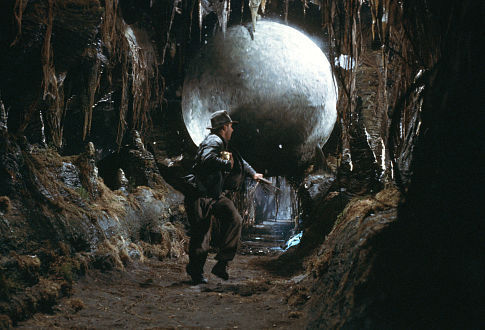
A little over a week ago, a friend posted the following question on Facebook – “Is RAIDERS OF THE LOST ARK the best action movie of all time?”

As would be expected, this led to a somewhat lengthy discussion. Several other titles were bandied about (DIE HARD, ALIENS, several John Woo HK films), and was summarized quite succinctly with “The main lesson here is that the 80s were a goldmine for high-quality action films.” (mea culpa – I’m the one who said it).

All I can think of for the 90s are TERMINATOR 2: JUDGMENT DAY and SPEED.

While you’re thinking about those, compare them to some more recent ones, such as:
-THE EXPENDABLES – a nostalgic remembering of the genre itself
-THE EXPENDABLES 2 – silly, over the top parody
-PACIFIC RIM – cool to look at, but that’s about it
-FAST & FURIOUS 6 – haven’t seen it, but I’ve heard nothing but good things about it
-THE LONE RANGER – couldn’t bring myself to see it, but will catch it on home video. Is it as bad as they say?

Now there’s this. Oy. Someday I’ll discuss how much I dislike reboots.

So why do action films from 20-30 years ago still hold up?

Looking at strong examples of the genre, they all have: Original stories. Smart writing. Three-dimensional characters. Action that enhances and supports the story.

If you’re writing an action spec, these should be your goals and objectives. Yes, it’s a lot of fun to blow shit up, but don’t use an explosion or shootout just for the sake of having one. It’s pointless.

Make the action part of the story, not what the story’s about. Use it to move things forward. Ratchet up the tension and create more conflict for your hero.

Need a refresher course in how it’s done? Pick one you’ve always liked, and watch it as a writer. Take notes. See how it all fits together. Then see if any of it can be applied to your story and rewrite accordingly.

If only all learning could be this enjoyable.

Don those X-ray specs and press ‘play’

Make sure to use them only for good
Just make sure to use them only for good

Many, many years ago, I attended an abbreviated version of Robert McKee’s seminar on screenwriting. While they usually run an entire weekend, this one was a merciful two hours long.

Of all the things he talked about, of which there were many, there’s only one point I still remember to this day:

If you want to really understand how to write a screenplay, watch a movie while following along with the script.  Do this every day (I’m assuming with a different script each time) for a year. Apparently this will instill in you how a screenplay works, the understanding of structure, etc.

I’m split on this.  On one hand, the only way you’re going to really learn is to just sit down and write.

But there is at least some merit to the idea. The more you watch and read, the more you’ll (hopefully) come to understand all the inner workings, nuances and intricacies that go into these things.

Say you’ve come up with an idea for your next spec.  A comedy.  You’ve got the basic story idea down, but there’s something missing.

Chances are you were influenced by other comedies. Compare your story to some of your favorites. What is it about them that you like? Is your story similar? What do they have that yours doesn’t, and vice versa?

Take the time to watch them again, but don’t just watch. Study them. View them through a writer’s eyes.

Can you see the elements at work? Are you able to look beyond the jokes and follow how the characters and storylines develop? Do the jokes and comic set pieces come naturally or do they feel forced?

Over time, identifying story components will become easier for you, and you’ll be able to put that knowledge into play on the page.

Getting left and right brain to work together

Image
It’s like they’re looking inside my head!

I have a deadline in place. I’m striving towards being completely done with the edit/polish by the end of the month, so I work on it when I can.  A scene or two here, a few pages there.  It’s coming together.

A key part of this is making sure each scene does what it’s supposed to and fits where it’s supposed to. A member of my old writing group used to say, “Each scene should advance the plot, the theme and the character.” A reliable chestnut, indeed.

It’s also been a good exercise to look at the components of each scene and figure out if there’s a way to do it more effectively. Do I need a stronger verb? Can the character say this in one sentence, rather than two? Does it fit within the framework of the story? (I’ve written before about the economy of the scenes in STAR WARS. Lucas was able to say a lot with a minimal amount of words. I need to work on that.)

We watched ATTACK THE BLOCK over the weekend (an unexpected absolute blast – smart and original, but watch it with subtitles on). One thing that really stuck with me were the character arcs, especially for the leads. This was done in a very subtle, non-in-your-face way. Very impressive.  This reminded me that I need to make sure this happens with my characters as well.

-Another great interview on The Script Adventurer! yesterday. Talked with writer Shawna Benson about her background, as well as some of her current exploits. Really interesting stuff. The show will play again here Sunday at 7pm PST.  Don’t mind the occasional technical difficulties.

-Apart from ATTACK THE BLOCK, other Movies of the Moment include: THE AVENGERS. Wow. The closest we’ve come to a live-action comic book. Further proof that Joss Whedon can do no wrong. We saw it as a family at a small 2-screen neighborhood theatre. Perfect setting. Everybody liked it, even to the point I may even seek it out on DVD.

The other movie was THE MUPPETS. It was okay, but a little disappointing. It felt like they were relying on the nostalgia factor almost as much as the script. Too many jokes were aimed squarely at adults (a reference to the TV show BENSON? Really?), which didn’t help. V watched it with a friend, and both seemed bored.  Apparently there’s a sequel in the works. Hopefully they can get back on track.

Thrillingly terrifying, or possibly terrifyingly thrilling

Yeah. Kind of like that...

My mind is racing at a faster rate than usual these days. There are a zillion things I need/want to do with DREAMSHIP over the next few weeks. Finish the edit. Polish where necessary. Research potential script analysts. Create and fine-tune a list of potential managers, agents and production companies. Compose a persuasive query letter.

I kinda/sorta knew this all along, but it didn’t really hit me until I started price-checking different services like Done Deal Pro and IMDB Pro:  this is like me officially entering the field of battle, and not entirely sure I’m armed and ready.

I hate self-doubt.

I know my script is good, but there’s still that little voice in the back of my head saying “But is it good enough?” There are literally thousands, probably even tens of  thousands of people just like me trying to accomplish the exact same thing.  It’s me against them. Every man for himself.

My script not only has to be a solid piece of work, it has to have that certain something that grabs your attention and doesn’t let go.  Once you start reading, you don’t want to stop. You NEED to keep going.  You are COMPELLED to know what happens next. That’s the impact I want.

I can only hope that’s what actually happens.

And the more I think about it, the more I realize I don’t have time to worry. I’ve worked too hard to let that stand in my way. I may be nervous about what’s coming next, but I won’t let that stop me.

Besides, this is what it’s all been about.

-In case you missed the most recent installment of The Script Adventurer!, my guest this week was Gordon McAlpin, the mind behind the webcomic Multiplex.  Apart from some technical difficulties, it was great talking to him. The fine folks at Radioslot have added an additional replay, so now you can catch the show live at 1PM on Monday, or hear it again 7AM on Wednesday or 7PM on Sunday (all times Pacific Standard Time).

That’s almost that

Reaching my goal seems a little closer now

It took me longer than I wanted, but I finally finished the DREAMSHIP rewrite. 116 pages, which isn’t too bad. Now begins the editing phase, primarily of the second half.  I managed to trim about 7 pages for the first half, and hope to cut at least 4-5 this time around.

It bothers me that it won’t be ready for the Nicholl, but I’ve accepted it and moved on.

I’m also exploring the idea of sending it to a couple of professional script analysis firms. One of them might be ScriptQuack, especially since this rewrite was based on their suggestions for the previous draft.  I like the idea of getting some solid feedback, but I don’t know if I have it in me to go through another rewrite.  I like the idea of doing what I can with this and moving on, since LUCY is still waiting.

There’s something that’s been gnawing away at me inside for the past few weeks. I’ve noticed a unique writing style in a lot of recent scripts I’ve read; a lot of it really good.  My writing may not necessarily be as vivid as others, but it gets the point across. I try to use a little flair, but not enough so it distracts you from the story.  I’d rather let the story do its job than wow you with fancy-schmancy writing.

I’m also hoping that once the editing/polishing is done to fine-tune the logline and start sending out query letters. I did this before using a hard copy of the HCD, sending out about 200 email queries. It got the script optioned, which unfortunately didn’t lead to anything.  Maybe I’ll have better luck this time around.