Make that sprawling epic a little less so

There can be such a thing as too much

An underrated bonus of working on a first draft is having the freedom to put in just about anything you think will work (provided, of course, it advances the plot, story and character development).

There will be the inevitable edits and rewrites afterward, but this is your chance to take that outline and really build on it.

But it’s also easy to overdo it.

All that witty dialogue, intricate scene descriptions or clever subplot you just thought up can quickly add up without you realizing it, and suddenly your tight, compact story has become a bloated, overstuffed mess.

Scripts usually run 90-120 pages – one page equals one minute of screen time. Does yours fall somewhere in that range? Anything more or less, and you’ve got some work to do.

If you ask somebody to read your script, one of the first things they’ll do is check out how long it is. 97 pages? Cool. 137? Unless you’re an award-winning filmmaker, not so cool.

“But there’s nothing I can cut!” you exclaim.

Wanna bet?

Once you’re done with your current draft, don’t look at it for at least a week; two would be better. Put it away and walk away. Focus on something else.

Then come back and just read it.  No editing, just reading.  Still think there’s nothing you can do with it?

Now the fun begins.  Go through it and really scrutinize each scene.

Is it absolutely crucial to the story? If so, can it be shorter?

All that great stuff you came up with on the fly – does it still work?

It may be tough at first to kill all those darlings, but more than likely, you won’t even miss them after they’re gone.

If you want to be a better writer, you have to learn how to not let your ego and emotions dictate your edits. In the end, both your script and writing skills will be the better for it.

That’s me – the human flying buttress

Just offering what little support I can
Just offering whatever support I can

When another writer follows me on Twitter, I’ll send a thank-you DM when applicable and ask how their latest project is coming along. The responses are usually pretty enthusiastic, and it’s great to see such a wide spectrum of material and how each person’s path is developing.

(What writer doesn’t like to talk about their work? I’m no exception either.)

Or maybe they’ve hit a bump in the road. “I’m stuck in Act Two,” “This rewrite’s killing me!” or “I’ve been dragging my feet on getting this draft done.”  Happens to all of us.

Based on how they’re doing, I’ll usually write something like “That’s awesome!” or “Hang in there!”, followed by the ubiquitous “Best of/Good luck!”

And I actually mean it.

Honest.

So it was a little surprising when I got this response during a recent DM chat – “You have a special gift of encouragement. WHO does that these days?”

Really? Nice, supportive people are now considered a rarity?

I’m not an idiot. This is a savage business a lot of us are trying to break into. It’s extremely competitive, and the odds are definitely not in our favor.  It’s extremely easy to get disenhearted and want to throw in the towel after receiving that 97th rejection letter.

A few words of support are never the wrong thing to say, even if it’s something as simple as “Good luck.” That may be just the extra push you need to get yourself to keep going, start again, or what have you.  If you’re lucky, you have loved ones, friends and trusted colleagues who support your efforts, regardless of how long it takes.

And consider me part of that group as well.

-Movie of the Moment – STAR TREK INTO DARKNESS (2013). Nice to look at, but is it really asking too much for an original story and characters – again? I didn’t like the Leonard Nimoy/Spock part of the 2009 movie, and was disappointed at the way this one played out.

For a funnier, NSFW spoiler-filled review, click here.

It bothers me that Orci, Kurtzman and Lindelof have become the go-to guys for pop culture sci-fi flicks. Yes, they’ve got talent (to a certain extent), but their work just feels like something’s missing. Maybe too much relying on flashy spectacle and not enough smart storytelling?  The effects should enhance the story, not the other way around.

As much as I enjoy a good fanboy film, I’ll take a solid story over gee-whiz special effects every time.  I suspect a lot of people also feel this way, or at least hope they do.

Trust your audience to be able to follow along; they’ll appreciate it.

Pedal to the metal

It may be kmph, but it's still fast
It may be kmph, but it’s still fast

Nice to be back. Didja miss me?

Y’know, visiting three major metropolitan areas in a week (four if you count the one where I started and ended AKA home) can really tire a guy out.

So while I work on readjusting to my native time zone, I’m also working on getting some writing-related affairs in order.

-Due to a last-minute family medical emergency, my manager had to cancel our face-to-face meeting. Bummer. And his assistant was up to his eyeballs in reducing his steadily-growing workload, so he couldn’t meet either. Double bummer.

Fortunately, there is a silver lining: I got emails from both the next day about the rewrite. Overall: great job, nice scene changes and choices, very solid structure.

Up next – a “high-octane” logline and synopsis. Although I’ve always had problems with the latter, I really like the sound of that particular adjective.

“High-octane.”  Sounds fast, powerful and strong.

This is a fast-moving script with lots of swashbuckling action, so that’s the mood my 1-2 sentence description and 1-pager should convey.

The logline and synopsis are your best chances to really showcase what your story’s about, but letting the genre do the heavy lifting. Comedy – play up the jokes. Thriller – keep us in suspense. Horror – scare us.

In my case – adventure – both logline and synopsis should give you an idea of what kind of rollercoaster ride you’re in for.

I’ve written before about what a solid logline should include, but just in case: hero with a flaw, villain with a goal, the conflict between the two, and what’s at stake.

The synopsis has always given me trouble. It’s easy to get lost trying to accurately describe the story. You want to include all the cool stuff, but you can’t.  As a result, here’s a tip I’ve found very, very helpful: focus on the main character and their storyline. Don’t worry about the subplots and supporting characters.

Although it comes from publishing, this may be a huge help for those also struggling with the synopsis.

You’d think after tackling a 100+-page script, writing the same story in one page would be easy. But it isn’t.

But it is doable. Like for a script or any kind of writing, you just have to work at it.

Deliberately avoiding a QT comparison

Mine is nothing like this
Something to admire, but not duplicate

When I was working on that student short a few years ago, the director was concerned the way a scene was playing out was too similar to how things worked in INCEPTION, and that people would think he was ripping it off.

I assured him it wasn’t on both fronts. It may share some similar aspects, but it was totally different.

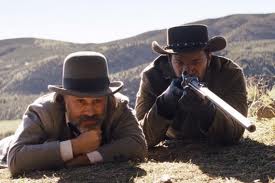
Jump ahead to now, or at least last week. I finally got around to watching DJANGO UNCHAINED. It was great and a lot of fun. I loved it, especially the writing.

(Side note: Christoph Waltz fully deserved Best Supporting Actor, and I found King Schultz to be a much more interesting character than Django.)

So as I continue work on my western spec, I can’t help but think “But this isn’t how Tarantino did it.  Would somebody hold that against me?”

I’m inclined to think “probably not”, which is actually a good thing, and may even work in my favor.

He writes in a certain way, which is totally different from mine.  Nobody’s going to read my script and say “not grindhouse enough”.

Our two stories may share some similar elements, and that’s where the comparison ends.  It’s a western, so there are going to be the unavoidable elements (horses, shootouts, etc.), but that comes with the territory.  My challenge is to put my own spin on them.

Same rules apply to UNFORGIVEN, the vastly-underrated OPEN RANGE and the forthcoming LONE RANGER (which in theory may be the closest to my story in terms of rip-roaring, dime novel-type adventure).

This script is my opportunity to work in a genre I love, tell a story I’m excited about and create its world the way I want to.  The whole time, I’m striving to be as original as I can, and present stuff that hopefully hasn’t been seen before.

There are countless ways to tell a story, and there’s no reason mine can’t be one of them.

Don those X-ray specs and press ‘play’

Make sure to use them only for good
Just make sure to use them only for good

Many, many years ago, I attended an abbreviated version of Robert McKee’s seminar on screenwriting. While they usually run an entire weekend, this one was a merciful two hours long.

Of all the things he talked about, of which there were many, there’s only one point I still remember to this day:

If you want to really understand how to write a screenplay, watch a movie while following along with the script.  Do this every day (I’m assuming with a different script each time) for a year. Apparently this will instill in you how a screenplay works, the understanding of structure, etc.

I’m split on this.  On one hand, the only way you’re going to really learn is to just sit down and write.

But there is at least some merit to the idea. The more you watch and read, the more you’ll (hopefully) come to understand all the inner workings, nuances and intricacies that go into these things.

Say you’ve come up with an idea for your next spec.  A comedy.  You’ve got the basic story idea down, but there’s something missing.

Chances are you were influenced by other comedies. Compare your story to some of your favorites. What is it about them that you like? Is your story similar? What do they have that yours doesn’t, and vice versa?

Take the time to watch them again, but don’t just watch. Study them. View them through a writer’s eyes.

Can you see the elements at work? Are you able to look beyond the jokes and follow how the characters and storylines develop? Do the jokes and comic set pieces come naturally or do they feel forced?

Over time, identifying story components will become easier for you, and you’ll be able to put that knowledge into play on the page.