I can see clearly now

Ahoy! Rewrite dead ahead!

This week’s installment of The Script Adventurer! featured an interview with the multi-talented Heather Hale.  She’s worked as a writer, a director, a producer and as a consultant, so she definitely knows her stuff. (Mark your calendars – the show re-plays Sunday at 7PM on radioslot.com)

I always like to know what key piece of advice a professional or working writer would offer to the rest of us.  A thought or phrase to jot down on an index card and attach to the wallspace in front of your working area.

Heather named two.

1. Clarity is king.

You may know your story inside and out, but if the person reading it can’t follow it or is confused as to what’s going on, then you’ve got a problem.

It doesn’t matter if you’ve got the most brilliant concept ever.  The plot and story have to be clear so anybody can pick up the script and know exactly what’s going on.

It’s up to the writer to make their story as easy to follow and comprehend as possible, or else the reader/audience will get lost in the story, and not in the good way.

2. The reader is never wrong.

You think your script is perfect. The reader knows better. It’s their job to go over it with a fine-tooth comb and look for flaws.  And unless you’ve attacked that script from every conceivable angle, fixing any potential problem you can think of, they will find them.

The reader really does want to like your script, but if you give them any reason to say no, there’s no reason to be bitter about it.  They know what they’re talking about.  Look at this as an opportunity to make your script better or stronger than it was before.

-Movie of the Moment: Three over three days!  It’s been a long time since I’ve done that, and two were actually in theatres. Wow!

THE HUNGER GAMES (2012). I read the book last month, so it was pretty fresh in my mind. I liked it, although it could have been a little shorter. I can appreciate a strong female protagonist, and it’s easy to see why Katniss has caught on.  She’s tough and doesn’t give up.  Congrats to Jennifer Lawrence for doing a solid job in the lead.

I also really enjoyed Stanley Tucci as Caesar Flickerman, the blue-coiffed TV personality with perfect teeth. A great accomplishment in casting.

My only complaint – Katniss doesn’t always drive the action forward. She’s more reactive than active in some scenes.

-THE SECRET WORLD OF ARRIETY (2010). Another animated gem from Miyazaki and Studio Ghibli, based on the classic books THE BORROWERS.  A recurring theme in a lot of their films is the main character’s coming of age. And this one is no exception. If it weren’t for 3 of the characters being 3 inches tall, this could easily pass as a stage production. Good for all ages.

-RISE OF THE PLANET OF THE APES (2011). Smart and well-written. Easy to see why this was a surprise hit last summer. Especially fun if you’re familiar with the original films. K made an interesting point in that you’re rooting for the apes to win, which would mean the eventual downfall of humanity.  Count me in the camp of those who think Andy Serkis should have gotten some kind of recognition for his mocap work as Caesar.

Finding a method in all that madness

Image
pre-computer 'delete' button

I was doubly fortunate to interview two writer-directors live and in-studio on yesterday’s installment of The Script Adventurer! – Joshua Grannell and Mary Regan.  Among the many subjects discussed was how each of us develop our ideas, especially in the beginning phase of building a script. (If you weren’t able to catch the show live, never fear – it will replay this Sunday at 7PM PST on radioslot.com)

While everybody has a different approach to how they put a story together, the style is usually very similar.  You come up with an idea, then figure out how to develop a story around it. Some people like to come up with as many potential scenarios that could arise from that original idea. Others may choose to meticulously weave an intricate web of storylines around it.  There’s also the time-honored practice of metaphorically throwing everything at a wall and seeing what sticks.

No matter what your style, it’s extremely important to hammer out all the kinks of your story BEFORE you start on pages.  It’s a lot easier to fix a problem contained in one sentence rather than one page.  This will also cut down on your frustration over having to go back and edit and/or rewrite.

Another plus is it gives you a more condensed and detailed view of your story, so it’s easier to keep track of where something happens if you need to jump back in and fix it. This way you’re not wasting time scrolling through pages trying to find that one thing you need to change.

Maybe this comes from years of focusing more on the outline first, but I’ve found that once I’m satisfied with how the outline is put together and start on pages, if I find something that needs to be fixed or I come up with a way it could be better, making those changes is a lot easier than it used to be.  I suppose it’s because I already know what the point of the scene or sequence is, so I don’t have to worry about what’s supposed to happen next and can instead channel my creativity into making it stronger/more effective.

Whew!

And...exhale

Wow, what a jam-packed couple of days! Here’s a quick rundown:

-Whirlwind trip to New Orleans for the Half-Marathon. 13.1 miles in 1:56:06. Wooo!  Next up – coming in under 1:55 for a race in September.

-On this week’s installment of The Script Adventurer!, I interviewed Scott Myers from Go Into The Story. He had a lot of interesting stuff to say, including the most important thing a new or aspiring writer should focus on is having a strong story concept. If the idea behind your story isn’t strong, then the script won’t be either.  Also served as a reminder of what a great resource the site is for aspiring and professional writers.  Check it out if you haven’t already.

-Now that the big run is out of the way, I can devote more time to finishing the DREAMSHIP rewrite. There’s no reason I can’t wrap it up by the end of the month, and I don’t foresee much of a problem with the follow-up editing.

I also realized the Nicholl deadline is coming up, and I could actually submit to it.  Not sure which way to go on that.

-I spent part of the going-there flights muddling my way through the latest section of the LUCY outline.  Progress remains slow but steady.

-Movie of the Moment: Lots of ’em! Best Picture winner THE ARTIST (2011) was featured on the plane.  I liked it, but not sure if it should have won Best Picture over HUGO. If you’ve ever seen SINGIN’ IN THE RAIN or A STAR IS BORN, then you know how this plays out.  John Goodman was really good as the studio boss.

Also got to watch BATMAN: YEAR ONE (2012), an animated adaptation of the comic by Frank Miller and David Mazzucchelli. Solid work on both story and voice fronts.

K watched NEW YEAR’S DAY (2011), which I had no desire to see.  When it was over, she said, “It’s trying too hard to be LOVE, ACTUALLY.”  I caught about three scenes because I was zipping through THE HUNGER GAMES, which I liked more than I expected to.  Easy to see why this is the latest YA novel headed for the big screen later this month.

Also caught the first 30 minutes of MY WEEK WITH MARILYN (2011) before the plane landed. I’ve always had a problem with biopics. It’s tough for me to separate the actor from the real-life person they’re playing.  So while it was easy to imagine Kenneth Branagh as Olivier or Michelle Williams as Marilyn Monroe, I kept seeing them as actors playing somebody else.  Nevertheless, I liked what I saw.

-JOHN CARTER opens this weekend. I may actually go see it.

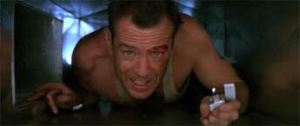
When all else fails, go to DIE HARD – or – Thank you, John McClane

An action film done right

Unusually busy this week, including initial prepping for a potentially huge project, so not much progress on the rewrite front.  I also feel like I’ve been ignoring LUCY, so I brought the trusty notepad to last night’s hockey practice in an effort to see what I could come up with.

I’m up to around the page 75 mark, and need to get to the end of Act Two.  The action and stakes have to be ramped up, and just about everything in that part of the initial outline wasn’t going to work.  Simply put, I’m starting over.  Sometimes that can be good and inspirational, but looking at that blank page didn’t help.

My good guys need to reconnect with the bad guys. The situation has to be progressively harder for them, with the title character driving things forward.  But how to make this happen?  Ding! The light bulb appears.  Pick ’em off, one by one, leading to the showdown in Act Three! That’s it! Wooo! And what better an example of this than DIE HARD?

*Side note – you gotta admit it’s incredibly cool that DIE HARD is now considered a Christmas classic, right up there with A CHRISTMAS STORY and IT’S A WONDERFUL LIFE.  No holiday season should be without watching it.

While there have been numerous copies, some done right, some not, this is a great blueprint to follow for a solidly-constructed action story.  Hard to find any big flaws in it.

For an entertaining analysis/review, click here.

Now that I have an idea of how to move ahead, I can work out the details of how to break up each sequence into 2-3 scenes per scenario, all of which will lead into the “all is lost” moment at the end of Act Two.  I still have a few gaps to fill, but confidence is running high.

Gotta tell ya – feels pretty good to overcome a seemingly insurmountable obstacle.

Stop thinking and write!

proof that a script is like a blueprint; everything has to fit perfectly

A very interesting thing happened during the first scene of the rewrite of the second half of DREAMSHIP.  I got about halfway through when I realized my hero was just sitting there, doing nothing.  And that ain’t right!  He’s supposed to be the one driving the action, pushing the story ahead.  Fortunately, it’s easily fixed.  But it got me thinking.

Since finishing the first half rewrite, I’m more careful going into each scene.  You could even call it overthinking. Does this scene advance the story, theme and character? (A cardinal but often-ignored rule for screenwriting)  Does it follow the one before it and lead to the one after it?  If I take it out, will it impact the rest of the story?  I also realize taking the time to analyze each scene with such intense scrutiny will slow me down.  The feeling of getting stuff done will vanish.

In some ways, just storming ahead seems like a great way to go.  But then there’s the whole issue of going back and fixing things.  But if I apply the proverbial fine-tooth comb, then it won’t be fun.  And will take longer than I’d like.

I think rather than move ahead on pages, I’ll go through the outline and edit accordingly, thereby saving valuable time during the page-writing period as well as trimming some fat from the story.

-I’ve read some of the scripts from the 2011 Black List. So far, not too impressive.  I liked the 2010 selections much better.

-Movie of the Moment – 9 (2009). A really interesting animated film that came and went from theaters pretty quickly.  I can see why.  Set in a post-apocalyptic world, a band of foot-high dolls struggles to survive.  This is probably not the best way to describe it, but it’s all I can think of.

While the story is a little unusual, I thought it was a great take on the genre.  Really clever use of the animation and each doll had a distinct personality and appearance that made it easy to distinguish one from another.

My only complaints:  a slightly confusing resolution to the main conflict, and a lot of back-and-forth in terms of moving the story forward.  I think the main character said “We have to go  back!” at least twice.  It’s never explained how the dolls function, but in the end doesn’t really matter.

I didn’t realize this was based on a ten-minute short, which was included on the DVD, but I didn’t get a chance to watch it.  Tim Burton and Timur Bekmambetov were among the producers, and it’s easy to see the influence of each.