Oh, how I loves me a challenge. Which is what this rewrite has become.
But in a good way.
I’ve figured my way through several problem areas, came up with (hopefully) better ways to show important story/plot points, but still have quite a ways to go.
Bonus – what originally seemed like an insurmountable task is slowly becoming an opportunity to push my creativeness beyond its limits and turn this thing into even more of a thrill ride.
Which was my original intent to begin with.
So far, the hardest part has been forcing myself to stop hanging onto the contents of the previous draft. Which ain’t easy. A lot of it is material I thought worked fine, but as always, can be better. Letting go of something I slaved over and hammered out is tough, but it has to be done.
Once I come up with new or revised scenes and sequences I like, working them into the story shouldn’t be too hard.
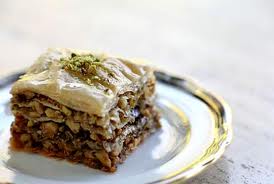
Baklava has nothing to do with this post, but I could really go for some right about now
My creativeness did it again.
Looking over those notes* I got the other day has triggered the inevitable: more ideas for more scenes, or at least trying a new approach in some of them.
I originally thought the necessary rewrites would be quick and painless.
Ha. Silly boy.
The more I think about how to implement the suggestions from those notes, the more I devise potential alternate ways of telling the story while still keeping everything intact.
As always, it’s all about making the story stronger.
Going through this process also reminds me I don’t have to be hesitant to change things around. Chances are I could come up with something even better. Never know if I don’t try, right?
Most importantly, I want to avoid that burned-out feeling I was getting as I neared the end of the edits and polishes the last time around. If this ever starts to feel like work, then it’s time for a short break.
Which, knowing me, would probably trigger more ideas.
*Can’t believe I forgot to mention where I got the notes – right here. Definitely worth your while.
Time to take a little break from working on this outline. I got some really good notes back on DREAMSHIP from a highly recommended reader, and he did a great job of pointing out what works and what doesn’t. So the next couple of weeks will be devoted to making changes where necessary.
My initial thoughts were along the lines of “This is going to take FOREVER!” But taking another look at his comments, it might not be as big a hurdle as I thought. There are definitely some parts that need work, or at least a little creative tinkering, which I think I can handle.
And it probably goes without saying that the query letter stage is also on hold for the time being. For now, it’s all about making the script better.
After I sent him the script, I admit I succumbed to that short-lived fantasy of getting notes consisting of “This is terrific! Don’t change a thing!” Who hasn’t?
But I’m also realistic about this, so I was relieved he didn’t say “This sucks,” or words to that effect. When the first part of the summary reads “A lot of good stuff here,” that’s a sort of mini-vindication for my time and effort.
Part of me was dreading having to go through another rewrite or three, but there are countless stories of working writers having to churn out dozens of rewrites in order to make the script better, so if this is what I have to do to move things forward, so be it. The more I can do to hone my craft, the better.
Not gonna lie. There was a brief period of “woe is me”, complete with an air of melancholy, but I’m over it now.
Nobody said this was going to be easy. And it isn’t. And there’s no way I’m going to stop trying, either.
Working from the end of Act Two into Act Three is certainly proving to be an exercise in staying organized, story- and detail-wise.
It’s one thing to jot down the idea behind a scene in your notes, thinking “I’ll fill in the details later,” and totally another when it’s time to fill in those details.
Case in point: I write “daring escape!” to sum up a scene. Now I have to figure out not only HOW the escape is daring, but have to put it together in a way that’s exciting, original and entertaining, reinforces how it fits between the scenes before and after it, all while making sure it also works within the context of the story, characters and theme.
Quite a lot to keep in mind, isn’t it? And this applies to EVERY scene in your story, no matter how big or small.
Not only that, but while you’re putting a scene together, it’s easy for some details to slip your mind. How can this character be involved here when I had him trapped over there? Hey, this character is just sitting there. How can I involve them?
This also re-emphasizes that most of the heavy lifting comes while putting the outline together. It’s a lot easier to fix a sentence or short paragraph rather than a few pages of script, especially when you come up with a scene or sequence you absolutely love, then discover it just doesn’t work.
It’s also a great opportunity to experiment. What if this happens? How about if the character does THIS instead of this? Let your imagination run wild. Pull out all the stops. Just make sure it all makes sense in terms of moving the story forward.
Work your way through the details during the outline phase, and you’ll find the page-writing phase will go much more smoothly.
I’m getting over a nasty bout of some kind of respiratory virus, which at one point included a fever of 104.1, thereby completely nullifying my ability to do just about anything. I was hoping to utilize the time being laid up to work on the rewrite, but it’s kind of difficult when your head feels hotter than the surface of the sun.
Over the weekend, I got some helpful feedback from a trusted colleague. This was a repeat evaluation for him, and he again raised some points about the antagonist and the way she acted. At first, I basically glossed over his comments, most likely because I didn’t necessarily agree with them.
But his words gnawed at me. If he had issues with that, who’s to say a potential future interested industry-connected person wouldn’t say the exact same thing? It’s up to me to make this thing as tight, connected and bulletproof as possible, so any criticism needs to be taken into consideration.
Since my health wasn’t exactly around 100 percent, and it was easier to read then to actually write, I went through the sequence he was talking about. I read through it not as the person who wrote it, but as a reader/audience member going in blind.
And of course, he was right. Why would the antagonist do these things? It made no sense. That and a two-scene sequence that the more I thought about, didn’t seem to serve much of a purpose. So out that went as well.
Suffice to say, a mini-rewrite is in progress. It’ll take a little bit of effort to work my way through this, but as usually happens, the new end result will (in theory) be stronger, more effective and just improve things overall. At first I was annoyed that I had to go through this, but upon reflection, anything that has to be done to improve the script is necessary and should always been seen as a positive rather than a negative.
Hopefully, it won’t take too long.
-Movie of the Moment – MARY AND MAX (2009). Don’t let the animation fool you – this ain’t no kids film. This claymation feature from Australia deals with adult subjects such as depression and mental illness. The title refers to 8-year-old Mary, growing up lonely and ignored in the suburbs of Melbourne, who becomes pen pals with 44-year-old Max, living alone and afraid in New York City. Their relationship spans 20 years as we get to see the impact each has on the other’s life during that time.
This description really can’t do the story justice; it’s one of those films you have to see for yourself. Highly recommended for adults, NOT recommended for kids. This has also got to be one of the most heart-wrenchingly sad movies you may ever see (if you don’t cry at the end, then you just have no soul), but at times can also be extremely hilarious. It leans more towards black humor, so if that’s not your thing, you might not enjoy it as much.




 Maximum Z