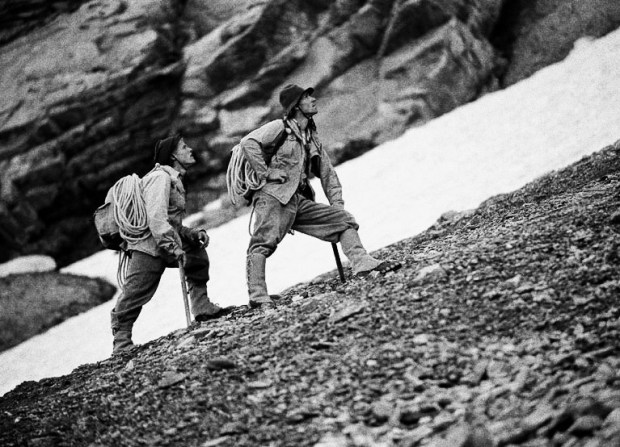
Let the ensuing commence!

mountain climber 2
That was when our heroes realized things were about to get a lot tougher from here on in…

When I write out a scene, I have a pretty solid idea of what needs to happen in it; how to make it follow the one before it, and lead into the one after it.

Sometimes it ends up the way I intended, and sometimes it needs a little more punching-up.

And a lot of the time, that punching-up involves making things more complicated, which does a simultaneously effective job of upping the conflict, which was already a necessity.

This whole process most recently came into play while working on a scene in the pulp spec. I’d planned out what was supposed to happen, and on the surface, it seemed okay.

And then I wrote it, but it wasn’t the same as I’d envisioned. It was still missing a vital component, and I couldn’t determine exactly what.

Did it successfully connect the scenes before and after? Was there conflict? Did it advance the necessary elements?  Yes on all counts, but it still seemed off.

I read through it again. It was tight and efficient, and did what it was supposed to. But this second read also revealed the hidden problem that was nagging at me.

It was too tight and efficient. The protagonist accomplished what they were supposed to, but it needed to be tougher for them to do so.

So back I went to the planning-out stage, tossing in a few more wrinkles to make it that much harder for my hero. Although they still achieve their goal within the context of the scene, this time I made sure they really earned it.

Plus, the new complications really emphasized the overall nature of the story, which is always good.

This isn’t to say that every scene has to have some kind of monumental obstacle to your protagonist, but the journey towards their goal shouldn’t be an easy one. It might not even be a physical thing; maybe your hero has to overcome an internal or emotional problem.

It may be easier for you to keep things simple and straightforward, but unfortunately that makes for dull storytelling. Making things more complicated for your protagonist may complicate things for you in putting it all together, but it will definitely make for a better story while also improving your skills as a writer.

Don’t hold back. Put both yourself and your protagonist through the wringer. You’ll both be better for it.

An amiable assortment o’ items

study group
Everybody’s keeping busy, so there’s lots to talk about!

First three months of the year wrapping up today, which makes it the perfect opportunity to offer up your Project Status Update! Feel free to step up to that virtual microphone (aka the comments section) and announce the latest developments for whatever is currently occupying your attention.

My list is pretty short:

-Work on the pulp spec continues. Currently around page 83, with a projected final count of 120ish. Strongly suspect FADE OUT will be typed sometime in mid-April, give or take a couple of days.

-Dipped my toe into the waters of rewriting the low-budget comedy courtesy of some helpful notes. Not a total page-one rewrite, but definitely taking my time with this one.

-My western was named a finalist at the WorldFest-Houston International Film Festival screenwriting contest. (Editor’s note – yay) Further details (i.e. how it placed) won’t be announced until the awards ceremony at the end of April, but still quite proud to have made it this far.

And a couple of items tacked on to the bulletin board, which spotlights creative-type folks and their even more creative projects well worth your time and attention:

-Filmmaker/screenwriter Eric Claremont Player has launched a crowdfunding campaign for his courtroom drama film project. Make sure to check out the colorfully captivating and absolutely true backstory that led up to it.

-Writer-director Dianna Ippolito is running a crowdfunding campaign for her new project Robb’s Problem: A Horror Short. As Dianna puts it, “Our goal is to bring you a really smart, beautiful and thought-provoking horror film, produced, written and directed by women.”

As with all crowdfunding projects listed here, donate if you can!

If you’d like to get the word out about a project of your own, feel free to drop me a line. Operators are always standing by.

-Ran the San Francisco Rock & Roll Half-marathon this past weekend. Made it just under the 2-hour mark with 1:59:11. Next race is in July, so hoping to shave a few minutes off of that.

It requires some planning ahead

planning-ahead_4
Sometimes mapping it out by hand can prove most beneficial

Lots and lots going on within the hectic hallways of Maximum Z HQ, what with all the writing, note-giving, and career-developing taking place.

Much as I would love to offer up an original composition, my current schedule is a bit tight, so instead I humbly present a trio of posts, all plucked from the archives, and all dealing with what I consider to be a most important aspect of telling a story.

Enjoy.

Set up, pay off

Strong rope & solid knots required

Tying it all together


A writer does what again?

typewriter
Just another schmuck with an Underwood

In case you haven’t been following me on social media (which is easily rectified), I’ll post semi-daily updates regarding my progress in writing the latest draft of my current spec.

(Incidentally, just passed the page-75 plot point on the pulp spec)

After I post an update, my network of fellow creatives will offer up their very supportive and encouraging comments.

“Great job!”

“Keep going!”

“I don’t know how you do it!”

I do, and it’s actually a pretty simple formula: I try to write every day. Even if it ends up being just a short amount of time, or all it yields is a single page. Sure, sometimes life gets in the way and I’m not able to write, but there are definitely more days of writing than not-writing.

Writing scripts (preferably my own, but I’m not picky) is what I want to do. More than anything. So I continuously work at it, trying to improve my skills and produce quality material. It’s the only way I know how to get there.

Some might say I currently have the luxury of just writing specs. No pressure. No deadlines. No conflicting sets of notes. But I don’t really see it that way. I treat this like a job because I’m working on making it my job.

To reinforce the whole “marathon, not a sprint” concept, maintaining a daily regiment of writing helps me prepare and get in shape for when it’s time to take on the real thing.

And when that actually happens, I’ll be able to keep up.

(Speaking of which, I’ll be running my first half-marathon of the year this weekend. Once again hoping to hit the 1:55 mark, but breaking 2 hours will be just fine and dandy.)

Mini Bulletin Board time!

-Writer/friend-of-the-blog Mark Sanderson is proud to announce the release of his new book A Screenwriter’s Journey to Success. Mark is also an accomplished screenwriter and script consultant.

-Script consultant/literary manager Whitney Davis will be teaching an 8-week Introduction to Screenwriting course through the Writing Workshops Dallas program beginning on April 4th. Even though the course will be conducted in Dallas, attending via Skype is also an option. Bonus for attending in person – Whitney’s homemade cookies.

Psst! Your desperation is showing

liz
Liz knew the value of taking one’s time

Seeing as how I post links to this blog on a few social media and networking sites, it’s inevitable that word about it will continue to spread across the globe (even more than it already has, apparently).

So along with global recognition (which is always nice), this also attracts attention from those with an idea for a story, a dream of hitting it big, and pure, unbridled ambition.

Those that have all of the above seem to be actively seeking me out, as I have once again received an out-of-the-blue request/plea for some screenwriting assistance.

A writer asked if I would take a look at their script, adding that English wasn’t their first language, so that part might still need some work. Even though this was their first script, they felt it was ready to go and if I liked it enough, they’d be willing to share the rights or even give full ownership to me.

They also included the logline and a few personal details about really, really wanting to move to the US so they can make it in the film industry.

One of my guiding tenets is to never insult or belittle somebody, nor do I have any desire to ridicule somebody for pursuing their dream. Tough as it was, I felt I had to explain a few hard truths to them.

-First, about the script itself. “Everybody’s first script is always bad. Always. I say this not to be discouraging, but from experience (both mine and from others). DO NOT expect me to read it and say it’s perfect, because it won’t be. When you’re starting out, you have to realize what you don’t know and be willing to learn from your mistakes.”

-About wanting to move to the US. “It takes a VERY long time to have anything happen. Focus on studying and improving your craft. Fortunately, that’s something you can do at home. Join some online writing groups. Network. Be friendly. Don’t just start with “Hi. Can you help me?” Nobody likes that.”

This was their response:

“Thanks for getting back to me. I really appreciate your advise. I know that everything you said is true. So I understand. I know you are trying to help me. I know it’s bad to ask help at the first moment I get to know someone. So I won’t do that again. I’m really grateful that I got to know you. Thanks again for your support.”

If you’re like me, you totally get where this person is coming from. They want it so bad it hurts. And that this is something that takes an excrutiatingly long time for anything to even happen just makes it that much harder to endure.

We all know this is not an easy or overnight process; there are no short cuts or quick fixes. It takes time to learn how to this right, so patience is an absolute necessity. But if you’re willing to put in the time and effort, then you’ll eventually start to see results.