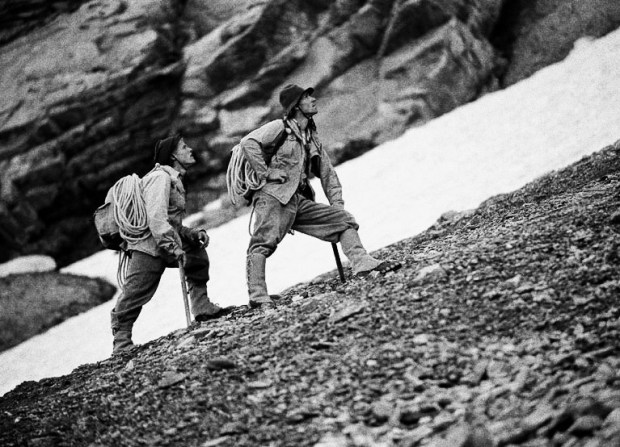
Let the ensuing commence!

mountain climber 2
That was when our heroes realized things were about to get a lot tougher from here on in…

When I write out a scene, I have a pretty solid idea of what needs to happen in it; how to make it follow the one before it, and lead into the one after it.

Sometimes it ends up the way I intended, and sometimes it needs a little more punching-up.

And a lot of the time, that punching-up involves making things more complicated, which does a simultaneously effective job of upping the conflict, which was already a necessity.

This whole process most recently came into play while working on a scene in the pulp spec. I’d planned out what was supposed to happen, and on the surface, it seemed okay.

And then I wrote it, but it wasn’t the same as I’d envisioned. It was still missing a vital component, and I couldn’t determine exactly what.

Did it successfully connect the scenes before and after? Was there conflict? Did it advance the necessary elements?  Yes on all counts, but it still seemed off.

I read through it again. It was tight and efficient, and did what it was supposed to. But this second read also revealed the hidden problem that was nagging at me.

It was too tight and efficient. The protagonist accomplished what they were supposed to, but it needed to be tougher for them to do so.

So back I went to the planning-out stage, tossing in a few more wrinkles to make it that much harder for my hero. Although they still achieve their goal within the context of the scene, this time I made sure they really earned it.

Plus, the new complications really emphasized the overall nature of the story, which is always good.

This isn’t to say that every scene has to have some kind of monumental obstacle to your protagonist, but the journey towards their goal shouldn’t be an easy one. It might not even be a physical thing; maybe your hero has to overcome an internal or emotional problem.

It may be easier for you to keep things simple and straightforward, but unfortunately that makes for dull storytelling. Making things more complicated for your protagonist may complicate things for you in putting it all together, but it will definitely make for a better story while also improving your skills as a writer.

Don’t hold back. Put both yourself and your protagonist through the wringer. You’ll both be better for it.

Words properly arranged

typist
Behind that disarming smile lurks the constantly-devising mind of a creative genius

Jumping back to focus on the pulp adventure spec, along with a return of that certain ZING! one gets when quite psyched about a story. Yep, still going strong.

Gotta say, this whole “break down each scene to its individual elements” thing is really working out nicely. It’s tremendously easier to have a line-by-line description of what happens rather than trying to figure it all out on the fly.

The most recent wrinkle has been manipulating the events that lead up to and just after the midpoint of the story. I originally had the antagonist explaining their sinister plan, but seeing as how it sounded a lot better in the outline than it does on the page, there’s been some extensive editing, rewriting, cutting and pasting going on over the past couple of days.

And this was just for a couple of pages’ worth of material.

Among the pleasant surprises:

-discovering that a line or action in one scene could easily be relocated, thereby making the new scene that much stronger. All the elements were in place; it was just a matter of finding the right order in which to put them.

-being reminded of the concept of “less is more”. Some scenes as originally written turned out to be simply overly complicated – just too much going on. By eliminating everything EXCEPT what’s necessary in that scene naturally tightens things up, but also really moves things along and gets the point across that much faster.

-figuring out a way to present details of the plot without being so blatantly obvious about it. Implying seems to be much more effective.

It took a while, but the changes that have been made have proven to be most satisfying. No doubt there will be more of this sort of thing in future drafts, but for now it works.

Crafting a tale to thrill, astonish, and exhilarate

mad-scientist
Those fools at the film academy dare call me mad? I’ll show ’em! Mwahaha!

2017’s writing got off to a pleasantly rousing start with the commencement of the first draft of my latest project: the pulpy adventure spec.

Yep. After years of working on the outline, I finally decided to take the plunge and write the damned thing.

Seeing as how this is a genre near and dear to my heart, I dove into the opening sequence headfirst and just had at it, surpassing the original goal of completing at least 2 pages a day by two and a half times that amount. Add to that the 4 pages for yesterday, and that places me further ahead than anticipated. It’s not expected to maintain this kind of output on a daily basis, but no complaints so far.

That being said, upon reflection, the latest scene still leaves a little to be desired, so an impromptu rewrite is already being planned out and will be implemented straightaway.

A few alterations have also been made in regards to the overall writing process.

First, even though the outline needs to be rock-solid before starting on pages, the scene descriptions are sometimes a little vague. “Big fight happens!”, that sort of thing.

When that happens, the focus shifts to plotting out the beats of that particular scene. How do things play out so it tells the story and moves things forward? Is it accomplishing what it needs to? It’s quite helpful, and helps prevent a lot of frustration in trying to think up stuff on the spot.

Another is fully embracing the whole “just get it done” attitude. Write it down and move on. There’ll be time for all that fancy-pants editing and polishing stuff later. It’s also been noticed that sometimes the first idea is still the best.

And in what may be the most important development, seeing as how this is at its core my interpretation of the old pulp novels, I’m doing what I can do to really make it read that way. One could even argue that writing the western was just a warm-up exercise. The writing in this script might be a little more over the top than usual, but that could be exactly what it needs.

Even though it’s a screenplay, I take a certain pleasure in coloring things a slightly stronger shade of purple.

There’s no specific target deadline for completing this draft, but hopefully it won’t take too long. For now, I’m just enjoying the ride.

First, you build a solid foundation…

foundation
And this is what could happen if it isn’t

As the daily churning-out of pages continues for my November writing project, I’ve found it extremely helpful that so much time was spent working on the outline.

Only through trial-and-error did I eventually discover that making sure the outline is rock-solid before starting on pages makes a huge difference.

Keep in mind that this is what works for me. You may have an entirely different approach, and that’s totally cool. Actually, I’m curious to hear about some of them. Feel free to discuss in the comments section.

And now, back to the subject at hand…

I see putting together the outline as a gradual building-up process. I start with establishing the main plot points. What are the pivotal moments in this story? Does each one properly fulfill its purpose in the overall context of the story?

Then I fill in the blanks between those plot points. Does it make sense how we get from, say, the inciting incident to the end of the first act? Does each scene do its job in moving the story and characters forward? Are you presenting information we need to know, or setting things up so as to adequately pay them off later? Does each scene appropriately follow the one before and lead into the one after it?

Something important to keep in mind during this part: eliminating unnecessary scenes. You may have a scene you really, really like, but may not be absolutely vital to the story. My recommendation is to either make it vital or get rid of it entirely. The last thing you want is to interrupt the flow of your story for a scene that really doesn’t have to be in there.

Once you’ve got all those blanks filled in, then you move on to expanding each scene – mostly just putting in the necessary elements that reinforce the purpose of the scene. Sometimes I’ll add in a snippet or two of dialogue.

Another very important detail about each scene: get to the point, then get out and into the next one. Once the scene fulfills its purpose, anything after that just slams on the brakes.

Hang in there. You’re almost done. The outline is pretty sturdy, but it could probably use a little more editing, fine-tuning and polishing. When you think it’s honest-and-truly ready, that’s when you make the big jump to pages.

This isn’t to say there won’t be more changes in store once you’re into pages mode, but by putting so much time and effort into your outline, you’ve eliminated a lot of the heavy lifting for when you get there.

Avoiding the dreaded unfilmable

flagman
Don’t go this way!

I recently had the pleasure of giving notes on a friend’s script. It was an early draft, so it had some of the usual problems that were easily fixable.

But the one thing that really stood out to me was their use of unfilmables.

“Unfilmables?” some might ask. “What are those?”

I’m glad you asked. Here’s an example:

“EXT. PORCH – DAY

Jane sits on the stained deck chair her father bought for her birthday last year.”

If you saw that onscreen, you know what you’d see?

A woman sitting on a chair.

In other words, HOW DO WE KNOW it was a birthday present from her father? We don’t. How can you let us know? Maybe we see the father giving it to her. Or another character asks about it, and she delivers a one-line explanation.

If there’s an important detail to your story, you need to find a way to include it as part of the story, and preferably in the most organic way possible.

What’s on the page is what we see and hear.

Unless there’s a line of dialogue or some kind of action somewhere in there that reveals these kinds of things, the audience has no way of knowing them.

Here’s another:

“INT. KITCHEN – NIGHT

Kevin washes dishes. He thinks about that time he and his high school girlfriend crashed her mom’s car.”

What’s on the screen? A guy washing dishes.

HOW DO WE KNOW that’s what he’s thinking about?

Maybe we see the accident take place. Or hear Kevin talking about it. Maybe the story involves how the accident leads up to him washing dishes.

In my old writing group, one writer was insistent about leaving these sorts of things in. When pressed on why they were so adamant about not being willing to take them out, they’d launch into a long-winded explanation of why it was necessary to include them.

“So if we were watching this, you’d be there explaining things, rather than working them into the story and showing them on the screen?”

I’m not sure if they got the point.

Hopefully you do.