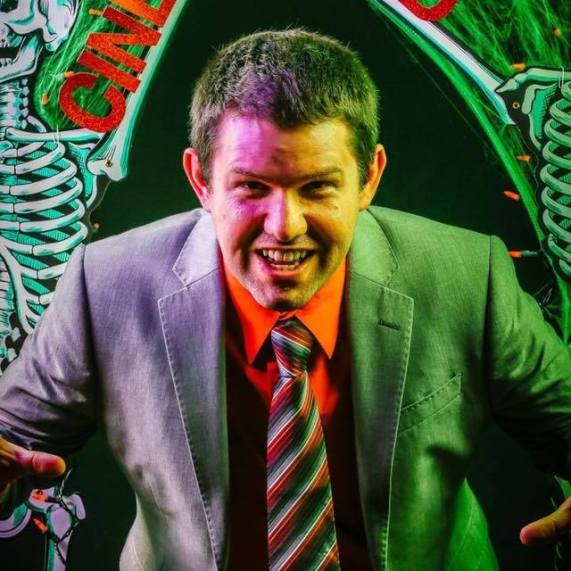
Jimmy George, aka Script Butcher, has been writing and producing films for over a decade. Along with optioning several screenplays, Jimmy has lent his name as co-writer/co-producer to six award winning feature-length films, garnering rave reviews, and boasting international distribution.
He has a talent for engineering fun and innovative productions on shoe-string budgets with few of the modern technological marvels used in major Hollywood blockbusters. Each of his films have been praised for circumventing their meager budgets, standing out through memorable storytelling.
Jimmy co-wrote and co-produced WNUF Halloween Special (2013), which won numerous festival awards, alongside national press from The New York Times, VICE, MTV, Birth.Movies.Death, Fandango, and Red Letter Media, and is currently available on the AMC Networks’ streaming service, Shudder.
After tearing up the festival circuit, his most recent film, Call Girl of Cthulhu generated enormous buzz in the horror industry. Harry Knowles of Aintiticoolnews declared it “fun, better than it should be and quite splattacular.”.
Jimmy’s current project (and his seventh feature), What Happens Next Will Scare You, will be released next year.
In addition to writing and producing, Jimmy has a passion for helping creators succeed. As the Script Butcher, he consults with screenwriters, empowering them with the necessary tools to sharpen their scripts into dynamic stories that slice through the competition.
What’s the last thing you read/watched that you thought was incredibly well-written?
The pilot episode for GLOW. The world-building is excellent. It takes you into a sub-culture that’s mysterious and relatively unknown. The characters are memorable and entertaining. We meet the lead character at her lowest point. It leaves us with so much promise for what could take place during the series. Does everything a pilot should do and more.
How’d you get your start reading scripts?
There are many screenwriting gurus out there. I am not one of them. I’m just a guy who’s written a ton of screenplays, produced a half-dozen movies of my own, and learned a lot along the way.
Over the last ten years of making movies, I’ve become the go-to script doctor for a lot of friends and colleagues. I’ve been doing this for free for a decade and it became clear a few years ago that this was my purpose. So I decided to start this service and try to make a living doing what I love.
Telling stories is what I was put on this Earth to do. Helping others fine tune their stories is a close second. I’ve been in your shoes. I know the blood, sweat, and tears it takes to complete a screenplay. This isn’t a job for me. It’s my passion. It’s what I live for.
Where does the moniker “Script Butcher” come from?
Whenever someone would ask for notes, I always delivered their script covered with red ink. The pages looked bloody. I once joked with a friend that I was their “script butcher” and it just stuck. To this day, every time I finish a set of notes my hands are covered with red ink splatters. I have a background in horror so a lot of people assume those are the only scripts I work with, but I provide the same exhaustive notes for all genres. I’d say 75% of my clients don’t write horror.
Is recognizing good writing something you think can be taught or learned?
Writing well and recognizing good writing are skills that go hand in hand. Both can be taught and learned. For me, recognizing good writing as compared to bad has come from reading thousands of scripts at all levels of the talent spectrum. Having my own scripts brought to life on a frequent basis, sitting in theaters watching what works and doesn’t has also taught me invaluable lessons most script doctors haven’t had the opportunity to learn or pass along.
Studying the work of pros is a must too, but a lot of scripts available to the public are shooting drafts which are different from spec scripts and teach new writers bad lessons. So much can be learned from script consultants as well. I wouldn’t be where I am today without the mentoring advice and guidance I received from my own trusted script doctors.
I didn’t go to film school. The notes I received from these professionals over the course of a decade and a half, became my film school. By failing time and again, by continuing to experiment with the form and seeking constant feedback, I learned the craft. I never stopped trying to get better. Growing thick skin and learning how to use feedback to improve your stories is an important skill set for a writer.
Sending my scripts for notes became a crucial part of the writing process and continues to be.
What are the components of a good script?
A good script should have an original, marketable concept.
With flawed relatable characters who are actively seeking something they care deeply about, that we can emotionally connect with and root for, and that deals with the most important events of these character’s lives.
It should present a visual goal for the character or characters to achieve which form the central story question, and present primal, relatable stakes for what will happen if they fail to achieve those visual goals with formidable forces of antagonism that cause never-ending complications, standing in the way of the character’s achieving their goals.
It’s properly formatted on the page, relies on visuals instead of dialogue to tell the story, with plausible surprises and reversals of expectation at every turn.
And it builds to an emotionally satisfying climax that answers the central story question of whether our characters will achieve their visual goal in a positive or negative manner.
Other elements such as a quick pace, character arcs, thematic resonance, and memorable dialogue are a bonus, but not absolutely necessary for a script to do its job.
(Some of this is inspired by Terry Rossio’s 60 Question Checklist, which every screenwriter should read here.)
What are some of the most common mistakes you see?
1) FAILURE TO DELIVER ON THE PROMISE OF THE PREMISE
A story is a promise. Imagine Mrs. Doubtfire if the story followed Robin Williams working as an accountant instead of following the trials and tribulations of trying to reconnect with his wife and kids while dressed as an old woman.
The audience is waiting for you to deliver on the promise of your concept. If your script is about killer beer, you better have a beer pong massacre scene.
2) TONAL IMBALANCE
If you’re writing Schindler’s List, there’s no room for campy comedy. Vice versa.
Even if you’re mixing genres, keep your characters’ reactions to the events around them and the events themselves consistent in tone.
3) LACK OF CLARITY EMOTIONAL OR OTHERWISE
Clarity of what a character is feeling in reaction to a situation or what is being conveyed in general is a common issue I encounter with client scripts. Because the story is alive in your head, it’s difficult to tell what is and isn’t conveyed on the page. It’s all crystal clear for the writer, but often muddled on the page.
There are many more common mistakes, but these are the big ones.
What story tropes are you just tired of seeing?
UNDESERVED CELEBRITY STATUS – I see so many scripts that give their characters a level of celebrity status that’s unbelievable simply for the sake of telling the media-frenzied story they’re trying to tell. The paparazzi and press are very specific about the types of people they will follow. Make sure your characters are worthy of the celebrity status you’re giving them in your story.
USING NEWSPAPER HEADLINES AS EXPOSITION – Many of my clients rely on one newspaper headline after another to show the passage of time and relay important exposition. Media has changed. This is an antiquated story device that no longer holds weight with the audience.
What are the 3 most important rules every writer should know?
1) REVERSE EXPECTATION at every turn in a way that feels organic to the story and not calculated or contrived.
2) FIND THE CLICHE AND THROW IT AWAY. If we’ve seen it or heard it before, find another way to show it or say it that’s premise-specific. This will ensure your story always feels fresh and unique. Premise specificity is the key to storytelling freshness.
3) MAKE IT VISUAL. If dialogue comes last instead of first when you’re crafting scenes, it will ensure your story is cinematic and not better suited for the stage.
Have you ever read a script that was an absolute, without-a-doubt “recommend”? If so, could you give the logline?
I have once, it’s called BaSatai by my longtime client Suzan Battah. She’s in the process of turning it into a graphic novel. You can find out more here. https://www.patreon.com/suzanbattah
How do you feel about screenwriting contests? Worth it or not?
Not worth it. Writers put so much time, emphasis, and worst of all, money into contests. In my opinion they’d be better off spending that time improving their craft and spending their money on attending networking events and writing workshops.
While I understand the allure of getting a festival or contest win to stand out from the crowd of writers trying to break in, a contest win can be detrimental to a writer’s sense of skill level and give them a false sense of completion with their scripts.
I’ve worked with dozens of screenplays that were “award-winning” with multiple festival monikers to their name, that I don’t feel would get a RECOMMEND from a single studio reader.
Writers are paying money to contests, being assured their scripts are good enough, when they aren’t ready yet. There’s nothing more detrimental to your career than trying to shop around a script that isn’t ready.
How can people get in touch with you to find out more about the services you provide?
My website has all the details you’ll need at www.scriptbutcher.com/services
You can also find me on Twitter at www.twitter.com/scriptbutcher
Instagram at www.instagram.com/_jimmygeorge
And Facebook at www.facebook.com/scriptbutcher
Readers of this blog are more than familiar with my love/appreciation of pie. What’s your favorite kind?
Offbeat answer here. My wife and I were passing through Intercourse, Pennsylvania, otherwise known as Amish country. There was a gift shop that sold Shoofly Pie with cartoonish construction paper flies advertising how fresh it was. We bought a slice. Needless to say, it was so delicious we left with two whole pies.


 Maximum Z