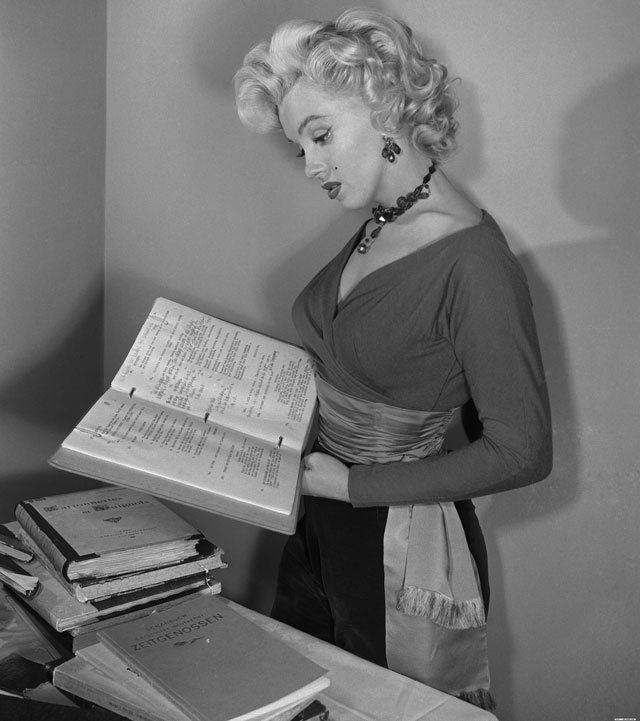
From the archives: Writing in your own voice

“Hmm. Billy’s new script. Something about men dressing up as women to hide from gangsters? Hope it’s funny.”

I’ve seen a good number of articles and online comments recently about how a script should convey the writer’s “voice”. That prompted this blast from the past from June 8, 2018.

Enjoy.

“When I’ve done script notes for writing colleagues, no matter what the genre is, I can usually tell who wrote it – because of the way it reads. Each writer has their own particular style, so each of their scripts has its own corresponding “sound”. Or I’ll get notes back on my material which often includes a comment along the lines of “this sounds like something you’d write”.

This isn’t just about dialogue. It’s about a writer’s overall style, or how they tell the story of their script. You don’t just want the reader to read your story; you want them to experience it. Which can be accomplished by adding that extra layer.

Everybody develops their own individual style, and it takes time to find it. The more you write, the more you’ll be able to hone your writing to reflect your own individuality.

Just a few things to think about:

-How does your script read? Is the writing crisp and efficient, or are you wasting valuable page real estate with too many lines of  your loquacious verbosity? Taking it one step further, do you use the same words over and over, or do you relish any opportunity to give your thesaurus a solid workout?

-How is your story set up and how does it play out? Is it simple and straightforward, or complex and full of deliciously tantalizing twists and turns? Are you working that creativeness to show us things we haven’t seen before, or is just page after page of the same ol’, same ol’?

-Is it a story somebody besides you would want to see? Just because you find the subject matter interesting doesn’t mean it has universal appeal. However, there is the counter-argument to that in which you could attempt to have your story include elements that would satisfy fans of the genre while also appealing to newcomers.

-Can’t ignore the population within the pages. Are your characters well-developed and complex, or do they come up lacking? Do we care about them, or what happens to them? Can we relate to them?

-What are your characters saying, or not saying (subtext!)? How are they saying it? Do they sound interesting or dull as dishwater? Very important – do they sound like actual people, or like “characters in a movie”?

Remember – the script is a reflection of you. A solid piece of writing shows you know what you’re doing. Offering up something sloppy is simply just sabotaging yourself.

Who hasn’t heard a variation on the line about a script being a cheap knockoff of a more established writer? While I can understand admiring a pro writer’s style, why would you attempt to copy it? It probably took them a long time to find their own voice, and by trying to write like they do, you’re denying yourself the opportunity to do the same thing for yourself.

Or to put it another way: they didn’t take any shortcuts to become the writer they are today, so why should you?”

Knowing your nails and how to use them

Savvy and experienced consumer of literature I’m sure you are, no doubt you’re more than somewhat familiar with the classic piece For Want Of A Nail:

For want of a nail the shoe was lost.
For want of a shoe the horse was lost.
For want of a horse the rider was lost.
For want of a rider the message was lost.
For want of a message the battle was lost.
For want of a battle the kingdom was lost.
And all for the want of a horseshoe nail.

Sometimes we don’t realize how important something is that at first glance might seem completely insignificant.

The same concept could apply to screenwriting and the details of your story. A reader could see something and wonder “I don’t get it. Why is this in here?”

If you do the work and plan accordingly, the answer/reason will soon be obvious. That little detail is there for a reason, probably an important one, and without it, the rest of the story won’t work.

This is important on several levels.

It shows you put a lot of thought into putting the story together.

It shows you understand the concept of effective setups and payoffs.

It shows you respect the intelligence of your reader/audience and don’t feel the need to deliberately draw our attention to this sort of thing.

It always bothers me when a story sets something up and doesn’t pay it off, or has something later on in the story that comes out of nowhere.

Some writers go into it with a solid idea of how everything is set up and know how it’s going to play out, some come up with the bare bones of a foundation and fill in the blanks, and there are even those who sit down with a blank page, start writing, and see how it goes.

I tend to waver between the first two.

Sometimes you might even go back over what you’ve already written and discover an opportune moment to put in a small detail that can further enhance something later on in the story. It’s as if your subconscious was working in conjunction with your creativity and giving you an unexpected helping hand.

Are parts of your story set up that they start with a “nail” and escalate from there? Or does something happen later that could use a stronger setup?

You’d be surprised at seeing the ripple effect one little change can have on the rest of your script. Hopefully for the better.

How about a li’l boost?

Had the chance to talk to some writing colleagues this week. Some new, some I’ve known for a while. One via Zoom, one on the phone, and the rest in person.

(Ah, the results of networking and making connections!)

While each conversation was specific to each person, there were a few common threads: what we were working on and how it was going, experiences and results of previous projects, and glimpses ahead to potential future work.

But apart from discussing actual writing stuff, there was also a mutual contentedness about just being able to have a nice chat and offer up some morale-boosting encouragement.

For most of us, writing is a solitary activity, so social interactions might be on the sparse side. As much as I enjoy a productive session that sees progress on my script, there’s just as much enjoyment from shooting the breeze with another writer (or writers) over a cup of coffee.

I’m extremely fortunate to have a lot of other writers live nearby, so I take advantage of that and meet in person whenever possible. (Highly recommended if you can)

If this isn’t the case for you, what’s stopping you from dropping another writer a line and inviting them to talk on Zoom? You’re probably already connected on social media, so why not take it one step beyond? It’s a great way to meet and get to know each other better, all from the comfort of home. And you might be surprised how receptive they are to the idea.

No matter how you do it, one of the unspoken benefits of talking with other writers is the pleasant reminder that YOU ARE NOT ALONE IN THIS. It’s more than likely they’ve gone through the exact same things you have, so they can relate. Maybe they’ve endured more, so you can learn from their experience, and vice versa.

Just as it’s important to try and maintain a regular writing schedule when possible, taking the time to step away, relax, and engage in a casual conversation can be just as helpful.

For all the writers involved.

From the archives: Two shoulders, no waiting

shoulder
Plus two sympathetic ears at no additional cost

Over the past few weeks, as part of group Zoom calls and one-on-one discussions, I’ve discussed with other screenwriters the frustration with how things are going for the writing, establishing/maintaining a career, and just the overall experience. And the current writers strike ain’t helping much, either. Sometimes all you can do is listen and offer encouragement and moral support. It might not be much, but it can still make a difference. It also reminded me of this post from August 2019. Enjoy.

Trying to make it as a screenwriter is a tough choice to begin with. It’s a long, drawn-out process that takes a long time before any significant results can be achieved. Sure, there are exceptions, but for the most part, it remains a marathon, not a sprint.

And that also means there’s going to be A LOT of heartache and disappointment along the way, and that can really take its toll on you. Not to sound too New Age-y, but all that negative energy can do significant damage to your confidence and self-esteem.

“This is never going to work.”

“I can’t do this.”

“Why do I even bother?”

If you’ve never said or thought any of these things, I’d love to know how in the world you managed to accomplish that and still call yourself a screenwriter.

Many’s the time I’ve seen comments on a public forum from another writer that echo these sentiments, or had them send me a private note saying something similar.

And I feel for them – whole-heartedly. I’ve been that writer thinking those thoughts a lot, too.

Do I wish I could help them out in any capacity? Without a doubt.

Even though it may not be much, I’ll offer up whatever support or encouragement I can. Don’t underestimate the power or effectiveness of telling somebody you’re in their corner. It makes quite the difference knowing you’re not alone during this tumultuous journey.

I once got a note from a writer I barely knew. They knew a writer I knew, and had seen some of my postings online. We were both semi-finalists in a prestigious contest, and it was the day the finalists were being announced.

For reasons totally unknown to me, they contacted me, asking if I’d received any kind of update. I hadn’t.

“Having a total shit writing year so far so I’m clinging to anything positive ha,” was their response.

I told them I was sorry to hear that, and offered up my own frustratingly good-but-not-great batting average, along with a few words of encouragement in the vein of “much as it hurts to get thrown off, you just gotta keep getting back on the horse”.

They were in total agreement.

An hour or so later, the finalists were announced. I wasn’t one of them. But they were. Naturally, I was disappointed, but also happy for them because they had something good happen.

The takeaway here is that you’re not alone in this. Every other writer goes through it. We’re all going to have a lot of bad days, probably a lot more than the number of good days, and it can be tough to get through it, let alone come out stronger.

This is one of those added benefits to networking and connecting with other writers. You’re not just helping to develop your writing and analytical skills, you’re creating your own emotional support network.

Chances are you’ll have a stronger relationship with a small number of people; the ones you’ve interacted with, or shared scripts, exchanged notes, etc., on a more regular basis.

Don’t be afraid to reach out and tell one of them “Hey, I’m not feeling too good about this right now. Mind if I talk about it?” They’ll understand, and be supportive about it (in theory). Just being able to talk about it could help you feel a little better.

Screenwriting is complicated enough, and gets even more so when you throw all your hopes and ambition into it. Sometimes you’ll feel strong, powerful, ready to take on the world. And sometimes you’ll feel like the world’s beaten you to a bloody pulp with no hope for recovery. (Again, I’ve experienced both.)

You can’t force yourself to feel better and restore your confidence, but you can take little steps to help yourself out – at your own pace. And any help you might need is always there and easily accessible.

The possibility of successfully navigating an asteroid field is approximately 3,720 to 1

During a recent break from the writing, I saw a few posts on social media celebrating the 43rd(!) anniversary of the release of THE EMPIRE STRIKES BACK.

I was around for that. Proudly so.

I decided to give it another watch, mostly for nostalgia’s sake.

Even though I’ve seen it numerous times, this time felt a little different. I found myself watching it from a writer’s point of view.*

It made for a very different experience, involving continuously making mental notes and asking questions.

“How did this look on the page?”

“Wow, that dialogue gets right to the point without being on-the-nose”

“What an incredibly tight scene”

“Pay attention to how the characters are shown changing over the course of the story”

Just seeing how smooth the story flows, how tight the whole thing is, and how all the subplots are laid out really struck a chord for me.

THIS is how I want my scripts to come across.

I’ve already said that this current draft of my sci-fi adventure is all about getting pages written and holding off on editing/revising until it’s complete. That still applies.

But when I do get to that point, I’m already anticipating looking at each scene and trying to figure out what changes could be made to achieve that same level of tightness, structure, and efficiency.

And it’s just a coincidence about my script being a similar genre; this approach would help no matter what I was working on.

This is all just further proof that a writer’s education never truly stops, watching well-written films can benefit your own writing process, and that there’s always an opportunity to learn how to improve your writing.

*Full acknowledgment to credited writers Leigh Brackett, Lawrence Kasdan and George Lucas*