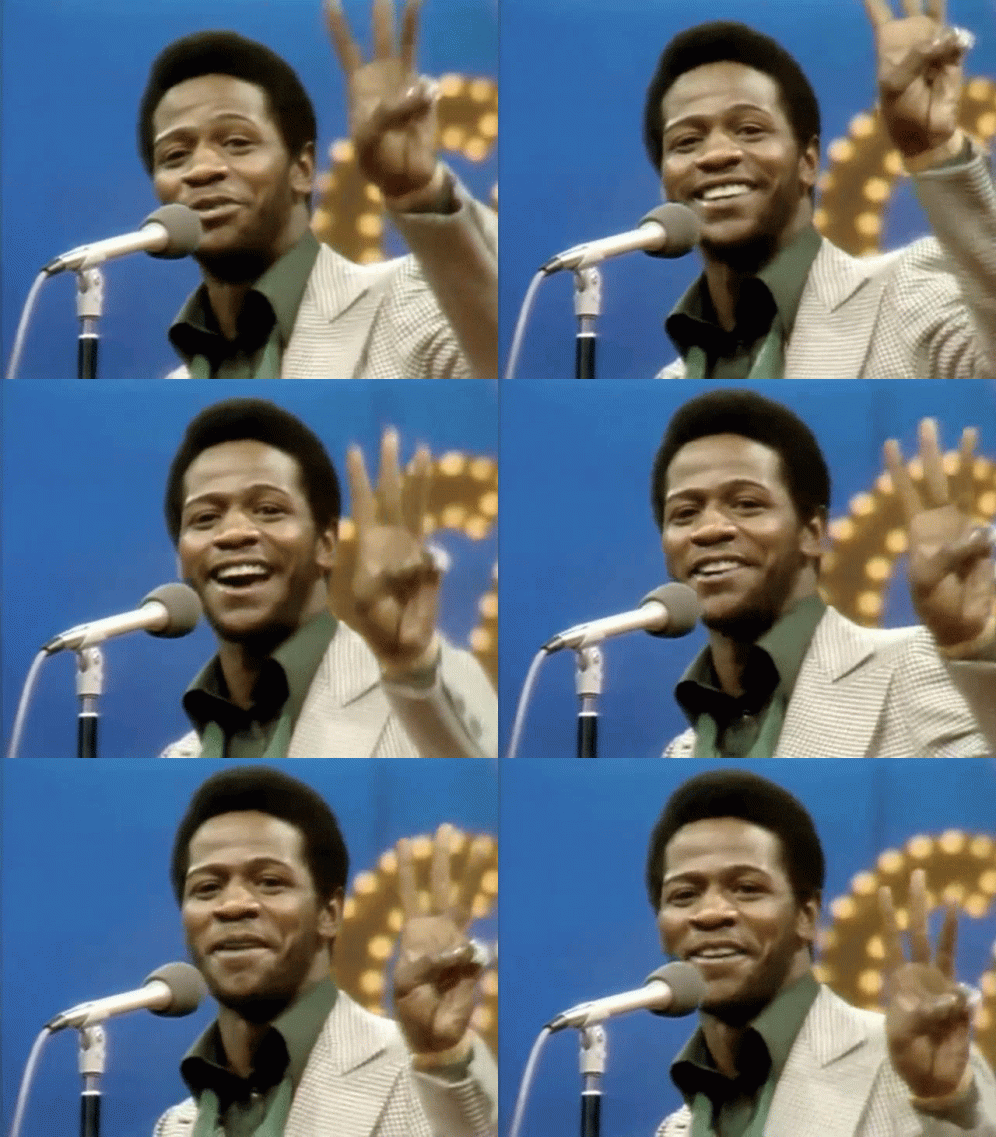
The other three little words

My, what a rough week this was.

PAGE semifinalists and Nicholl quarterfinalists were announced. My script was not on either list.

Disappointing, especially since I think it’s a pretty solid script.

At least that’s what my readers say.

But like you always hear: it’s all subjective.

Your first thought when you get that notification that includes “Unfortunately,…” is probably “I must be a really shitty writer”.

Not so. I’ve read a lot of scripts of exceptional quality that also didn’t advance, including one by a previous Nicholl top 10 finalist.

There is absolutely no way to tell how a script is going to do in a contest. You send it, hope for the best, then move on to whatever the next thing is.

After I’d posted about not advancing, more than a few writers responded in kind.

“Me too.”

“Another swing and a miss.”

“Whoo! My eighth consecutive year of not advancing.”

It’s taken me a lot of time to accept that while it’s great to see your script do well in a contest, when it doesn’t do well is no absolute reflection on you as a writer.

Again: it’s all subjective.

One writer I know was frustrated after years and years of their script never doing well in a contest. That script then went on to place in the top 50 for the Nicholl.

This isn’t to say that your script couldn’t do with a little more work. That’s really up to you.

If you’re among the horde of writers whose contest journey has come to an end, give yourself a minute to vent and air those grievances, then decide what you’re going to do about it.

Is your script as solid as it can be, or would it be worth your while to give it another read to see if anything could use some tweaking?

Something to also keep in mind: winning a contest can be a stepping stone to a career as a writer, but it’s not the only way. A script can not do well in a contest but still attract the attention of somebody interested in making it.

As another writer put it: “I’d rather write a script that would be a good movie, than one that wins contests.”

At this point I don’t know what my plan is for next year’s contests. I’m too busy working on scripts to worry about it.

Which reminds me of another three important little words:

Don’t. Stop. Trying.

Create your own doorway

Had a great Zoom chat the other day with a newer writer. They’d found me on social media and liked what I’ve had to say about screenwriting and working on establishing a career at it. Would I be open to imparting some of what I’ve learned and any other advice I might have that could potentially help point them in the right direction?

Even though I admitted to still being one of those trying to “break in”, so my two cents of guidance was probably worth about that much anyway, how could I say no?

We talked about wide variety of topics, mostly involving screenwriting, including our respective backgrounds, experience, short- and long-term goals. They also asked for potential suggestions as to how they could go about achieving those goals.

I told them what I’ve said to many writers before, and it still rings true.

Everybody’s path to success (however you gauge it) is going to be unique to them and them alone. What works for me will probably be totally different than what works for you. If you know what your goals are, then it’s up to you to figure out what it will take for you to get there.

You need to create your own doorway, because nobody’s going to do it for you.

Use everything at your disposal. You might think you don’t have anything to work with at first, but you’d be surprised how effective even the littlest thing can be. It’s all about perspective and determination.

For example, the writer had worked on some short films in various capacities. They could use those to showcase their skills, as well as adding the other filmmakers and crew into their network. You never know who knows of another gig or has heard of a project that needs someone who can do the things you do.

If that’s what it takes for you to find that way in, that’s what you do.

The writer said nobody had put it that way before, which really helped them as they start to figure out their approach and possible strategies. They appreciated the advice, and the honesty.

This sort of stuff might seem pretty basic to those of us who’ve been at it for a long time (such as yours truly), but there will always be those just starting to dip their toes into these turbulent waters. I didn’t really have anybody like that when I was starting out, so why not offer up a helping hand in some capacity?

Now if you’ll excuse me, I’ve got a doorway to finish creating, followed by kicking it wide open.

How about a li’l boost?

Had the chance to talk to some writing colleagues this week. Some new, some I’ve known for a while. One via Zoom, one on the phone, and the rest in person.

(Ah, the results of networking and making connections!)

While each conversation was specific to each person, there were a few common threads: what we were working on and how it was going, experiences and results of previous projects, and glimpses ahead to potential future work.

But apart from discussing actual writing stuff, there was also a mutual contentedness about just being able to have a nice chat and offer up some morale-boosting encouragement.

For most of us, writing is a solitary activity, so social interactions might be on the sparse side. As much as I enjoy a productive session that sees progress on my script, there’s just as much enjoyment from shooting the breeze with another writer (or writers) over a cup of coffee.

I’m extremely fortunate to have a lot of other writers live nearby, so I take advantage of that and meet in person whenever possible. (Highly recommended if you can)

If this isn’t the case for you, what’s stopping you from dropping another writer a line and inviting them to talk on Zoom? You’re probably already connected on social media, so why not take it one step beyond? It’s a great way to meet and get to know each other better, all from the comfort of home. And you might be surprised how receptive they are to the idea.

No matter how you do it, one of the unspoken benefits of talking with other writers is the pleasant reminder that YOU ARE NOT ALONE IN THIS. It’s more than likely they’ve gone through the exact same things you have, so they can relate. Maybe they’ve endured more, so you can learn from their experience, and vice versa.

Just as it’s important to try and maintain a regular writing schedule when possible, taking the time to step away, relax, and engage in a casual conversation can be just as helpful.

For all the writers involved.

A verbal solution for a writing problem

Even despite a temporary lapse, output on the sci-fi adventure rewrite was progressing at a decent pace.

I already knew there’d be more work to do once it was done, but something still felt off. A piece of the puzzle was missing, and it felt weird to keep pushing forward. Like building a house with incomplete blueprints.

Although my original intent was to finish the rewrite, I wanted to take care of the missing puzzle piece. This in itself was quite challenging.

Once again, my network of savvy writing colleagues comes to the rescue.

I’ve been doing more one-on-one Zoom calls with writers I’ve only known through social media. It’s a great opportunity to get to know them as people, as well as talk a lot of shop about screenwriting.

Such was the case earlier this week. Another writer and myself were discussing some of our current projects, and the sci-fi adventure came up. Despite my stumbling through the “pitch”, my friend got really into the concept, prompting them to ask a lot of thought-provoking questions about the story and the characters. Some I had an answer for, some I didn’t.

(side note – I used to be embarassed about not having all the answers when it came to my stories, but have since embraced it and am now willing to say “I don’t know” or “no idea” because this usually leads to a discussion where everybody involved helps me come up with an answer.)

This led me to realize that some aspects of the story weren’t as defined as I thought. That, in turn, had a ripple effect on the rest of the story. The same story of which I had just passed the halfway mark with rewriting.

It was like taking a piece out near the bottom of the tower in a game of Jenga. Not that everything came crashing down; more like things got a whole lot more wobbly.

We talked things through some more, and did some impromptu brainstorming, all of which which helped point me in the right direction.

Long story short: the rewrite’s on hold and the reset button’s been pushed. But like I mentioned during the discussion, once those fixes are worked out and implemented, it shouldn’t be too difficult to get back on track.

While I originally hoped to be done with the rewrite around now, or at least mighty close to it, I don’t mind making another trip to the drawing board to take care of this. I’m already looking forward to taking this on and seeing how it goes.

Bonus – the chance to make any other fixes in the 50+ pages I’ve already written.

Yet another reason to be active and interactive within your personal writing community.

The final chapter in the Indiana Jones series opens today. The characters and storytelling have been a huge influence for me and my writing, and I can only hope that my scripts can someday be compared to them.

I also hope the movie’s good.

From the archives: Two shoulders, no waiting

shoulder
Plus two sympathetic ears at no additional cost

Over the past few weeks, as part of group Zoom calls and one-on-one discussions, I’ve discussed with other screenwriters the frustration with how things are going for the writing, establishing/maintaining a career, and just the overall experience. And the current writers strike ain’t helping much, either. Sometimes all you can do is listen and offer encouragement and moral support. It might not be much, but it can still make a difference. It also reminded me of this post from August 2019. Enjoy.

Trying to make it as a screenwriter is a tough choice to begin with. It’s a long, drawn-out process that takes a long time before any significant results can be achieved. Sure, there are exceptions, but for the most part, it remains a marathon, not a sprint.

And that also means there’s going to be A LOT of heartache and disappointment along the way, and that can really take its toll on you. Not to sound too New Age-y, but all that negative energy can do significant damage to your confidence and self-esteem.

“This is never going to work.”

“I can’t do this.”

“Why do I even bother?”

If you’ve never said or thought any of these things, I’d love to know how in the world you managed to accomplish that and still call yourself a screenwriter.

Many’s the time I’ve seen comments on a public forum from another writer that echo these sentiments, or had them send me a private note saying something similar.

And I feel for them – whole-heartedly. I’ve been that writer thinking those thoughts a lot, too.

Do I wish I could help them out in any capacity? Without a doubt.

Even though it may not be much, I’ll offer up whatever support or encouragement I can. Don’t underestimate the power or effectiveness of telling somebody you’re in their corner. It makes quite the difference knowing you’re not alone during this tumultuous journey.

I once got a note from a writer I barely knew. They knew a writer I knew, and had seen some of my postings online. We were both semi-finalists in a prestigious contest, and it was the day the finalists were being announced.

For reasons totally unknown to me, they contacted me, asking if I’d received any kind of update. I hadn’t.

“Having a total shit writing year so far so I’m clinging to anything positive ha,” was their response.

I told them I was sorry to hear that, and offered up my own frustratingly good-but-not-great batting average, along with a few words of encouragement in the vein of “much as it hurts to get thrown off, you just gotta keep getting back on the horse”.

They were in total agreement.

An hour or so later, the finalists were announced. I wasn’t one of them. But they were. Naturally, I was disappointed, but also happy for them because they had something good happen.

The takeaway here is that you’re not alone in this. Every other writer goes through it. We’re all going to have a lot of bad days, probably a lot more than the number of good days, and it can be tough to get through it, let alone come out stronger.

This is one of those added benefits to networking and connecting with other writers. You’re not just helping to develop your writing and analytical skills, you’re creating your own emotional support network.

Chances are you’ll have a stronger relationship with a small number of people; the ones you’ve interacted with, or shared scripts, exchanged notes, etc., on a more regular basis.

Don’t be afraid to reach out and tell one of them “Hey, I’m not feeling too good about this right now. Mind if I talk about it?” They’ll understand, and be supportive about it (in theory). Just being able to talk about it could help you feel a little better.

Screenwriting is complicated enough, and gets even more so when you throw all your hopes and ambition into it. Sometimes you’ll feel strong, powerful, ready to take on the world. And sometimes you’ll feel like the world’s beaten you to a bloody pulp with no hope for recovery. (Again, I’ve experienced both.)

You can’t force yourself to feel better and restore your confidence, but you can take little steps to help yourself out – at your own pace. And any help you might need is always there and easily accessible.