Who done it?

The right detective and how they handle the case can make all the difference

Ever watch or read a mystery and think to yourself “I could do that.”?  Well, let me tell you something:  It ain’t easy.  Especially since I’m not especially adept at figuring them out from an audience point of view.  K and I could be watching a mystery, and within a few minutes, she’ll say, “Got it.  Do you want to know who did it?”  And I’ll say no, because I’d like to try and do it myself, thank you very much.  Besides, I usually stop trying around halfway through, and most of the time she’s right anyway.

This short is eating up a lot of my focus and creativity this week.  The outline’s due Monday. I’ve got somewhat of a grasp on the basics.  Guy murdered, suspects all around, and each with a valid motive for wanting to bump him off.  I think that takes me to about the halfway mark.  I’ve been working on coming up with some nice plot twists and red herrings to keep the reader/viewer guessing, so that’s what I’ll be working on for at least the next day or two.

I keep going back and forth as to who the actual killer is.  It may work better to decide that, then work backwards to where I am now.  We’ll see how it works out.  I don’t know how professional mystery writers do it.  I guess it’s just hardwired into their brains.  More power to ’em!

I got an email from the director the other night that was labeled ‘character updates.’ Basically, it was a bunch of photos of scantily-clad women, each one labeled with who they represent in the story.  I’m beginning to have some suspicions about why he’s doing this. An ulterior motive, perhaps?  But that’s not for me to say.  I’m just the writer on this thing.
here we go again

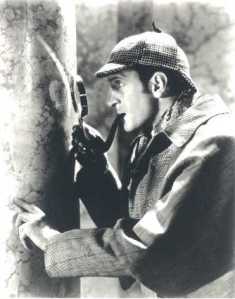
Seeking out clues to a strong script

I had a very interesting chat last night with the director of  my new short project. His latest venture: a whodunit/thriller.  Materials so far include character descriptions, a scene-by-scene breakdown and a one-paragraph synopsis.

I’ve never written an out-and-out thriller before, but am always up for a challenge.  Even more so when I’ve got a maximum time limit of 25 minutes.  I know this isn’t going to change cinema as we know it, but it’s fun to try.

He’s a very nice guy, but I worry he’s too influenced by what’s out in theatres when he comes up with an idea. He referenced some aspect of the recent release ANONYMOUS as being particularly well done, and thought it would work well in his story.  I haven’t seen it, and think it’s already gone from theatres, so there’s not much I can do with that.

This happened when we were putting together his previous short. He was concerned his story was too similar to INCEPTION, and feared people would think he was ripping it off. I had to reassure him his script was nothing like it, and just because something was done in a certain way in Nolan’s film, didn’t mean he had to follow the same rules.

Reading over his materials, I noticed a few potential red flags in terms of the story (in this case, the structure of a mystery) and voiced my concern. What did he want to do about this? How did he want to handle that?  A few times, he sounded a little caught off-guard (which I’m not faulting him for; I suspect he’s not that experienced in this genre), but said nothing was written in stone and I could make changes where appropriate.  I doubt major studios are this lenient with writers, so I’ll take my breaks where I can get them.

There are some traits of a few characters that present a challenge to work with, but he seems pretty set on them, so I’ll do what I can.

My deadline for an outline is Dec 4th, which is fine by me. He also mentioned how he likes how I’m pretty good at fast turnaround.  But another hurdle is now how much time to I can allocate to all of my in-development projects (which I get a certain thrill out of saying. That’s projectS. Plural.).

I can get the outline done, but also want to be able spend time on DREAMSHIP and LUCY.  Overall, no complaints whatsoever. Every writer should be this busy.

Fasten your safety belts

The Thunderbolt at Kennywood Park in West Mifflin, PA

After some nice progress on fixing problems at both ends of the first act, I ventured into Act Two and was able to make some good changes there as well.  A lot of on-screen action takes place, and I want to make sure it really grabs you and doesn’t let go until absolutely necessary.  I think I was able to do that, and made it to the midpoint as a reward.

I opted to stop at another point that’s been giving me trouble. My hope is that I’ll be able to get past that and continue on to at least the end of Act Two.

I’ve noticed when trying to convert a scene from the outline to the pages that it’s really easy to say in the outline what I want to happen, but things suddenly get a lot harder to translate into something on the page. I know in my head want I want to say, but have trouble getting it out the way I want to say it.

We’ll see how it goes.

-Movie of the Moment – THE MAN WHO KNEW TOO LITTLE (1997), a clever pseudo-homage to Hitchcock-style mysteries.

Bill Murray is a video store clerk who pays a surprise visit to his wealthy brother in London.  But the brother is hosting a dinner party to finalize ‘the biggest deal of his life’, so sends Bill off to an audience-interactive show, where scenes are played out throughout town.  But he intercepts a call meant for a secret agent, and follows the trail of clues, thinking the whole thing is part of the act.

Only got about halfway through it, but really looking forward to finishing it.

I was worried it would be more like WHAT ABOUT BOB?, but it’s actually smarter than you might think.  What’s really fun about it is how something is set up, followed by a payoff, but there’s also a twist in interpretation or context, thereby giving even more effectiveness to a well-structured double plotline: the one Bill sees as the theatre experience, and the one we the audience know is the actual secret agent storyline.

All that and Joanne Whalley’s gams.  What more could a film geek want?