While work continues on my actual writing projects, I’ve also been trying to reduce the number of scripts in my “Scripts to Read” folder.
It’s a decent-sized mix of recent and not-so-recent films, along with material written by professionals, colleagues, and “Hey, I saw you posting about this on social media. Sounds cool. Could I read it?”
It’s amazing how fast you can go through a script when you don’t have to give notes. Even more so when it’s exceptionally well-written, which a lot of these are.
One pair in particular, both written by the same pro.
Each script was unique unto itself, primarily in its story/concept. But you could tell that they were written by the same writer. A very distinctive style for how the stories played out, how it looked on the page, and even moreso in terms of voice.
One detail in particular that really stood out was the lightning pace in which these stories are told. Scenes are brief, to the point, and really move things forward. There’s no lingering, no unnecessary dialogue. The writer really adheres to the “get in late, get to the point, move on” method.
These were scripts that once you started, you didn’t want to stop. Honestly. The writing really was that good.
It’s also worth mentioning that these scripts don’t necessarily break any screenwriting rules, but they sure do bend them. Nothing major or drastic, but the writing is so strong that you’re willing to overlook this unusual approach.
Reading these scripts definitely makes you appreciate (and enjoy) how well-written they are, and also starts you thinking “My scripts aren’t at this level, so what can I do to get them closer to it?” Not that I’d ever try to duplicate this writer’s style – that would be futile. It’s more about letting my own voice and style really come through on all those fronts.
I’ve always been guilty of overwriting scenes, and seeing this very streamlined presentation is a good reminder that I should try for that as well.
It’s probably a good thing that I’m reading all of these scripts now because it’s still relatively early in the rewrite/overhaul phase for my scripts. I don’t think it’ll be too much of an issue to start applying what I’m picking up into them.
My scripts were good, but now it feels like there’s more potential for them to be much, much better. Here’s hoping.
In addition to all the work on my scripts, the short film and the recent writing conference, I’ve been making more of an effort to read more scripts. Fortunately, members of my network of trusted colleagues continue to come through and provide me with a constant supply of quality material.
It may be part of a swap, or they ask me to read their latest draft and give notes, and sometimes it’s just for hell of it.
I try to read one per week, preferably in one sitting, but that’s a time management thing. Not having to do notes really speeds things up.
The latest lineup includes two pilots, two features, and the manuscript for a book about screenwriting – all from writers I know, and another writer sent me three scripts from an established pro; one in production, the second just announced, and the third in development.
Sometimes I’ll track down the script for a film I really enjoyed and want to see how the writers had it on the page, and then see how it compares to what’s onscreen. I’ve also started compiling a list of scripts I’d love to read.
Reading scripts can be incredibly helpful. Seeing how somebody else put their story together along with how it reads on the page can influence your own methods. Not that you should try to copy them, but it helps you hone your skills and craft to make your writing more effective, as well as establishing your writer’s voice.
Speaking of voice – check out scripts by Shane Black, Quentin Tarantino and Brian Duffield as shining examples. Great writing, each with a distinctive voice that really engages and involves the reader.
Reading scripts can also help motivate ideas. If I’m feeling stuck, I’ll watch a scene that’s similar to what I have in mind, then find the script to see how it reads on the page, then figure out a different way for mine to go.
I’d forgotten how satisfying it is to take the time to read a script. Doesn’t matter whose it is. Good writing is good writing, great writing is better, and a solid, well-written script is the best.
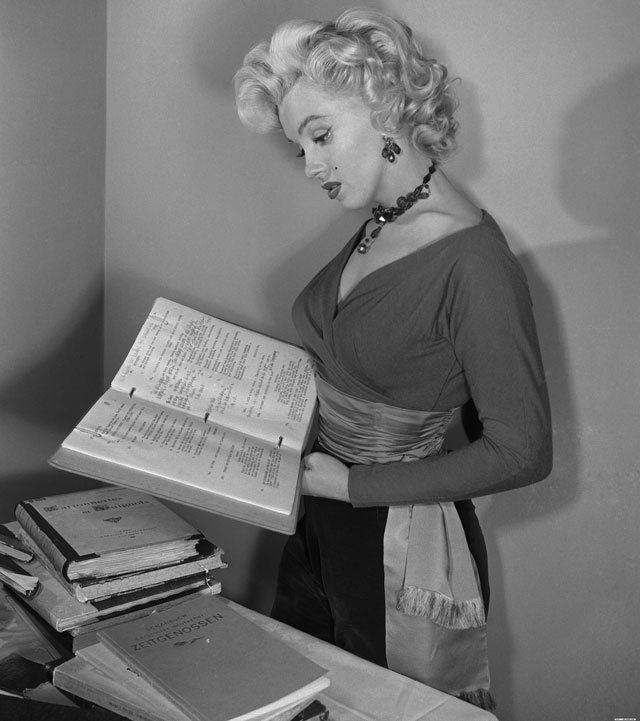
“Hmm. Billy’s new script. Something about men dressing up as women to hide from gangsters? Hope it’s funny.”
I’ve seen a good number of articles and online comments recently about how a script should convey the writer’s “voice”. That prompted this blast from the past from June 8, 2018.
Enjoy.
“When I’ve done script notes for writing colleagues, no matter what the genre is, I can usually tell who wrote it – because of the way it reads. Each writer has their own particular style, so each of their scripts has its own corresponding “sound”. Or I’ll get notes back on my material which often includes a comment along the lines of “this sounds like something you’d write”.
This isn’t just about dialogue. It’s about a writer’s overall style, or how they tell the story of their script. You don’t just want the reader to read your story; you want them to experience it. Which can be accomplished by adding that extra layer.
Everybody develops their own individual style, and it takes time to find it. The more you write, the more you’ll be able to hone your writing to reflect your own individuality.
Just a few things to think about:
-How does your script read? Is the writing crisp and efficient, or are you wasting valuable page real estate with too many lines of your loquacious verbosity? Taking it one step further, do you use the same words over and over, or do you relish any opportunity to give your thesaurus a solid workout?
-How is your story set up and how does it play out? Is it simple and straightforward, or complex and full of deliciously tantalizing twists and turns? Are you working that creativeness to show us things we haven’t seen before, or is just page after page of the same ol’, same ol’?
-Is it a story somebody besides you would want to see? Just because you find the subject matter interesting doesn’t mean it has universal appeal. However, there is the counter-argument to that in which you could attempt to have your story include elements that would satisfy fans of the genre while also appealing to newcomers.
-Can’t ignore the population within the pages. Are your characters well-developed and complex, or do they come up lacking? Do we care about them, or what happens to them? Can we relate to them?
-What are your characters saying, or not saying (subtext!)? How are they saying it? Do they sound interesting or dull as dishwater? Very important – do they sound like actual people, or like “characters in a movie”?
Remember – the script is a reflection of you. A solid piece of writing shows you know what you’re doing. Offering up something sloppy is simply just sabotaging yourself.
Who hasn’t heard a variation on the line about a script being a cheap knockoff of a more established writer? While I can understand admiring a pro writer’s style, why would you attempt to copy it? It probably took them a long time to find their own voice, and by trying to write like they do, you’re denying yourself the opportunity to do the same thing for yourself.
Or to put it another way: they didn’t take any shortcuts to become the writer they are today, so why should you?”
When was the last time you read a script that was really hitting on all cylinders?
Great story, cinematic writing and vivid imagery, compelling characters, the whole kit and kaboodle.
What’s the one thing that ties all of them together?
That writer’s voice.
We hear about it all the time, and I’ve always described it as how the writing in a script is a reflection of the writer’s style.
If you read a script by Shane Black, Judd Apatow, Nora Ephron, or Quentin Tarantino, you’d know it by the way it reads. Each one is written in the distinctive voice of each writer.
And that’s what you want to achieve with your writing. When somebody reads your scripts, they’ll know it was you.
The need to establish your own voice when it comes to your scripts can’t be stressed enough.
I’ve read a lot of scripts that try to mimic an established writer’s voice, and it usually falls flat. Part of the reason is that the writer is trying too hard to sound like the established writer, which seems counterproductive. If I want a script that reads like Judd Apatow wrote it, I’ll read a Judd Apatow script.
It also doesn’t help that some of these established writers created a niche for themselves with their writing style, so anybody who comes after them with the same approach will immediately be labeled a pale imitation. You might have a phenomenal script, but if the only thing somebody remembers about it is that it’s just ripping off Tarantino, you’ve just wasted everybody’s time.
Now this isn’t to say that you can’t write in a similar style, but you need to put your own spin on it to help it stand out.
What are some of your strengths, writing-wise? In what areas do you really shine? Is there a way you can apply that to other aspects of your script? You want your script to have a real impact on the reader; one with a strong voice can help accomplish that.
Another benefit of a script with a strong voice is that it helps make it that much more memorable. Not only does it leave an impression, but chances are it’ll stick with the reader long afterward. Many’s the time I’ve finished reading a script and within five minutes don’t remember a thing about it. Sure, the writing may have been adequate or possibly just slightly above average, but a lack of a distinctive voice from the writer is a key missing ingredient.
Then there are those I’ll remember a long time after. Maybe it was the story or even just the concept, or the protagonist, or a great scene/sequence. No matter what it was, you could come to me a few months from now, or maybe even next year, and ask “Hey, do you remember that script about ____?”
Hudson Phillips is a writer and producer from Atlanta, GA. He’s also the founder of ScriptBlast, an online community to help screenwriters navigate the emotional ups and downs of the writing journey, and host of the ScriptBlast Screenwriting Podcast.
What was the last thing you read or watched you considered exceptionally well-written?
The short story collection STORIES OF YOUR LIFE AND OTHERS by Ted Chiang is jaw-droppingly good. I don’t think I’ve ever read a short story collection where every single story is perfect. Each one is weird and memorable and moving and smart and tackles some big gigantic idea. I’ve also really enjoyed the Zoey Ashe series (FUTURISTIC VIOLENCE AND FANCY SUITS and ZOEY PUNCHES THE FUTURE IN THE DICK) by David Wong. Both are laugh-out loud funny with incredibly memorable characters in one of my favorite grounded science fiction worlds.
Movie-wise, NOBODY was a surprisingly fresh take on the action hero. I could use the same line to describe SHADOW IN THE CLOUD, another film that shook up traditional action films.
TV-wise, the first season ofKILLING EVE really blew me away. I can’t think of a TV show that surprised me as much as that.
How’d you get your start in the industry?
It is a very long, very winding road that has taken me here, where I still feel like I’m just getting started! I’d always been writing, but in my mid-20s I started taking it more seriously after a music career fizzled out. I ended up writing comedy scripts with two buddies of mine and the second script we wrote together (a sports comedy about church league softball) ended up getting optioned by Lionsgate films (thanks to a friend of a friend of a friend).
For a split-second we were “local celebrities” on radio and in the newspaper and then everything that could go wrong did go wrong. The writers strike happened, pushing it back a few years. Lionsgate changed out leadership and dropped the film. A local production company picked it up and made it, but completely threw our script out. I don’t think a single word of ours ended up on screen (I still haven’t seen it). So a quick high and low right out the gate. My two writing partners both gave up after a couple new scripts went nowhere, so I broke out on my own.
The problem with having writing partners is when you start writing on your own it’s like starting fresh all over again. So I leaned into the movies I loved the most – crazy sci-fi fantasy action adventure stuff – and started to write that. I’d write a script, send it out to connections in Hollywood, no one would be interested, and I’d write another one. I’d get occasional bites from a contest or the Black List, but nothing ever gained traction. I think in large part because I was a single dad to a young kid, so I couldn’t move out to L.A.
Pro tip: it’s SO much harder to make it in this industry if you’re not in the city where it all goes down. It was during this time of rejection after rejection that I started ScriptBlast as an online haven for writers to connect, talk about their struggles in a safe space, and find encouragement and inspiration.
Being stuck in Atlanta, I leaned into what the city had to offer, which was great filmmaking talent and started making short films. This was a great way to get to know local actors and crew, and we started pulling together our little “collective” of talent until eventually, in 2017, we shot our first feature film, THIS WORLD ALONE. It’s a post-apocalyptic drama / thriller about three women attempting to survive in a world without technology or power. And after a very long 4-year journey (with a year-long pause for COVID), the film was finally released in May and is now available wherever you rent or buy movies online.
THIS WORLD ALONE helped get my name out there enough and allowed me to make enough connections that I’ve since been hired to write a few other indie features. So while I’m not yet making a living at it, writing is bringing in a good second income right now. And I believe all these little seeds will eventually build momentum and add up to a career. Fingers crossed that 2021 is the year that it happens!
Is recognizing good writing something you think can be taught or learned?
It’s interesting that you say “recognizing good writing” and not “becoming a good writer.” I don’t think recognizing good writing is something that can be taught or learned. But I don’t look at good writing that way. Good writing is a feeling. Good writing is being whisked away to another world and laughing and crying and cheering and getting done and immediately wanting to go back. A technically excellent screenplay that checks all the screenwriting boxes is not necessarily “good writing.”
But I also think most people can be taught to become good writers (some just might take more time than others). I’d put writers into three categories:
Writers who can recognize good writing and turn around and immediately write an excellent story.
Writers who can recognize good writing but struggle to write an excellent story.
Writers who can’t recognize good writing and will therefore never write an excellent story.
The ones who can be taught are in that middle level but I think 90% of us are in that middle level. We know what a great story looks like but it takes a lot of time and work and practice and patience to create one ourselves.
What do you consider the components of a good script?
Such a great question. there’ s probably an infinite list, but here’s the first three that popped in my head:
Set-up and payoff. This is the easiest way to make your script look smart. Just set up everything you payoff and payoff everything you set up. Need a great line for your finale? Go back to your first act and find one that’s applicable. Have an item that represents something in the beginning? Make sure you bring it back in the end. My first rewrite is always looking for these things.
Emotional honesty. We’ve all seen the movies (usually starring Adam Sandler) where you get this pat life lesson at the end like “spend more time with family.” These kinds of lessons are ultimately forgettable because they aren’t honest. They are themes we’ve seen a million times before. The real honest emotions aren’t pat answers, they are deep questions. Mark Duplass decries this as “you know when you’re up at 2am with your best friend and you’ve had too much to drink and you talk about your biggest fears? That’s what you should write your movie about.” Give the audience an answer, and they’ll forget it right after they leave the theater. Present the audience with an honest and brave question, and they’ll keep thinking about it long after they’re done.
Tension & release. If a screenplay is a wavelength, it should go up and down. It’s all about pacing. A script should rise and fall and feel natural. I think this is one of the toughest things to teach because it’s a “feeling”. Lean into whatever genre you have, if it’s a horror movie it should be a little scary, medium scary, really scary, and then give us a break. If it’s a comedy, it should be a little funny, medium funny, really funny, and then give us a break.
What are some of the most common screenwriting mistakes you see?
Telling someone else’s story and not telling your own. So many writers just regurgitate their favorite movies and don’t have anything unique to say about the world. Audience members don’t care about the “what” of your story, they care about the “why.” If you’re just writing something because “it’s cool” or “it’ll sell”, the audience can see right through that. It goes back to the “emotional honesty’ thing above. It’s the old saying “write what you know” but that doesn’t mean write about your day job or your current boyfriend, it really means “write what you feel.” If you’re emotionally connected to your story, your audience will be too.
What story tropes are you just tired of seeing?
Usually the things that make me roll my eyes have to do with masculinity on film. I get so bored with cold, stoic, masculine action heroes. I’m equally tired of female action heroes who feel like someone went into the script and just did a search to change “him” to “her.” And don’t get me started on shallow descriptions of women in scripts “nerdy but beautiful” or whatever. Like the two films I mentioned earlier – NOBODY and SHADOW IN THE CLOUD, these are films with warm, broken, interesting, action heroes who lean into their vulnerabilities as much as their strengths.
What are some key rules/guidelines every writer should know?
Here’s kind of a checklist I try to run through for every scene I write:
GOAL: What does your protagonist want in this scene and how are they going to get it?
CONFLICT: What obstacles make it difficult for your protagonist to reach that goal?
CHOICE: What difficult choice will the character have to make as a result of the conflict?
STAKES: What is hanging in the balance with each choice?
TWIST: What does this choice tell us about the character that we didn’t already know?
THEME: How does this choice push the character’s emotional journey forward?
CONNECTIVITY: Can the elements of this scene be set-up in a previous scene or lay the ground-work for future scenes?
VISUALIZE: Is there a visual or item that can replace obvious dialogue or action?
LESS: Is there a “perfect line” or action that could say it better than a long drawn-out scene?
VOICE: How can you rewrite it to be more “you”?
Have you ever read a script where you thought “This writer really gets it”? If so, what were the reasons why?
The screenplays that I love all make me feel something. They get an emotional response out of me, whether that be fear or laughing or crying or warm-heartedness. They are masters of set-up and payoff. They surprise me at every turn and never make the obvious choice, I can’t predict where the story will go. They ask big questions about the world.
How do you feel about screenwriting contests? Worth it or not?
On their own, I think they’re worthless. I don’t know if I’d go as far as calling them scams. I think a lot of contests are well-intentioned, but it’s a model built on 99% of writers who enter paying money and getting nothing in return. That industry has created a lie that writers can write one screenplay, enter a contest, win, get an agent, and go write Hollywood films. This lie is why so many writers give up after their first script. It’s heart-breaking to me.
Having said all that, I still enter them. Why? Because I think they do have merit when combined with other things. It’s all about stacking the deck. If you google the winners of these contests, you’ll usually find that they’ve written multiple screenplays, have already made some indie films or short films, maybe published in a different medium, might even already have representation. A contest on its own means nothing, but when you put a win on your writing resume alongside a dozen other things, it helps stack the deck.
If you’re going to enter a contest, pick and choose carefully. First, only enter contests that actually give you something of value, whether that be notes or industry access. Secondly, don’t enter the big, giant contests where you’re competing against 10,000 other writers. Instead, find all the local film festivals that have screenwriting competitions, enter those and then attend those festivals! A strong connection with another filmmaker at a festival is worth a million times more than a laurel on your website.
I always tell writers “don’t put your career in the hands of someone else.” Contests are relying on someone else’s validation of your work. That’s a very unhealthy way to live. Go make a short film. Go make your own $1000 feature. Attend festivals and meet people. Seek out local producers and directors and pitch them ideas until you connect on something and go make it. Make a narrative podcast or YouTube series. There are a million options to advance your career and I suggest you do all of them.
How can people find out more about you and the services you provide?
I’ve been doing ScriptBlast as a free service for about 5 years cause I always struggled with charging for anything that wasn’t actually helpful for writers. So I just launched a new online community in 2020 where we have weekly Zoom calls, tons of free resources and courses, accountability worksheets, share notes on each other’s scripts, etc. It’s blown my own productivity through the roof just being a part of it, and multiple writers have finished their screenplays as a result of being in the group. And it’s only $10/month. You can try it free for a week at Members.ScriptBlast.com.
I also do a podcast and provide other free resources (like online courses or one-on-one consultations) you can find at ScriptBlast.com. And if you’re interested in checking out THIS WORLD ALONE, it’s available on all digital platforms. You can learn more at ThisWorldAlone.com
Readers of this blog are more than familiar with my love/appreciation of pie. What’s your favorite kind?
It’s hard to beat a slice of hot apple pie with a scoop of vanilla ice cream. But, if there is no heat source or ice cream, I might go with peanut butter pie.




 Maximum Z