
Reading truly is fundamental

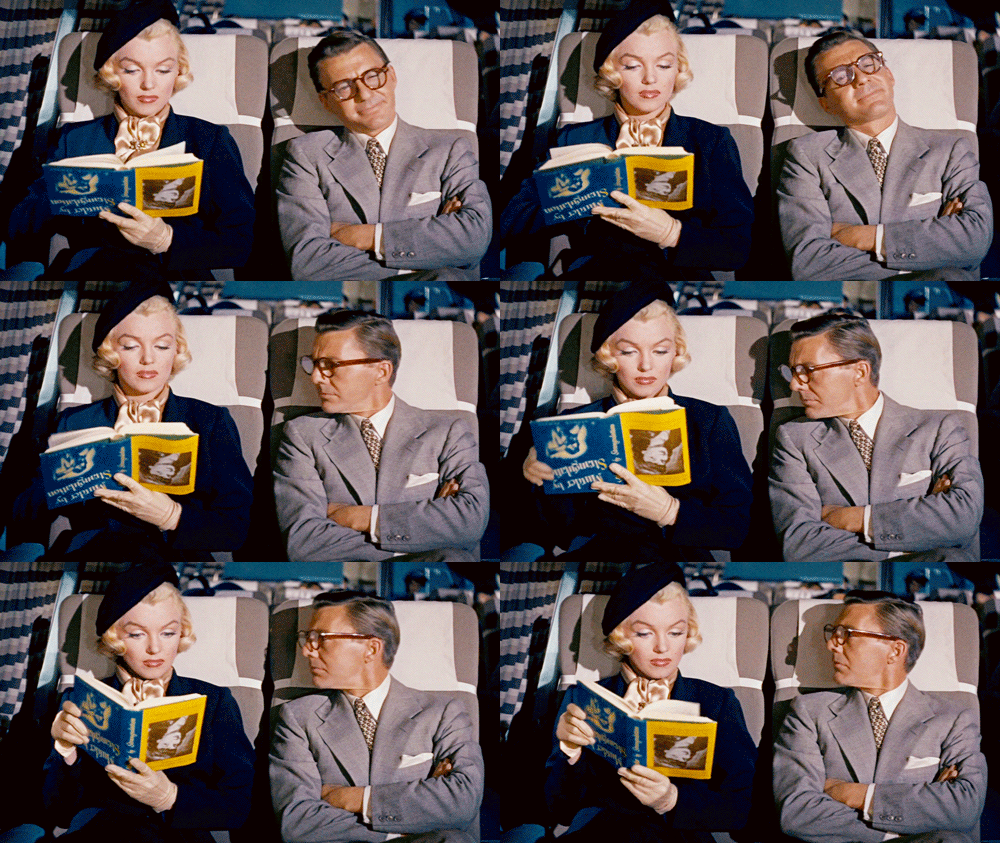
marilyn book

Even though I’ve been spending a lot of time working on new scripts, I’ve also made a recent effort to start reading more scripts.

The contents of the folder on my desktop labeled “TO READ” include around a dozen scripts of well-known produced films and those of my associates within my social network, along with a few I received with the advice “you really should read this”.

It’s a lot of scripts to work my way through. I’ve completed three so far, and each one has been amazing. It’s a fantastic experience I can’t recommend enough.

What’s probably the most important aspect is that taking a look at all these different scripts lets you see the multiple ways of how a story can be told on the page. Each and every script does an amazing job with its own interpretation of “Show, don’t tell.”

It also helps because many times we’re so wrapped up in our own material that reading something new and original where you have no idea what’s going to happen gives your imagination a much needed rest. You can literally just sit back and enjoy the ride.

When you get so wrapped up in the story that you can easily visualize it playing out in your head, and the words and pages just fly by, then you know you’re in the hands of a skilled writer who knows what they’re doing.

Very important – while you shouldn’t try to straight-out copy somebody else’s style, you can at least let it influence how shape your own. Don’t just read a script – study how it’s put together.

Is the writing crisp and colorful? Are you able to follow the story? Is the sequence of events organized so that you can’t imagine it happening any other way? Do the scenes make their point fast and move on? Do the characters seem like actual people? Does the dialogue sound natural and get the point across without being too on-the-nose?

These questions – and so many more – will come up while I’m reading a script for the purpose of giving it notes. But if somebody says “Read this. I think you’ll like it.” and notes are NOT involved, then it’s easier for me to read it just for the sake of enjoying it, and not feel the need to be critical.

That being said, it’s still tough for me to take off my editor’s hat – even for a casual read. It’s not uncommon for me to find the occasional typo or ask a question about something I’m just not sure about. This isn’t me being critical on purpose. Quite the contrary. When something like that takes me out of the story, I want to let the writer know so they can fix it and prevent it from happening for the next reader.

Even though this is a read for enjoyment, certain technical factors still come into play for me. Does it look good on the page? Is there a lot of white space, or do I have to endure big blocks of text? How’s the formatting? Any misspelled words? Pretty much – do they have the basics down?

And the stories themselves – WOW! Some are in genres I love, others totally new to me, and even a few offering a totally new take on an old standard. Even though I may not be a fan of something, I can still appreciate and enjoy a well-told story.

Also very important – after you finish reading, especially if it’s a friend’s script, thank them for letting you take a look, and let them know what you thought of it (preferably in the positive). If it’s a produced script and the writer is on social media, you can let them know that way. I’ve done this a few times, and each time the writer was very appreciative.

At my current rate, I’m getting through about two to three scripts over the course of a week, so I have at least another month to month and a half before the folder empties out.

I’m looking forward to getting through this batch, and even more so when it’s time to start compiling the next one.

Q & A with Paul W. Cooper

Paul7

Paul W. Cooper has been a working freelance television and motion picture screenwriter for more than thirty years. With over 60 television credits and one feature film, his awards include three Emmys, the Humanitas Prize, Writers Guild Award and the Kairos Prize.

He wrote the critically acclaimed film ONCE UPON A TIME…WHEN WE WERE COLORED winning Best Picture honors at the Movie Guide Awards. His television credits include MURDER, SHE WROTE, HIGHWAY TO HEAVEN, LITTLE HOUSE ON THE PRAIRIE and THE WALTONS. He served as Story Editor on Oprah Winfrey’s dramatic series BREWSTER PLACE, and has instructed Film and Television Writing at Pepperdine University.

Paul has written 21 ABC and CBS AFTERSCHOOL SPECIALS dealing with subject matter exploring every significant social issue including incest, alcoholism, physical abuse, homosexuality and racism. A number of these projects won Emmys as Best Television Specials for their significant social and dramatic impact.

Paul has written a number of films for cable television, which have appeared on Showtime, Disney, the Animal Planet and Family Channels. He wrote THE MALDONADO MIRACLE for Showtime, produced and directed by Salma Hayek. It earned 5 Emmy nominations and won the Writers’ Guild Award. His film for the Hallmark Channel, THE NOTE was the highest rated Hallmark movie of 2007 and 3rd highest rated of all time.

What’s the last thing you read or watched that you thought was incredibly well-written?

BEASTS OF THE SOUTHERN WILD. Visually stunning. I ached for the characters.

Two of my favorite genres to write in are straight drama and crime. There are two screenplays I constantly refer to so I’m certain the last material I read are one or both of these screenplays. The first is TERMS OF ENDEARMENT by James L. Brooks. It’s the only screenplay that actually brought me to tears while reading. The second is the crime drama SEA OF LOVE by Richard Price.

Here’s my practice. After I’ve written ten pages, I will pick up my dog-eared and worn copy of SEA OF LOVE. I’ll read ten pages (any ten) then come back to the last ten pages I wrote. Now I find myself re-writing those pages with a different tempo. I’ll knock out words from the dialogue to give it a more staccato and street feel. My shoot-outs become more cinematic because now I’m trying to write UP to Richard Price’s standard. And the more I do that, the better writer I become.

When I write a drama-charged relationship story, I use Terms of Endearment the same way. Again, I’m always trying to write UP to the standards of the masters. So those are two works I refer to constantly and believe are incredibly well-written.

Were you always a writer, or was it something you eventually discovered you had a knack for?

I learned I had a knack for writing when, in the 8th grade, the class was assigned to write a short story. Once I started, I couldn’t stop and the world of fiction opened up before me. From that time on I wrote stories, plays, songs and poetry. But I never considered pursuing writing as a career. I was eminently practical and got my degree in business administration.

How’d you get your start in the industry?

There was a war raging in Vietnam when I graduated college. Rather than being drafted, I joined the Air Force, attended Officer Training School, then pilot training. I was a pilot in the Strategic Air Command for six years. I got assignments all over the world including three tours of the war zone and came back registering 61 combat sorties. As a crewmember in SAC, I was also required to sit alert for seven day periods. The Strategic Air Command was our first line of offense in the event of a nuclear war. So we had to be ready. And that meant living in an underground alert facility (mole hole) for those seven-day tours. There’s not a lot to do while waiting for the horn to go off. Guys played poker, shot pool or watched TV.

One night I was watching an episode of MEDICAL CENTER and thought “I can do that”. So I went to my little bombproof room, took out a spiral notebook and started writing. I had never seen a film or television script and had no idea about formatting. So I wrote my story like a play, drowning it in terms like cut to, fade out, dissolve etc. When finished I was optimistically excited and immediately began writing another episode. Then I branched out and wrote for other series popular at the time; MARCUS WELBY, THE WALTONS, SANFORD AND SON, MCMILLAN AND WIFE, and others. Now, none of these scripts was very good, but that didn’t matter. What mattered was I was writing stories, creating characters, giving those characters words to speak. And I loved the sensation, the power I had over these fictional “people” and their lives.

After a year or so of writing television “scripts” I thought it was time for the entertainment world to be exposed to my heretofore undiscovered talent. I wrote to the Writers Guild of America and they sent me a packet of useful information, including a list of agents. So I began firing my material off to agents who would summarily return fire with a politely worded rejection letter and my envelope unopened. Dissolve to a year later when I met my future wife, an Air Force nurse. On a blind date, I discovered she had lived next door to the sister of Earl Hamner, Jr., creator of THE WALTONS. What do you know, I had written two Waltons episodes. Through that connection I contacted Earl and he graciously agreed to read my scripts. I sent them and a week later, he called me and said I should be in Hollywood writing for television. So off to Hollywood I went, Earl became my mentor who put me in touch with an agent, and I was on my way.

Sad to say, my story only reinforces the notion that you have to know someone in the business in order to get into the business.

What do you consider the components of a good script?

People ask, what is or are the most important elements of a screenplay. Some will say character. Others say story. But the answer is – structure. You may have the most beloved character since Hoke (DRIVING MISS DAISY) and an absolute jaw-dropping story (THE RIGHT STUFF), but unless the pieces are stacked properly, the whole construct collapses.

What are some of the most common screenwriting mistakes you see?

The thing I see most often is that a story is derivative. Nothing new. All the same old plowed ground. And this, of course, makes stories predictable. I believe it was William Goldman who said, “Always give the audience what they want, but in a way they didn’t expect.” If it’s true there is no story new under the sun, then at least get us to the desired ending by way of a different road.

Too many words, not enough story. I will often tell a student, “You have a 105-page script here but it only contains 65 pages of story.”

My pet peeves are typos, misspellings and grammatical errors. There’s no excuse for these infractions. They label the writer careless at best and illiterate at worst and create an unfavorable impression for the reader.

Other mistakes are what I call re-hash and deadwood. Never tell the reader what he already knows. And omit anything that doesn’t relate to the premise. Keep the story ever moving forward.

What story tropes are you just tired of seeing?

I’m not a fan of superheroes. It always comes down to the hero battling with an equally powerful villain in an epic cinematic struggle only possible with CGI. Yes, it’s visually impactful, but for me, cartoonish. No matter what the bad guy throws at the hero, he/she
always recovers and comes back for more. After ten minutes of lightning bolts being hurled and mushroom clouds rising over the city, I’m bored.

What are some key rules/guidelines every writer should know? 

-Determine what your premise is. This is found by asking who your hero is and what does he/she want, need or desire. You should be able to state your premise in ten words or less. The premise of Romeo and Juliet is Romeo desires Juliet (boy wants girl). Indy wants to find the Lost Ark of the Covenant. Rocky needs to go the distance. The premise is your searchlight that must always be in view as you write the story. If it disappears, you’ve taken a wrong turn.

-Be aware of the third question — why do we care? We must be endeared to the hero (or despise the villain) and the hero’s goal must be worthy and important. The implication is obvious. If we’re not emotionally attached to the hero, we won’t care what happens. And if his goal isn’t both worthy and important, we won’t care if he attains it.

-Until the premise is revealed, the story is pointless. In other words, until the audience knows what the hero WANTS, the story has nowhere to go. Example: In Raiders of the Lost Ark, we open with Indy in an Amazon jungle cave stealing some artifact. He barely
escapes with his life and manages to return to his work as a professor at Chicago University. Now what does any of that have to do with the Lost Ark? Nothing. Indy has stated no particular goal so the story is nowhere. But then… he learns of the existence of
the Ark and decides to find it before the Nazis get hold of it. Now the premise becomes, Indy WANTS the Ark. And everything he does from that point on is aimed at achieving his goal. I like to see the premise revealed within the first 20 pages.

-Love is a process. You can’t just put two people together in a story and tell us they’re in love. We may believe it but we won’t feel it. You MUST give us the scenes showing us the behavior that causes one person to fall in love with another. What is it in her that he needs? What does he have that makes her desire him? And it can’t be only physical attraction. We know that people in bars can be physically attracted, fall into bed and the next morning regret it and never see each other again. That’s lust, not love.

-Once the hero has attained his goal… THE STORY IS OVER. Think of it this way. You’re watching a film full of danger and intrigue keeping you on the edge of your seat as the hero hurtles ever onward toward his worthy and important goal. The drama builds. Tension is unbearable. Then, in the exciting climax, the battle between good and evil is waged and the hero wins (or loses as in a tragedy). At that moment, all of the dramatic tension that was built is released like air out of a balloon. At this point, the audience is ready to rise and file out of the theater. THE STORY IS OVER. A common mistake these days is for a writer to keep going with the story even though there is no more tension to be derived. Yes, you often have to spend time to tie up loose ends but this must be done
quickly so you can get out and fade out.

-Think about what the audience is seeing onscreen. I often read a scene wherein two people are at a restaurant. They order. The waitress leaves. The two people converse for about thirty seconds and the waitress returns with their chateaubriand.

-Think of a script as a document of information. Something happens. And that something is first registered in the brain, right? We see and hear the event. Now if that information stops in the brain (intellect), then you’ve failed as a writer. Once it registers in the intellect, then it must go further into the heart or the gut. Those are the places emotion comes from.

-Character development occurs when we create the scenes that show the character behaving in the manner we want him identified with. Don’t tell us Joe is wonderful, he’d give his shirt off his back. Give us the scene where Joe gives the shirt off his back or “Saves the Cat.” Don’t tell us Sam is so evil he’d stick a knife in his grandma’s back. Give us the scene where Sam not only stabs his grandma in the back, but then twists the knife. Those scenes hit straight at the heart and gut.

You’ve written for both TV and film. How does writing for one medium compare to the other?

No difference unless you’re writing for a series. Then you have time (page count) considerations. I’ve written a number of movies for cable television and every one I wrote as though writing a feature film

Have you ever read a spec script that was an absolute, without-a-doubt “recommend”? If so, what were the reasons why?

Yes. And the reasons are hard to explain. First, it followed all of the requirements listed above concerning proper mechanics, economy, etc., but beyond that it grabbed my interest on page 2 and never let me go. It had complication, conflict and invention. It gave me the satisfying ending I wanted but in a way that was unexpected.

How can people find out more about you and the services you provide?

Go to my website at www.PaulCooperScreenwriting.com or my IMDb site: http://www.imdb.me/paulw.cooper

Readers of this blog are more than familiar with my love/appreciation of pie. What’s your favorite kind?

Coconut cream. The best I ever found was in a little diner/pie shop in Williams, Arizona. My wife and I always stop there on our trips between California and Oklahoma.

coconut cream

New direction? Yes, please.

baby driver 2

Despite some unexpected delays in working my way through the revision/rewrite of the outline for the sci-fi adventure spec, progress is still…progressing.

Took a lot longer, along with a significant number of “how about…?”, than I wanted to fine-tune the first act, but I did manage to do it.

Which means I’m working my way through the second act, and thanks to several previous drafts, I’m able to cherry-pick from all of it and forging ahead, and the midpoint is comin’ up fast.

I thought all I’d need was to do a little more cutting-and-pasting and keep pushing forward.

But all the new developments in the story I’ve come up with to this point have now created the need to really shake things up.

Which means more changes.

Initially, a bit of a daunting challenge. I’m always resistant to this sort of thing.

But as has happened many times in the past, the more I weighed the options, the more it seemed necessary to implement those changes. Plus, if I tweaked a few things here and there, not only would it significantly add to the hero’s story, but it also created a whole bunch of new potential conflicts.

How could I resist such a temptation? Besides, I’m already behind where I was hoping to be by now, so what was a little more time spent on it?

Since then, I’ve been busy jotting ideas down, filling in a few blanks here and there, and changing this around to that. All the fun stuff.

What’s great is that the story is still for the most part the same as I originally planned, but, as is usually my experience, slightly different from the initial idea.

Can’t wait to see where it goes and how it all works out. Watch this space.

Strong start out of the gate


weiner dog race

My first project of the year was to keep pushing through on revising the sci-fi adventure outlines, but a few days before New Year’s, a colleague contacted me and asked if I could take a look at his collaborator’s first ten pages.

English isn’t the writer’s first language, so while the intent and context of the words and the overall sense of the story were there, in addition to a lot more telling than showing, the pages just didn’t read smoothly. I asked my friend if they wanted to me to do some cleanup work and polish it.

“Please. And feel free to make any changes you think are necessary.”

Challenge accepted.

My project was put on hold, with all focus redirected to this. It’s been a lot of fun. What the original story had made for a good foundation, and I’ve really enjoyed putting my own spin on it and doing what I can to kick things up a notch. Nothing drastic, but again – fun stuff.

It also helps that my friend gave me a deadline. I know what I need to do, and how much time I have to do it. That really helps you stay focused.

If I can keep up my daily output of productivity, it looks like I’ll beat the deadline by at least one to two days. Which is what I was hoping for.

And then it’s right back into my own material.

Part of my plan for 2020 is to not only get something done every day, but to have it help me move things forward. So far, so good.

And the first week isn’t even over yet.

Q & A with Dominic Carver

Dom Carver

Dominic Carver is a screenwriter, script consultant, and script editor.

In 2008 his first short film, AGN, was produced by Split Edit in Norway and broadcast on Norwegian TV. His second short film written in 2010, the mystery thriller THE TRAVELLER, was a collaboration with Dubai-based director Musaab Ag. In June 2011, Dominic won the Prequel To Cannes Feature Screenwriting Prize for FAITH, a bleak unflinching look at the life of a London street prostitute.

Dominic has since been commissioned for seven feature screenplays and has also worked as a script editor on other projects, including the feature THE DYING EYE (2013).

Dominic continues to place highly in many competitions most notably the FINAL TEN of FINAL DRAFT’S BIG BREAK 2016 FEATURE COMPETITION – FAMILY/ANIMATED, the FINAL TEN of STAGE 32 TV WRITING CONTEST 2017 and the FINAL TEN of Idris Elba’s GREEN DOOR, GREEN LIGHT INITIATIVE 2017.

What’s the last thing you read or watched you thought was incredibly well-written?

DUBLIN MURDERS by Sarah Phelps. Utterly spellbinding, a haunting examination of loss set in and around the search for the murderer of a young girl. Sarah’s work is wonderfully paced and her dialogue frighteningly good. She writes beautifully dark, complex characters, and with THE ABC MURDERS she breathed new life into the well visited character of Poirot.

How’d you get your start in the industry?

I have always loved stories, often reading a novel a day during my teens. On one particularly slow and boring day at work, I decided I’d had enough and needed to do something other than rot away in a dead-end job, so I signed up to do the Scriptwriting for Film & TV degree at Bournemouth University. Skip forward a few years and I won the Prequel To Cannes Screenwriting Competition, and one of the judges recommended me to a producer, who offered me my first feature commission.

Is recognizing good writing something you think can be taught or learned?

A very interesting question. I believe that to be a truly great writer you have to have a certain amount of natural storytelling talent. You can be taught how to create characters, develop ideas, write characters and dialogue to a reasonable level and to recognise what works and what doesn’t, but if that natural storytelling ability isn’t there. you’re going to struggle and will only ever be average.

Good storytelling is instinct; getting to the emotional core of your characters and their journeys and being able to put that on a page to move and manipulate your audience in ways they weren’t expecting. It’s easy to spot a good screenwriter – they stand out from the crowd. From the hundreds of scripts I’ve read over the years, only four really made me sit up and pay attention and go, ‘This writer has real talent!’

What do you consider the components of a good script?

The characters and the journey they’re on. If your audience doesn’t feel for your characters or their journey, then you’ve lost them before you’ve even begun.

The film JOKER is the perfect example. He’s the most despicable character, a psychopath you would go out of your way to avoid in real life, but on the screen we understand and can empathise with the circumstances that made him. Even when he goes on a killing spree at the end of the movie, regardless of how horrifying and distasteful it is, we understand why and empathise with him. If, as a writer, you can make even the most despicable character sympathetic, that’s masterful writing.

What are some of the most common screenwriting mistakes you see?

Where do I start? Poorly developed characters. If you don’t know who your characters are, how can you expect your audience to? Generic storylines. A popular one at the moment seems to be the ‘mid-life crisis’ and the search for meaning in characters’ lives.

If you don’t approach it from a unique angle, give the audience something they haven’t seen before, then why bother as your screenplay will be lost amongst a sea of similar scripts. Static scenes where characters share their secret feelings around a table and a cup of tea. It’s a visual medium, people sitting around chatting about their feelings is boring to watch. Busy those static scenes up. And when have you ever opened up to a stranger and told them your inner most feelings? Never! People just don’t do that, unless verbal diarrhea is a character trait.

If new writers took more care in developing their characters and their stories, rather than copying what has come before and populating those tired stories with generic characters, there would be a lot more interesting stories out there.

What story tropes are you just tired of seeing?

The mid-life crisis. The hero whose family is murdered and they go on the hunt for revenge. And that’s just two. There are so many more, I’d be here all day listing them. Dig deeper, people!

What are some key rules/guidelines every writer should know?

-Spend time on developing your characters and ideas.

-Don’t write great chunks of dialogue or scene description. Less is more. You’re writing a screenplay, not a novel.

-Study people. Find out how people tick.

-Don’t try and write a Tarantino (or another writing hero) movie. Write your own, what appeals to you. Find and develop your own voice.

-Always, always, always have your work read by a professional screenwriter before you send it out into the wider world. Yes, it will cost you money, but you need to know if your story and characters work as it will save you a lot of time and effort. Far too many writers send work out before it’s ready and they wonder why they experience so much rejection.

-Write the first draft quickly without over thinking it too much. The following draft will be a lot better. Just get those ideas on the page and then worry about reworking them. A page of crap is easier to rewrite than a blank one.

-Don’t make a tit of yourself on social media. Be kind, be polite, be inquisitive but never ever pester others to read your work. If you are friendly, polite, respectful and get to know them as friends, people will start to ask to read your work or even recommend you to others.

-Rewrite! Rewrite! Rewrite!

-Network like your life depends on it… because it does.

-Never take rejection personally. It’s never about you, it’s just that your script isn’t a fit with that person at that time. If you get rejected, rework your screenplay and then send it out to two more people. Developing a thick skin is an absolute must for being a writer.

Have you ever read a spec script that was an absolute, without-a-doubt “recommend”? If so, what were the reasons why?

Yes, and it still puzzles me why it hasn’t been made. I don’t usually mention clients I read for, or their work, as it’s confidential, but in this case I’m going to name the script and the writer. It’s MINOTAUR by ADEWOLE ADEYOYIN.

I hate horror movies, I don’t see the point of watching something that you know is going to scare the poop out of you, but Ade’s script stood out because of its characters, story, themes and its depth. It took a well-explored genre and turned it into something original and compelling, a thrill ride from start to finish.

If any producer out there reads this and is looking for a cracking monster movie, get in touch and I’ll pass it on. It needs to be made!

How do you feel about screenwriting contests? Worth it or not?

Yes! Not only do they test your work, but if you do well they can help propel your career forward. A friend and I wrote a feature from conception to finished second draft in twelve days back in 2016. She wrote the first draft in seven days and I spent the next five rewriting. We entered it into Final Draft’s Big Break and made it through to the final ten in the family category. If it had been entered in the historical category, I think it would have gone even further. Every competition we entered this script into it made at least the quarterfinals, so we knew we had something special.

But which competitions to enter? Pick the well-known ones, the ones with an impressive lineup of judges or that offer access to industry players. Paying for feedback is a great idea, but how well your screenplay does in the competition will also be a great indicator of how good your writing is.

How can people find out more about you and the services you provide?

From my website at www.thescriptwriter.co.uk. It needs updating, but as usual I’ve been busy. I’m sure I’ll get around to it at some point. Maybe next year.

I’m also on Twitter – @DomCarver

Readers of this blog are more than familiar with my love/appreciation of pie. What’s your favorite kind?

Steak and kidney… nothing beats it!

steak-and-kidney-pie