Still a thing?

That little paper box full of extra cards is tucked away somewhere

A few weeks ago, I had the pleasure of being interviewed on the Telling The Show podcast to talk about networking as it relates to screenwriters.

Over the course of the discussion came this question: in pre-COVID times, it wasn’t uncommon for a writer to have a business card. Does a writer still need one?

I thought it was a great question, and had to really think about it.

My initial thought is probably not, especially due to how most networking is now done online, and most writers have their phone with them, so contact – or at least reaching out – can be practically instantaneous.

What good is having a card to hand out when you’re practically isolated and there’s nobody around to hand it to? These days you’re more likely to connect with somebody via a social media platform, so you’ll probably do everything via email and/or texting in order to set up meeting one-on-one.

A lot of writers now have a strong online presence – websites, blogs, an account on Youtube, Twitter, Instagram, etc., so it’s significantly easier to get in touch with somebody to strike up a conversation, or at least establish a professional relationship.

Keeping that in mind, in-person interaction is slowly coming back, so if we get to the point where you show up at a venue where you don’t know anybody, and then have some nice conversations with people, would you want to have a card to hand out, or be comfortable asking for their email address?

There are exceptions, of course. A majority of writers tend to be on the introverted side, so dealing with a real live person can be somewhat intimidating. This makes online networking easier for some people. Somebody quiet and shy in person might be more involved or outgoing on a Zoom call or on Twitter.

Just as an example, I recently tweeted a compliment to the hosts of another screenwriting podcast regarding the interview they did with a high-profile manager (I also included the manager in the tweet). Both hosts and the manager liked it, and another writer friend of mine added in his two cents, leading to a brief discussion among all of them.

I didn’t do it because I was trying to suck up to the hosts or hope the manager would offer to read something; it was because I liked what I’d heard, and wanted to let them know that. Would I have achieved the same results if this had been done in person? I’m going to go with “slightly maybe, but probably not to the same extent”.

Online interaction is one of the things I encourage for writers seeking to expand their network. Nobody’s going to get to know you if you hang back and stay quiet. Become involved. Join conversations. Just make sure to be polite, civil and respectful.

There are forums and group chats to take part in, as well as lots of screenwriting groups on Facebook. I find the smaller ones to be better because the members tend to be more experienced, more mature, and of a more rational temperament.

Networking and interacting has really changed, especially over the past few years. But one thing remains the same: online or in person, business card or no, be the kind of person you’d want to know.
Getting your time to work for you

Most of this week for me has been splitting time among a few projects, with notable progress on each. Especially notable was that two of them had felt somewhat stalled, so to have broken through that wall and kept going was quite the endorphin rush.

Since I was feeling rather accomplished about this relatively minor feat, I put out on social media how nice it was to have done so. A number of writing associates offered up congrats and encouragement, as well as one person who asked “How do you find the time to do all this?”

I’ve gotten this question before.

How DO I find the time? How does any writer?

I guess the simple answer is: I make the time, whenever I can.

Some writers are able to have a designated window of when they work. Maybe they wake up a little earlier than they need to and write for an hour or two before they need to get ready for the day job.

Or they have mini writing sprints at the day job; 10 minutes here or there, during the second cup of coffee or lunch, what have you.

Or maybe they wrap up their day with writing before going to bed.

It really depends on what works best for you.

As much as I’d love to have a big block of time each day to be all about the writing, some days that just isn’t possible, so I make do. I have a little downtime during the day job, so I try to squeeze something in when possible.

But I’m also trying to get in better shape, so a certain amount of my day might involve an hour-plus at the gym or going out for a run. This in turn means I’d have less time to write, but if I don’t exercise, I’ll feel lousy mentally and physically, which in turn won’t help me be productive for the writing. If that means a slight extension of how long it takes to finish a project, I’m okay with that.

(One exception – if I’m on a deadline, all bets are off and it’s all about the writing.)

Sometimes it’s not about how much time I have to write, but how much I plan to write in that time. More than once I’ve sat down thinking “I want to write at least three pages today.” If I write three, great. A lot of the time I’ll push myself to do at least a little more, depending on how productive I’m feeling. Anything beyond the original objective is a bonus.

It’s all about setting up your own goals and expectations. Be realistic. What do you think you can accomplish each day with the time you have to work with? You know better than anybody how you operate, so plan accordingly. Write for an hour and see how far you get? Set an achievable goal (the aforementioned three pages) and see how it goes?

It’s easy to feel negative when you see other writers proclaiming things like “Woo-hoo! Another dozen pages done today!”, and all you could manage was two or three.

Don’t. Everybody runs at their own pace. Like I remind myself when I take part in a race:

It’s the distance, not the time.

It’s more important to do this – and finish – on your own terms, rather than pushing yourself too much and running yourself ragged, resulting in collapse and/or burnout. And I’m not just talking about running.

Know what you want to accomplish, and knowing how much time you have to do it, you can plan accordingly.

Repeat as long as necessary until the damned thing’s finished.

Until the next draft, where you go back and find the time to do it all over again.

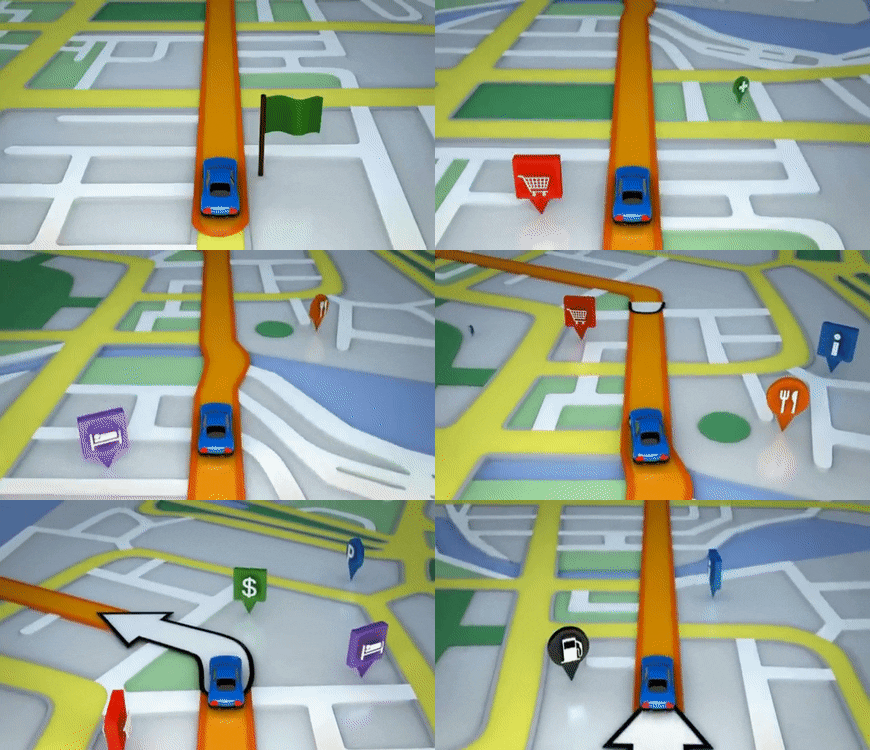
The writer’s GPS: always recalculating

The road to screenwriting success is a long and hazardous one, filled with constant obstacles that make you constantly second-guess yourself, doubt your judgment, and even make you wonder if you’re even headed in the right direction.

Trust me, we’ve all been there.

And the longer the journey takes, the longer it seems like anything good is going to happen – if it happens at all.

Who doesn’t know a writer who’s made some progress, only to have things stall out, making them question if it’s worth continuing on, or are just so fed up that they throw up their hands up and say “That’s it. I’m done.”?

As someone who’s been at this for a good number of years, again – totally been there.

There’s a part of me that always feels bad when I hear somebody say this sort of thing. Thanks to social media, I’ve been able to follow many a journey, offering congratulations on successes, and encouragement for the bad times.

So when I’m engaged in an online conversation with someone, and they talk about being so frustrated that they’re ready to chuck it all, I go into pep talk mode with the hope it helps replenish their reserve of strength to keep going.

No idea how effective these are, but I keep trying.

And just like these writers, I feel that way sometimes too. I accept there’s a chance it might not happen, but the optimistic cheerleader in me is quite stubborn and keeps pushing me to stay at it. That, and I like writing too much to stop anyway.

There’s also the realization that my road to success may not be what I initially set out on, and is totally what I make it.

If things don’t seem to be going my way, and often times they’re not, I’ll take a step back and explore what my other options are.

Queries not getting any responses? Read requests fizzling out? Contest results not attracting any attention? The industry constantly saying “Thanks, but no thanks”?

Frustrating, so I’ll try something else.

I’ve got a phone with a movie camera in it, and my computer has basic film editing software, so I can take a stab at making a short film. It might not look great, but it’s something.

Bonus – the $ I’d normally spend on contests can now be put towards a film budget.

I’m fortunate to be connected to some local filmmakers. I can ask if they need any help with their projects. No qualms about being part of the crew, and it’s a great education in filmmaking.

(If the filmmaking opportunities are somewhat limited where you are, maybe see this an opportunity to start laying the foundation to create them.)

I’m extremely fortunate to be connected to writers literally from all over the world. I can ask for feedback on my scripts, and offer to reciprocate.

Since a lot of my scripts are of a visual nature, there’s the possibility of turning some of them into graphic novels. I know a few writers who’ve done this, so I could talk to them about their experience and get their advice and suggestions.

The dream to see the stories we create on the big screen is powerful, and what drives a lot of us to do this. The sad truth is it most likely won’t happen for a large percentage of us.

But that doesn’t mean we should stop trying, or that it’s the only way it can happen.

You’re going to keep getting knocked down. It’s up to you how many times you’re willing to get back up and try again.

A little effort with big results

Who doesn’t like hearing that somebody liked something you wrote? Great feeling, isn’t it? You’ve put all that time and effort into it, and this is the response?

Now look at it from the other side – you read something and really liked it. Did you like it enough to let the writer know?

Go ahead and do that. It doesn’t even have to be somebody you know, or who asked you for a read.

It could be somebody with a script you read after hearing good things about it, or who wrote a book or a movie you really enjoyed.

Since so many creative types have an online presence, it’s becoming easier and easier to drop them a line and tell them what a great job they did.

I’ve done this a few times over the past few weeks. One was a veteran comic book writer, one was the creative team behind a show on Netflix, and another was the writer of a great low-budget horror-comedy. The latter two let me know how much they really appreciated it, while the former never responded, which is also a possibility. I just file it under “one of those things” and move on.

This isn’t saying you need to send a gushing lovefest of an email or tweet; just a few lines telling them you liked it. Probably take you all of a minute or two.

It can’t be stressed enough how much of a positive impact this sort of thing can have on a creator. Maybe they were having a rough day, and then your email or tweet pops up. Mood lifted.

It’s tough enough to succeed as a writer, so getting this little bit of encouragement out of the blue could go a long way in feeling like all the work you put in was worth it.

Even better – being the one who sent it.

Reinforcing the shoestring

For those unaware, I had the good fortune last year to connect with a producer-director seeking a writer for their microbudget feature project.

After hearing their ideas and what they were looking for, I started developing the story, keeping them updated as things progressed at a decent clip.

One of the comments occasionally made during all this back-and-forth was, and I’m paraphrasing here – “Is there a way to cut the costs on that?” Since this is a micro-budget project, it’s imperative we get as much out of every dollar as possible.

Thus the changes and alterations began. A scene originally intended for a hospital room now takes place in somebody’s bedroom. A scene in a restaurant now has the two characters drinking to-go coffee and talking on a park bench.

You get the idea.

As the writer, it can be a bit of a challenge to revise a scene or sequence to accommodate the budget, but it also forces you to dig deeper into that creativity and come up with a solution that works just as effectively, if not more so.

If this were a regular spec, working within a budget wouldn’t be an issue. I’d just write whatever worked for the story. But if that script got picked up and the producer needed changes made, then they would be made.

Looking over some of the revisions, I also realized that some scenes could pack even more of a punch by utilizing sound and lighting (or lack thereof) for emphasis, rather than on just what we see. Leaving things to the imagination – what you hear and don’t see – has the potential to be much more effective.

(For a strong example of this, check out the 1942 classic horror-thriller CAT PEOPLE.)

Taking this “less is more” approach also helped with resolving a story problem in a significant way. A sequence that would already have been challenging to make is now drastically different but would be very simple to pull off, and we’re both very enthusiastic about how the end result would look.

While some aspects of the story and how it’s presented may have changed, the tone remains the same. There’s still a ways to go with the script, but writing it with this kind of mindset helps me figure things out so the story is just as compelling while also getting the most bang for the buck.