Good or fast? Pick one.

hurdles
Careful! All too easy to end up flat on your face.

As some of you may recall, earlier this year I had to get a script done in order to send it to somebody who’d requested to read it. Seeing as how I had all of eight pages written, I wanted to finish it and sent it out as soon as possible.

It took a grueling 10-day writing marathon, but somehow I managed to do it. I got a draft written, polished it up and sent it out.

It was quite an experience, and the end result could best be described as…adequate. I’ll be the first to admit the script still needs a ton of work.

My sole objective was simply to get it done to the best of my ability in as short a time as possible. Would I have benefited from more time? Of course, but at the time, it wasn’t an option.

Fast forward to the beginning of November. My goal: have a completed draft of the latest project by the end of the month. Sadly, I wasn’t able to get as much writing done as I’d hoped, so I’m heading into December with a script that’s right at the halfway point and the intention to have the whole thing done by the end of the year.

Sure, I could push myself through that exhausting process of cranking it out just to get it done, but by working with a slightly longer timeframe, I can take it slow and spend more time fine-tuning the script. In theory, this increases the likelihood the end result will be more acceptable and not require as much extensive follow-up (i.e. rewrites).

Would I love to be done with this draft sooner rather than later? Again, of course. But I’m also willing to be patient and focus on a few pages at a time. If that means it takes me until the end of the month/year to have a quality script ready to go, so be it.

Everybody writes at their own pace. Some are extremely prolific, some aren’t. It doesn’t matter how many pages you write. The important thing is that you’re actually writing.

This whole process can seem excruciatingly long at times, and we all want to produce lots and lots of quality work. But it already takes time to learn how to do it properly, let alone effectively. Patience is one of those things that gets easier the more you work on it.

There’s nothing wrong with churning out a draft in record time, but be aware that focusing on quantity rather than quality will definitely be reflected in those pages. I went through this firsthand, and definitely see it as a positive learning experience. I know I can write something quickly, but also know it’ll require a lot of cleanup work.

But given my druthers, I prefer to take my time. It’s less exhausting.

You don’t know me, but can you help me?

the-stranger
Let’s not complicate things with petty details like who I am

So this email arrived yesterday.

“Hi, Paul, Do you know any past or current Executive Producers that might be eager to engage in a new multi-billion dollar franchise that could be as good as “Harry Potter” or “Star Wars”?”

Immediate smartass answer: Well, of course I do, person-I’ve-never-communicated-with-before! I like the cut of your jib, especially with that totally unsolicited request for help! I’ll pass your info along straightaway! Even though I think smoking is a totally unhealthy thing, I’m going to learn how just to be able to literally light cigars with hundred-dollar bills which I’ll be grabbing out of the huge bags o’cash which will no doubt be continuously rolling in once Hollywood gets its mitts on this!

Secondary upon-reflection answer: Do you really think this is the best approach?

Sure, we’ve been connected on a networking site for several years, but as far as I can recall, have had absolutely no interaction during that time. No emails. No comments on a post. Not even a single “Hey, how’s it going?” And then, totally out of the blue, you come to me and ask for help.

I’m more than happy to help somebody out when I can, but it has to be somebody I know, somebody I’ve communicated with, and somebody I think is worth helping. Apart from this nebulous “connection” we have, to me you’re little more than a total stranger.

And you’re not asking for just any kind of help. You have what you proclaim to be “the next big thing”. If I had a dollar for every time I’ve heard or read that about a script/story/idea, I’d be able to fund my own franchise.

It’s great that you have a high opinion of your material, as you should, but keep in mind you might be the only one who does. You can prognosticate all you want, but that’s not going to impact anything. You can’t say something’s going to be a hit because you want it to be.

I’m still a little fuzzy on the details, but I think the title “Executive Producer” depends on the extent of that person’s involvement with the project. Until then, I believe “producer” is the appropriate title. Feel free to enlighten the rest of us in the comment section.

Let’s also discuss the fact that you sent this to me. Me. Why? I’m not exactly Mr Industry Insider. In fact, I’m more likely in the same boat as you; a nobody busting his ass trying to establish a career. Did you know that? Did you do any research, or are you just sending this to as many people as possible, hoping one of them works out?

I never responded to the email in question, simply because I don’t think it’s worth it. I suspect anything short of “Here are those names you asked for” would not be welcome, let alone “This is a really unprofessional email, and here’s why”. As always, I wish them the best of luck.

I’ll admit I’ve made a lot of mistakes over the years, but each one has been a learning experience unto itself. I’ve learned how to network, how to communicate, and how to interact. I know how to seek out help and how to offer it. I’m a firm believer in researching and finding out everything I can about whatever it is I’m working on.

I always strive to be as professional as I can when it comes to this sort of thing. Everybody’s a potential future partner/connection/resource, but I don’t take it for granted.

I’ll treat you with respect provided you do the same.

Is the t-shirt THAT important?


oz-bucket
You know that bucket is mentioned a few pages earlier

Writers put onto paper how they visualize the events of the story.

Your get an idea of how you want things to look, maybe even a picture-perfect image, so you put those details onto the page, which is fine.

But sometimes the writer feels the need to include as much detail as they can. “To really paint a picture with words,” they might say. But it’s easy to get carried away. Some writers see this as a golden opportunity to really flex their literary muscles, so they go all out.

A big write-up about the contents of a room. Or identifying specifics about the clothing a character is wearing. That sort of thing.

While that kind of colorful minutiae might work in a novel, many see it as a negative when it comes to screenplays (opinions may vary, but this appears to be the general consensus).

There’s only one reason the writing should be that specific: if the item in question plays a part in the story. Is it vitally important that we notice it? If the answer is “no”, then all it’s doing is taking up valuable real estate on the page.

When the writer makes a point of identifying a particular item, then we should expect it to make a return appearance later on. Set up, pay off, remember?  It’s better to have a reader think “Aha! So that’s what that was for,” rather than “Huh? What was that for?” or “Why was that in there?”

By drawing our attention towards something that is more of an issue for the set designer or wardrobe department, it slows down the story’s momentum and makes for some unsatisfying reading.

Tell us the things we need to know, rather than the things you think would be nice to know.


Big net still at the ready

net
It’s all in the wrist

The current work slate involves a few story ideas, a fair mix of new and old, and all of them appeal to me as far as being “I’d want to see this” and “that sounds like fun” types of material.

As they should.

But it’s easy to forget that while you may be crazy about your story and totally get it, others might need a little more convincing.

It’s one thing to have a built-in audience already clamoring for your material, but what about trying to appeal to everybody else?

That can be a little tricky, but it’s not totally impossible.

This line of thinking reminded me of a post I wrote a little over two years ago, and I believe it’s still relevant.

Enjoy.

“As you work your way through the various stages of assembling your story, how much do you take the audience’s needs and wants into account?

You’re obviously writing something you would want to see, but do you ever consider the viewing tastes of someone who’s not like you whatsoever?

While I may write high-concept tales of adventure that would definitely appeal to 12-year-old me, it’s also my objective to try to craft those stories in such a way so they could entertain anybody of any age.

(Strong examples of this kind of storytelling? Most of the Pixar catalog.)

Here are just a few things to take into consideration:

-Are you treating the reader/audience the way they should be treated? Which means with intelligence. I’ve always hated when a story feels dumbed down, and suspect most other moviegoers do as well.

-That being said, is your story simple enough to the point that anybody could understand what’s going on, or at least have a general understanding of it?

-Regardless of what genre your story falls into, how much are you taking advantage of the elements of that genre? Since you’re most likely already a fan and probably have a good idea of what’s expected, this is your golden opportunity to show the rest of us what’s so appealing about it. Play on those strengths.

-With modern audiences more knowledgeable and movie-savvy than most writers realize, it’s more important than ever to come up with material that’s really new and original. What is it about your story that really sets it apart? What can you offer that we haven’t seen before?

As we start with an idea, develop it into a story that will eventually end up as a script, a lot of us daydream about the resulting movie, and how totally awesome it would be for it to be a big hit.

We can just picture the tremendous box office, rave reviews, non-stop awards, a king’s ransom of a paycheck, being begged to pick from a smorgasbord of new projects, all stemming from this story we cranked out with our own little hands, now practically guaranteed a place in the pantheon of pop culture.

“Everybody’s going to love it!” you imagine.

The reality is – they’re not, and a lot of that stuff won’t happen. But don’t let that stop you from trying.

The best we can do is write a solid, entertaining story populated with interesting characters who find themselves in unique situations, and hope people like it.”

Avoiding the dreaded unfilmable

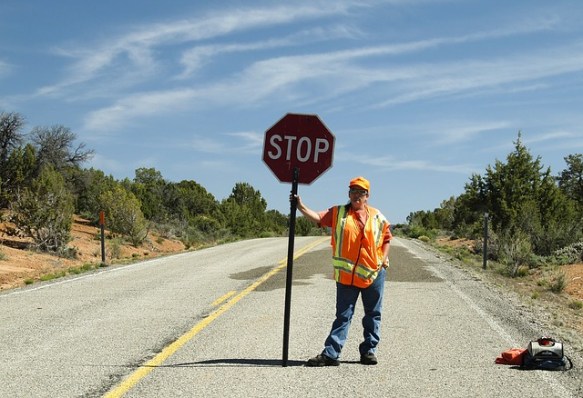
flagman
Don’t go this way!

I recently had the pleasure of giving notes on a friend’s script. It was an early draft, so it had some of the usual problems that were easily fixable.

But the one thing that really stood out to me was their use of unfilmables.

“Unfilmables?” some might ask. “What are those?”

I’m glad you asked. Here’s an example:

“EXT. PORCH – DAY

Jane sits on the stained deck chair her father bought for her birthday last year.”

If you saw that onscreen, you know what you’d see?

A woman sitting on a chair.

In other words, HOW DO WE KNOW it was a birthday present from her father? We don’t. How can you let us know? Maybe we see the father giving it to her. Or another character asks about it, and she delivers a one-line explanation.

If there’s an important detail to your story, you need to find a way to include it as part of the story, and preferably in the most organic way possible.

What’s on the page is what we see and hear.

Unless there’s a line of dialogue or some kind of action somewhere in there that reveals these kinds of things, the audience has no way of knowing them.

Here’s another:

“INT. KITCHEN – NIGHT

Kevin washes dishes. He thinks about that time he and his high school girlfriend crashed her mom’s car.”

What’s on the screen? A guy washing dishes.

HOW DO WE KNOW that’s what he’s thinking about?

Maybe we see the accident take place. Or hear Kevin talking about it. Maybe the story involves how the accident leads up to him washing dishes.

In my old writing group, one writer was insistent about leaving these sorts of things in. When pressed on why they were so adamant about not being willing to take them out, they’d launch into a long-winded explanation of why it was necessary to include them.

“So if we were watching this, you’d be there explaining things, rather than working them into the story and showing them on the screen?”

I’m not sure if they got the point.

Hopefully you do.