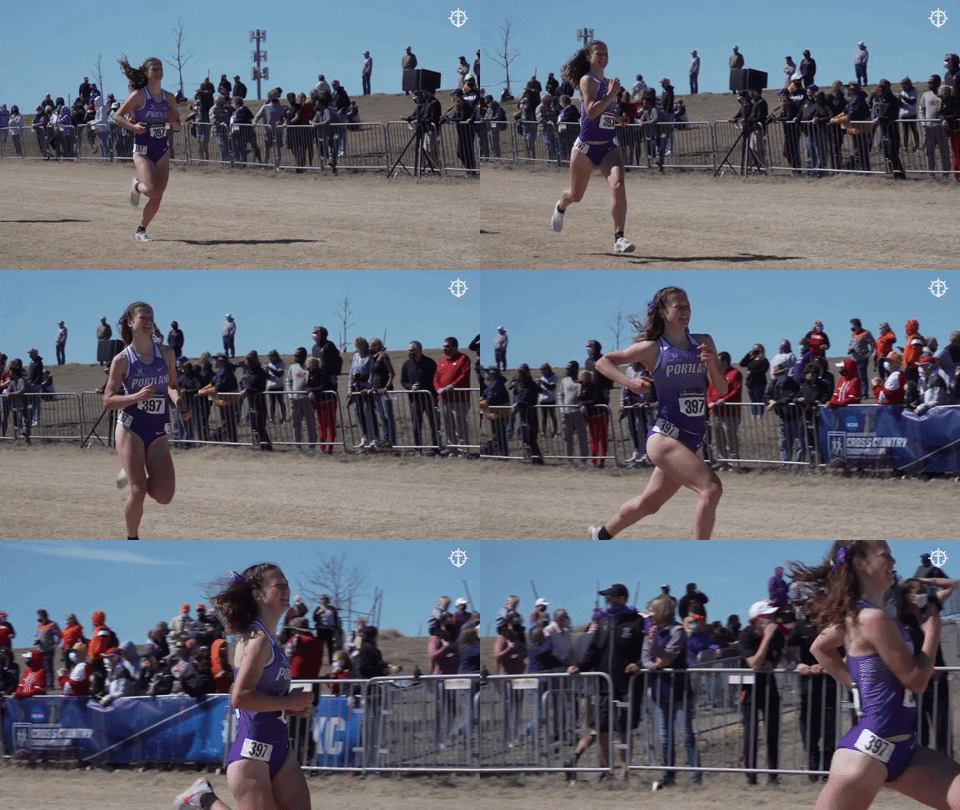
Even just a few steps is still good

It’s the onset of a holiday weekend here in the US, so file this post under “short, but relevant”.

The good news is I hit the midpoint for the outline of my current spec. The not-so-good news is that I’m still figuring out the rest of Act Two and most of Act Three. Plot points (such as they are) are in place, and the filling in between them continues.

Daunting as that may be, I’m just happy to have gotten this far. Current mindset is “just get it written and fine-tune it later.”

I know I’ll figure things out, but count on lots of ruminating in my near future.

Speaking of which…

As if by divine intervention by the writing gods, a friend posted online that the upcoming month is being labeled “Spectember” in that a writer could complete a spec script by month’s end. Pretty certain I couldn’t complete an actual spec, but the outline? That’s a definite possibility – or as mighty close as I can get.

Enjoyment levels and overall excitement for this project remain strong and steady, which always help.

Easiest screenwriting contest ever! No, really. And it’s free

After seeing several recent big screenwriting contest announcements, I couldn’t help but notice that the number of entries they get usually average in the thousands. Those numbers are then drastically reduced to the respective finalist tiers, continuously being whittled down to single digits and the final GRAND PRIZE WINNER.

(Said winner most likely goes on to fame, fortune, glory, and sudden anonymity.)

But I digress.

All the scripts entered means there are a shit-ton of writers who got the email that began with phrasing along the lines of “Thanks for entering (CONTEST)! We got X entries, and unfortunately, (YOUR SCRIPT) was not selected to advance.”

It’s heartbreaking. And I’ve gotten my fair share of them.

So in a valiant but most likely ultimately futile effort, I humbly present

The Maximum Z Screenwriting Contest.

It’s the only contest of which I’m aware that requires the barest, leastest, most minimal effort one can possibly make to claim victory in a contest.

What makes it so easy? Here’s how it works:

-You wrote a script? Fantastic! You get a set of laurels to shamelessly promote yourself as A GENUINE WINNER.

That’s it.

And as you may have noticed in the title of this post – IT’S FREE

Why am I doing this? Because the fact that anybody who wrote a script should be properly acknowledged for such an important accomplishment. You know it ain’t easy, so why should only a select few get all the glory?

Hence: laurels.

And who’d say no to being offered what amounts to a totally worthless but still-validating award?

So if you’d like to claim this meaningless yet quite meaningful symbol of recognition for yourself and all your hard work, then just click/right-click on the image below and save it to the appropriate page on your computer or wherever you keep that sort of thing. You can even print it out to proudly display above your designated writing area or hold up in the coffee shop where you’ve spent so much time working on said script.

A very hearty congratulations on your well-earned and well-deserved victory!

And it would be awesome if you could so a shoutout on social media – @maximum_z on X/Twitter, @pezscreenwriting on Instagram and Blue Sky, along with photos of you and/or your laurels.


Did it before. Can do it again

Made an interesting discovery this week.

My manager and I have been doing what is for the most part a line-by-line edit/polish of my western.

(A quick aside to note that it is quite a thrill to include that part about having a manager.)

We’re about halfway through, so I took it upon myself to go through the second half and then go over it with him. I like how it turned out.

But while I was reading, one thing that really stood out about it: there were a lot more scenes and sequences than I remember. It had more of an impact this time because I’m still working on the story of my new spec, and seeing all those little scenes in the western that enhance the characters and story make me think “this is what I need to do for this one”.

I’m still figuring out the story, so this may just be me getting ahead of myself. I’m not concerned, and know I’ll eventually figure things out. This may just stem from seeing how put-together a previous script is and wanting to a similar outcome for the new one. This happens a lot during this stage in the process.

Not that I’m looking to re-capture what feels like lightning in a bottle, but figuring out the story and all the supporting details is always a challenge. I come up with the major plot points and then start filling in the blanks between them. Sometimes I’ll create a list of all the ideas and possibilities that could be included, and then start picking and choosing. I already had a few set pieces, so I may work on expanding that.

This is all part of how it works – for me, anyway. I’m always amazed to see another writer just crank ’em out with what appears to be little effort. This just reinforces the idea that I’m a plotter, not a pantser.

I don’t mind having to go through all of this. I’m sure I’ll be happy with the end result; it’s working my way there that’s the challenging part.

Finish line crossed. On to the next one

It might not be too far-fetched to say there were more than a few times I thought this day would never come, but it did.

It took a while, but yours truly can now honestly and proudly proclaim to be

A WRITER WITH REPRESENTATION

(insert triumphant fanfare here)

I recently signed with a manager who really likes my writing and is incredibly eager to help me establish a career as a working screenwriter.

I’d connected with him on LinkedIn after responding to a listing asking for scripts to review and potentially promote. I sent the fantasy-comedy. He and his team really liked it. Their notes and comments are buried somewhere in my laptop’s digital folder for the script.

This led to several back and forth emails and lengthy Zoom calls. He wanted to know more about me, my writing, my goals, career plans, etc. I also got to know more about him and his background (started as a producer, sold the company and switched to managing).

He liked my work and what I had to say, both in my writing and as a writer. A little more back and forth, a revised contract, and voila.

I am officially a repped writer.

Fantastic as it is to say that, I’ve no plans to kick back and take it easy. On the contrary. Bigger and more challenging goals of getting my scripts out there await, along with continuing work on new projects.

And I am ready like you wouldn’t believe to take on all of it.

I would also like to add that I am truly overwhelmed and incredibly humbled by all the positive and supportive comments and notes of congratulations I received from across social media. That kind of support and encouragement means a lot, and I am very grateful for it.

Heed the words of Mamet -OR- Don’t overstay your welcome

I’ve been on somewhat of a tear lately in regards to watching films – both at home and in theaters.

One of the things that’s really stood out is the tightness of the writing. In every film, the scenes don’t waste time. They present what’s needed at that particular moment while also advancing the story.

I’ve always had a tendency to overwrite – especially in my earlier scripts. There was just too much on the page, or some scenes just went on too long. This would result in necessary editing and trimming down in subsequent drafts.

But then I heard a piece of advice I’m fairly certain is attributed to playwright David Mamet:

GET IN LATE, GET OUT EARLY

I interpreted this as “Get to the point of the scene as soon as possible, then move on to the next one”.

You don’t want your reader/audience to be bored by slowing things down with anything unrelated to the story. They’ll become less interested in wanting to see what happens next. Once that happens, you’re pretty much screwed.

This is something I’ve seen in a lot of scripts – especially from newer writers, along with a handful of seasoned vets. Many is the time I’ve given a note along the lines of “this is good, but tightening it up would make a world of difference.” Sometimes it’s dialogue, or description, or action lines.

If something can be cut from a scene and the scene still accomplishes what it needs to, then whatever you cut didn’t need to be in there in the first place.

When I outline, I do so with a “what’s the point of this scene?” approach. What happens in this scene that advances the story? Even as the story continues to grow and develop, the focus on the main point of each scene continues. There may be a small amount of overwriting in the first few drafts, but those are quickly dealt with.

This approach has really helped contributed to establishing the flow and fast reads for my scripts, and I’m looking forward to applying it to the current spec.