Let the ensuing commence!

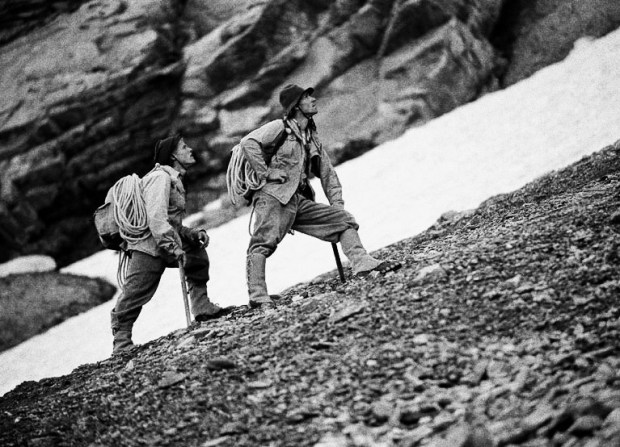
mountain climber 2
That was when our heroes realized things were about to get a lot tougher from here on in…

When I write out a scene, I have a pretty solid idea of what needs to happen in it; how to make it follow the one before it, and lead into the one after it.

Sometimes it ends up the way I intended, and sometimes it needs a little more punching-up.

And a lot of the time, that punching-up involves making things more complicated, which does a simultaneously effective job of upping the conflict, which was already a necessity.

This whole process most recently came into play while working on a scene in the pulp spec. I’d planned out what was supposed to happen, and on the surface, it seemed okay.

And then I wrote it, but it wasn’t the same as I’d envisioned. It was still missing a vital component, and I couldn’t determine exactly what.

Did it successfully connect the scenes before and after? Was there conflict? Did it advance the necessary elements?  Yes on all counts, but it still seemed off.

I read through it again. It was tight and efficient, and did what it was supposed to. But this second read also revealed the hidden problem that was nagging at me.

It was too tight and efficient. The protagonist accomplished what they were supposed to, but it needed to be tougher for them to do so.

So back I went to the planning-out stage, tossing in a few more wrinkles to make it that much harder for my hero. Although they still achieve their goal within the context of the scene, this time I made sure they really earned it.

Plus, the new complications really emphasized the overall nature of the story, which is always good.

This isn’t to say that every scene has to have some kind of monumental obstacle to your protagonist, but the journey towards their goal shouldn’t be an easy one. It might not even be a physical thing; maybe your hero has to overcome an internal or emotional problem.

It may be easier for you to keep things simple and straightforward, but unfortunately that makes for dull storytelling. Making things more complicated for your protagonist may complicate things for you in putting it all together, but it will definitely make for a better story while also improving your skills as a writer.

Don’t hold back. Put both yourself and your protagonist through the wringer. You’ll both be better for it.
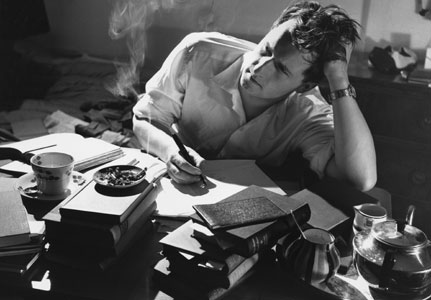
The goodness of just over 50 percent

writer
That was just the warmup

A most pleasant update to report regarding progress on the pulp spec: the point of no return has been reached (and even slightly surpassed).

Something incredibly significant has just happened to my protagonist, and everything between here and the end of the story is not only about answering the central question and everything connected to it, but also dealing with this important new development, which is also tied in to the main storyline.

From here on in, the stakes are consistently rising and my protagonist’s situation will continue to get more and more difficult.

As it should be.

Fortunately, a lot of these details were mapped out during the outlining process, which has once again proven to be extremely helpful. But even that’s not written in stone; one big sequence was deemed too similar to another, so the relevant elements of both were combined, which actually helped tighten things up on several levels.

To be perfectly honest, there’s not much I can gripe about regarding working on this script. It’s in a genre I love; this was always “something I would want to see.” I’ve made a real effort to make this an exciting read, both in terms of story and how it actually reads.

Like with some of my previous projects, I’m continuing to have a fantastic time writing it, and hopefully that excitement and enthusiasm will be evident on the page.

Sure, the ongoing plan of 2-3 pages a day has been slightly off, so it’s taking a bit longer than originally anticipated, but that’s par for the course for me. But every writing session, no matter how long or short, gets me a little more further along.

Today, the midpoint. Next up – pushing my way forward to the next plot point, which is about halfway through the second act of Act Two.

Why, and why now?

studying
A pair of questions to study thoroughly

An associate of mine is in the early stages of developing a low-budget film. Call it pre-pre-pre-production. The script is part of that (as in “about to be written”), and I was asked to take a look at the outline and offer up my two cents on it.

It wasn’t bad. The structure was a little wobbly, but not too far gone, and a few other minor issues, but overall, I’d call it a fairly solid attempt.

I totally got what kind of story they’re trying to tell, but reading this outline definitely raised some important questions.

Two, to be specific.

First: why is this happening?

I don’t mean this is in a negative way, like “why are you even bothering?” Quite the opposite.

More of a “does what happens in this scene adequately follow what’s come before it, and does it do an equally good job leading into what comes next?” sort of thing.

As it reads now, it felt more like a lot was happening because the story required it to, rather than letting it all unfold smoothly and organically. There wasn’t enough setting things up in order to pay them off later. Almost like each scene is saying “This MUST happen HERE, logic be damned!”

A should lead to B, which leads to C, and so on, but then you also find out that not only did A lead to B, but it also resulted in H.

Second: why is this happening now?

This applies more to the primary storyline. Things are taking place, but I never really got a sense of how or why it all started. A lot happens after whatever event triggered it all, but there’s no indication of exactly what that trigger was. When I asked the writer about it, even they admitted they didn’t know and were having trouble trying to come up with something.

A writer needs to know every part of their story; what things were like before it started, how it started, what happens, and how it ends. Sometimes you can even throw in what happens next. No matter what approach you take, all of these elements play a key role in the telling of that story. If one of those elements isn’t there, it just gums up the whole works and you’re left with an incomplete story.

The writer was very appreciative of my comments and was looking forward to finishing the latest draft in order to provide answers to the questions I’d raised. It’s probably safe to say we’re both quite interested to see how it all turns out (although I suspect I come in a close second).


Now it gets really interesting

desert
First few steps are always the toughest. Good thing I came prepared.

Let’s pause now for your humble blogger-in-residence to proudly proclaim that Act One of the first draft of the pulpy adventure spec is complete.

Whoopee.

But you know what that also means.

Yep. Time to buckle down even more, strap myself in, and jump feet-first into the intimidating arena commonly known as Act Two.

I’ll also admit it’s a little thrilling, too. There was a particular charge in working out the action sequences and story set-ups in Act One, so I’ve a strong suspicion the continuing build-ups for the former and the gradual development of the latter will be equally, if not more so, fun to write.

(and believe me when I say this is the kind of story that automatically requires a sense of fun)

Maybe it’s from continuously trying to improve as I go, but working on Act Two doesn’t seem as intimidating as it used to. Not to say that it comes easily; just slightly less insurmountable. I spent a lot of time on the outline, so confidence in that is pretty solid.

I read a lot about how a spec script might have a phenomenal Act One, but then things fall apart in Act Two for a myriad of possible reasons: the characters don’t do much/nothing really happens, or the overall story’s too thin, so a lot of Act Two is empty filler, and so on.

The only writing process I know is my own, and I always strive to make sure the story feels…complete? Full? It comes down to “I know what has to happen to tell this story,”, and while the first act is all about setting it all up, the second act is about fleshing everything out.

We get a closer look at the characters and how they’re progressing through the events of the story. We can see how they’re changing from when they were first introduced. Plot threads of all sizes get further developed. The central question is continuously asked (oh-so-subtly, of course).

It also involves steadily-mounting complications for your protagonist. They’ve got a goal, and it’s our job to throw all kinds of obstacles in their way that just keep making it harder for them to reach it. Again, a lot of it happens during our second act.

Act Two really is where the meat of the story takes place, so stuff needs to happen that not only holds our interest, but makes us want/need to know what happens next, and even that better be that much more intriguing.


As you’d expect, our work is cut out for us.

So off I go. Dispatches from this formidable excursion as they develop.

See you on the other side.

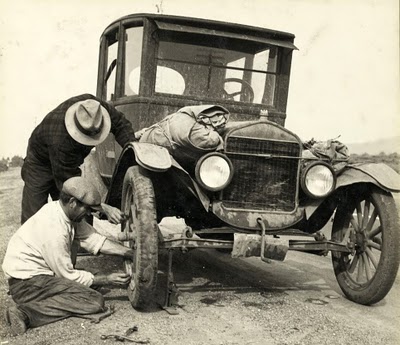
Tire, meet nail

flat-tire
You don’t expect it, but it’s good to prepared for when it happens

There I was, happily churning out pages for the pulpy adventure spec. The daily output was respectably above average.

(Gotta say, this new practice of writing out/establishing the beats of each scene has proven invaluable.)

If I could maintain this kind of pace, dare I even contemplate the possibility of having a completed draft, if not by month’s end, then maybe by mid-February?

But like the man who operates the guillotine might say, let’s not get too far ahead of ourselves.

Story-wise, things are still pretty solid, save for a previously unforeseen wrinkle: I need to do some emergency revision regarding exactly where and how a supporting character is introduced.

What was in the outline is completely different from what ended up on the page, so looks like I’ve given myself a few options:

  1. Leave it as is, but come up with how to tie everything together. A few possible solutions here. Not crazy about it.
  2. Go back and rewrite so it plays out as originally planned. It may lack some of the punch I was hoping to start with, but that sequence already has a significant amount of “attention-grabbing oomph” to begin with.

Some alternate approaches are currently under consideration, as are those of a drastically different nature. It’s also being discovered that implementing some of these changes could actually assist in reducing the number of pages, which was going to happen anyway. Only now it would be sooner. Not a bad result.

No matter which I choose, there’s some serious editing and rewriting in my immediate future.

This whole scenario definitely falls under the “kill your darlings” category because even though I really like what I’ve already written, as we all know, fixing the story takes precedence over placating the writer’s ego.

Keeping with the metaphor of this post’s title, what initially felt like a major problem is, after some careful analysis, evaluation, and plain old level-headedness, slowly developing into more of a bump in the road.